Archive for March, 2009|Monthly archive page
Seeing Obama’s burden, the drug war and more
Filed under: culture, politics | Tags: art, economy, foreign affairs, media, politics, technology
 Leave a comment
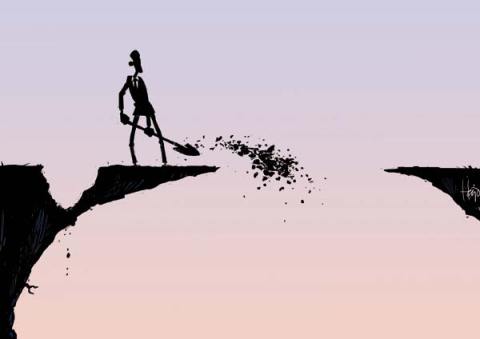
 Even in the loquacious realm known as the blogosphere, it is possible at times to lack words. Or to feel that there are simply too many of them. Either way, Daryl Cagle’s Political Cartoonists Index offers a pleasing alternative. Here are three recent entries that caught my eye.
Hajo (Amsterdam), on President Obama’s economic travails:
John Cole (Scranton, PA), peering into journalism’s truncated future:

Pat Bagley (Salt Lake City), a potent take on the Mexican-American drug war:

The month the news broke
Filed under: culture, media | Tags: economy, future-of-journalism, media, writing
Leave a comment It may be that we’ll look back at March 2009 as a pivotal time in the erratic but inexorable transition from print to digital news. In some ways it’s very much a slow-motion revolution, beginning perhaps as long ago as 1981, and far from over. But this month has been striking both for the destruction in the newspaper industry and the hum of activity focused on the digital future.
 It’s the latter that matters more. NYU media maven Jay Rosen has pulled together an essential roundup for anyone interested in diving deep into the discussion. Rosen credits a March 13 essay by Clay Shirky with triggering a flurry of writing; he summarizes a dozen recent pieces that build out the picture. I haven’t read them all yet, but in addition to Shirky’s piece I highly recommend Steven Berlin Johnson’s Old Growth Media and the Future of News, which he presented at the South By Southwest Interactive Festival in Austin. His use of ecosystems as a metaphor for the digital transformation is enlightening in multiple ways, while smartly avoiding utopianism:
Now there’s one objection to this ecosystems view of news that I take very seriously. It is far more complicated to navigate this new world than it is to sit down with your morning paper. There are vastly more options to choose from, and of course, there’s more noise now. For every Ars Technica there are a dozen lame rumor sites that just make things up with no accountability whatsoever. I’m confident that I get far more useful information from the new ecosystem than I did from traditional media a long fifteen years ago, but I pride myself on being a very savvy information navigator. Can we expect the general public to navigate the new ecosystem with the same skill and discretion?
Indeed, as Johnson suggests, information consumers may yet crave the guidance of authoritative institutions, including… newspapers. Some of which now command some of the largest online audiences. But many of them have been failing in the vision department, as Alan Mutter pointed out early this month:
As a direct consequence of the breakdown in the traditional media business model, publishers today are cutting the quality and quantity of the content they produce at the very moment they should be investing more aggressively than ever … As the most challenged of all the distressed media companies, newspapers are so strapped today that they are producing ever less original reporting … This is not merely a step in the wrong direction. It is a leap into the abyss.
As the fresh experiment with The P-I in Seattle seems to indicate so far, taking a newspaper all-digital while cutting its news gathering capacity by roughly 80 percent is not a great way to proceed.
While there is still plenty of handwringing going on, in my view the essays gathered by Rosen evoke daybreak far more than twilight. And March 2009 is ending on a bright note, at least symbolically. Ever since its election-year rise, the opinion-laden Huffington Post has been touted as a model for future journalism — never mind that it doesn’t pay most contributors and produces almost zero original reporting. Late yesterday the publication announced a new turn: the launch of a $1.75 million investigative reporting initiative.
Could marijuana light up the economy?
Filed under: California, politics | Tags: California, economy, foreign affairs, law, Mexico, national security, recession, San Francisco
Comments (2) The debate about whether to legalize marijuana in the United States has never been a mainstream one. So it’s been fascinating to watch how much attention the concept has gotten lately, however viable it may or may not be.
Preoccupation with Mexico’s violent drug war is one factor; marijuana is the largest source of revenue for the cartels’ multibillion dollar business north of the border. Commodify the major cash crop through legalization, the idea goes, and its cost will plummet, putting a serious dent in the bad guys’ bank accounts.
 But the larger issue lighting up the idea seems to be the battered American economy. In February, California state lawmaker Tom Ammiano proposed legislation that would regulate the cultivation and sale of marijuana, with a potential tax windfall of more than $1 billion to help bail out the state from a severe budget crisis.
On Thursday, the legalization concept wafted all the way up to the presidential level. In a live Internet “video chat” with Americans, President Obama found himself responding to a question that had been voted among the most popular of those submitted by the public: whether the controlled sale and taxation of marijuana could help stimulate the U.S. economy. “I don’t know what this says about the online audience,” Obama quipped. “The answer is no, I don’t think that is a good strategy to grow the economy.” By Thursday night, CNN’s Anderson Cooper was jabbering at length about the idea with law enforcement officials.
The issue of taxation just cropped up in another intriguing way. The Drug Enforcement Administration caused a stir in San Francisco on Wednesday when it raided a locally permitted medical marijuana dispensary. In part there was outcry because just days prior U.S. Attorney General Eric Holder had announced that the feds would no longer prosecute medical marijuana dispensaries where they are allowed under state and local law. So why the bust now?
So far the DEA isn’t sharing any details, but according to the San Francisco Chronicle, “A source in San Francisco city government who was informed about the raid said the DEA’s action appeared to be prompted by alleged financial improprieties related to the payment of sales taxes.”
It’s difficult to gauge the Chronicle’s anonymous source, but if accurate, the explanation seems rather odd. Last I checked, there was no national sales tax in the United States, so why would the federal government be interested in that issue? Moreover, while I’m not sure whether it applies to medical marijuana, prescription drugs are exempt under the current California sales tax regime.
The federal government does oversee interstate commerce, and U.S. border security, of course — perhaps better clues to the DEA’s continuing interest in the case. (Was supply at the SF pot club the real issue?) Which takes us back to the headline-grabbing drug war. You don’t have to stare for long at this DOJ threat assessment map tracking the Mexican cartels to notice the densely covered trajectory that runs the length of I-5, from San Diego to San Francisco to Seattle.
Ricky Gervais goes toe to toe with Elmo
So what happens when a friendly little red monster sits down with a top British comedian for an interview? Mayhem, of course.
 Outtakes from Ricky Gervais’ visit to “Sesame Street,” an appearance to be aired during the show’s 40th anniversary this fall, have been floating around recently on the Web. It’s potent stuff, and probably works well as an antidote to, say, lingering rage about AIG, or worries about the invasive drug war, or the grim economic headlines, or personal pain from the recession, or etc.
A little over a year ago I had the pleasure of spending a day watching Gervais work and interviewing him at length for a magazine profile. He was thoughtful and engaging, and at turns quite zany. But really I had no idea.
“Elmo is so glad Mr. Ricky Gervais is here,” the little guy chirps at the outset, and it’s quickly downhill from there. Soon Elmo admonishes a producer off camera. “Where did you lose this interview?” he demands. “Where? Where?”
“You call yourself professional,” Gervais retorts. “You can’t even control a muppet and a fat guy. Just calm down.”
Both are in top form — Elmo with his radiant third-person observations of self, Gervais with his ever tasteful subversiveness. Elmo points out that the dust-up “wasn’t Elmo’s fault,” and things ratchet back down a notch. But Gervais can’t let it rest. “Listen,” he says, “these are the no-go areas: Drugs. Child Abuse. The Holocaust. OK? Let’s stay off those three things.”
His riff about necrophilia probably won’t make final cut, either. Enjoy.
It’s no longer the war next door
Filed under: California, culture, politics | Tags: California, foreign affairs, guns, maps, Mexico, national security, original reporting
Leave a comment Rising talk stateside about Mexico’s violent drug war has included a lot of buzz about potential “spillover” of the trouble — but it spilled over long ago, reaching far and wide. According to a report in December from the U.S. Department of Justice, the Mexican cartels maintain distribution networks or supply drugs to distributors in at least 230 American cities, from Orlando to Omaha to Anchorage. They control a greater portion of drug production, transportation and distribution than any other criminal group operating in the U.S., filling their coffers with billions of dollars a year.
Indeed, the war against the cartels is very much a Mexican-American one. Just take a look at this current threat assessment map from the National Drug Intelligence Center, showing U.S. cities implicated:

U.S. cities reporting the presence of Mexican drug trafficking, January 2006 - April 2008.
Violence has also been imported in no small quantity. Although the most sensational killings have taken place south of the border, brutal assaults, home invasions and murders connected with the drug trade have plagued U.S. cities and towns, particularly in the south but reaching as far north as Canada.
Buzz in Washington has also included the specter of Mexico becoming a “failed state.” Journalist and author Enrique Krauze says the talk is overblown. “While we bear responsibility for our problems,” he wrote this week, “the caricature of Mexico being propagated in the United States only increases the despair on both sides of the Rio Grande.” It is also profoundly hypocritical, he said.
America is the world’s largest market for illegal narcotics. The United States is the source for the majority of the guns used in Mexico’s drug cartel war, according to law enforcement officials on both sides of the border. Washington should support Mexico’s war against the drug lords — first and foremost by recognizing its complexity. The Obama administration should recognize the considerable American responsibility for Mexico’s problems. Then, in keeping with equality and symmetry, the United States must reduce its drug consumption and its weapons trade to Mexico.
Apparently this concept has reached the presidential level. At a prime time news conference on Tuesday otherwise dominated by discussion of the economy, President Obama reiterated a major border initiative unveiled earlier in the day and acknowledged: “We need to do even more to ensure that illegal guns and cash aren’t flowing back to these cartels.”
One way to help achieve that goal, it seems, would be to reconfigure policy with the recognition that the war on drugs as we know it is a proven failure.
Update: The San Francisco Chronicle reports about how cheap and easy it is to get high-powered assault rifles in Nevada. Many of them filter south to Mexican gangs by way of California. One of them was used to kill two police officers in Oakland on Saturday.
Mexico’s drug war, fully U.S. loaded
Filed under: culture, politics | Tags: foreign affairs, guns, law, Mexico, national security, original reporting, politics
Comments (2) The raging drug war in Mexico is about to command even greater attention inside the United States. It’s not just the gruesome tales of drug cartel violence to the south; the U.S. is far more caught up in the maelstrom than many north of the border may care to realize.
Tuesday at the White House, Homeland Security Secretary Janet Napolitano laid out Obama administration plans to throw additional money and manpower at the problem, amid mounting fears about “spillover” of corruption and violence into the U.S. On Wednesday, Napolitano will go to Capitol Hill specifically to address the crisis, while Secretary of State Hillary Clinton is scheduled to arrive in Mexico.
The administration is deploying big guns like Napolitano and Clinton with good reason. As the Wall Street Journal reported recently, “The government is girding for a possible Katrina-style disaster along the 2,000-mile-long Mexican border that would involve thousands of refugees flooding into the U.S. to escape surging violence in northern Mexico, or gun battles beginning to routinely spill across the border.” A recent story from international reporting start-up GlobalPost shows how joint U.S.-Mexican operations have been implicated in the spreading violence, on both sides of the border.
Some relatively obscure testimony by senior officials from the ATF and DEA to a Senate subcommittee last week contains stark details about our country’s role in the predicament. Simply put, the U.S. is serving as a vast weapons depot for the drug gangs. Because firearms are not readily available in Mexico, cash-wielding drug traffickers have gone north to obtain many thousands of them. According to the law enforcement leaders’ testimony, 90 percent of traceable seized weapons have come from the United States. The ATF reports disrupting the flow of more than 12,800 guns to Mexico since 2004.

Smuggled weapons seized last December in Texas. (Photo via U.S. Immigration and Customs Enforcement.)
The weapons aren’t just coming from the U.S. border region. The law enforcement leaders cited a case from April 2008 in which 13 warring gang members were killed and five wounded: “ATF assisted Mexican authorities in tracing 60 firearms recovered at the crime scene in Tijuana,” they said. “As a result, leads have been forward to ATF field divisions in Denver, Houston, Los Angeles, Philadelphia, Phoenix, San Francisco and Seattle.”
Sources of the weapons, they said, “typically include secondary markets, such as gun shows and flea markets since—depending on State law—the private sale of firearms at those venues often does not require background checks prior to the sale or record keeping.”
Military weapons are also a growing problem: “In the past six months we have noted a troubling increase in the number of grenades, which are illegal to possess and sell, seized from or used by drug traffickers, and we are concerned about the possibility of explosives-related violence spilling into U.S. border towns.”
Given that the global war on drugs is a proven failure, there was another striking aspect of the testimony: The top revenue generator for the Mexican cartels isn’t cocaine, heroin or other hard stuff. It’s… marijuana.
Napolitano’s message Tuesday included the assertion that the Obama administration is “renewing our commitment to reduce the demand for illegal drugs here at home.” That comes on the heels of Attorney General Eric Holder’s announcing that the federal government will no longer prosecute medical marijuana dispensaries in California and other states where they are legal under state law. With the prospect of a day trip to Ciudad Juarez looking increasingly like a visit to Kabul, and with the violence ricocheting northward, perhaps those who have been advocating fundamental changes in the nation’s marijuana laws will start to see some political traction for their ideas.
Light in the darkness of David Foster Wallace
A prodigious amount has been written about David Foster Wallace since the heart-rending news of his suicide last September. The outpouring continues. This week, a humorous essay that keyed off Wallace’s hyper-baroque writing has seen a viral revival on the Web. Earlier this month, the New Yorker published a lengthy epilogue along with an excerpt from Wallace’s unfinished novel, “The Pale King.” His much-admired speech to the 2005 graduating class at Kenyon College in Ohio will come out in book form in April.
I finally had time to read the long New Yorker piece, and it made me realize that the world also deserves a published collection of Wallace’s correspondence, with fellow writer Jonathan Franzen, his literary agent Bonnie Nadell and others. The varied bits of it appearing in the New Yorker cast additional light on his humanity and highly emotive lexicon.

Steve Liss/Getty/Time Life
There is much insight and lyricism to be found in Wallace’s fiction, but it can be hard to track down and enjoy amid all the dense, cerebral text. He played language not as an instrument but as a postmodern orchestra, and it could get too cacophonous. (I remember when Bob Watts gave me his hardcover copy of “Oblivion,” barely cracked into. “Couldn’t really do it,” he said.) Although I much admired some of Wallace’s earlier short stories, I’ve always thought that he was at his best with essays and literary journalism. It seems the epistolary form (actual letters as well as email) brought out a more direct spirit of his, too, however painful. While in a deep rut in May 1990 he wrote to Franzen:
Right now, I am a pathetic and very confused young man, a failed writer at 28 who is so jealous, so sickly searingly envious of you and [William] Vollmann and Mark Leyner and even David fuckwad Leavitt and any young man who is right now producing pages with which he can live, and even approving them off some base clause of conviction about the enterprise’s meaning and end.
There was also a vivid kind of humor: In another correspondence with Franzen about 15 years later, this time regarding his struggles with “The Pale King,” Wallace wrote, “The whole thing is a tornado that won’t hold still long enough for me to see what’s useful and what isn’t … I’ve brooded and brooded about all this till my brooder is sore.”
One of his former editors recalls Wallace also comparing the writing of the novel with “trying to carry a sheet of plywood in a windstorm.”
For me, one of Wallace’s most memorable essays was published in August 2006 in the magazine Play, in which he profiled tennis titan Roger Federer.
A top athlete’s beauty is next to impossible to describe directly. Or to evoke. Federer’s forehand is a great liquid whip, his backhand a one-hander that he can drive flat, load with topspin, or slice — the slice with such snap that the ball turns shapes in the air and skids on the grass to maybe ankle height. His serve has world-class pace and a degree of placement and variety no one else comes close to; the service motion is lithe and uneccentric, distinctive (on TV) only in a certain eel-like all-body snap at the moment of impact. His anticipation and court sense are otherworldly, and his footwork is the best in the game — as a child, he was also a soccer prodigy. All this is true, and yet none of it really explains anything or evokes the experience of watching this man play. Of witnessing, firsthand, the beauty and genius of his game. You more have to come at the aesthetic stuff obliquely, to talk around it, or — as Aquinas did with his own ineffable subject — to try to define it in terms of what it is not.
It remains a memorable passage because it illumes not only Wallace’s profound talent, but also, in some sense, the linguistic-spiritual puzzle he died still trying to solve. He tells you it can’t be done and then he nearly does it, brilliantly. A deeper look at his personal correspondences — when presumably he was writing more free of the crushing performance pressures he put on himself — could only add to the picture.
Is AIG evil? Let’s hear from the people!
Filed under: media, politics | Tags: economy, future-of-journalism, media, NYT, politics, recession, technology, Wall Street
Leave a comment At hearings Wednesday on Capitol Hill lawmakers excelled at one of the things they do best: political theater. The outrage flowed, as Edward Liddy, the current CEO of American International Group, got grilled about the $165 million in bonuses going to a bunch of guys who helped bring the U.S. banking sector to the brink of collapse with immense and immensely reckless insurance bets. (A complicated scheme, but credit to President Obama, who did a decent job Wednesday morning of explaining in basic terms how they did it.)

To what degree Americans should be angry at taxpayer-backed AIG or our government leaders (past and present) is a murky discussion, but it’s clear that the level of outrage across the country is plenty high right now. (High enough not only to juice a show on Capitol Hill, but also some widely celebrated media blood sport.) What’s interesting to me at the moment is how a number of major news outlets have seen the popular discontent as an opportunity to highlight reader interactivity on the Web.
At the top of its home page Tuesday night the New York Times featured reader diatribes — treating them as news itself. “Some people are vengeful, calling for jail, public humiliation or even revolution,” reported A.G. Sulzberger. Over the last few days, “the most passionate voices, not surprisingly, could be found on the Internet — on blogs and discussion threads — in unusually bountiful numbers.”
On Wednesday afternoon, the Washington Post featured a round-up of its own reader comments, if not especially articulate or enlightening. (“Corporate and political self-seeking are devastating our families, our country, and out [sic] world.” Etc.) The Wall Street Journal’s home page gave top real estate to voices from the “Journal Community,” which tended, naturally, to reflect a constituency of a somewhat different kind. “The Obama administration is spending too much time and resources to go after this money,” scolded reader Craig Cohen. “The fact is, it will probably cost the US more money in legislative time, attorney fees, opportunity cost, etc to get these bonuses back than they are worth. But that doesn’t matter to the President. This is not about bonuses. It’s about class warfare. These bonuses went to the elite…. They must be punished!”
A key question on my mind is, how can media companies unlock greater potential with reader engagement and participation? It’s stating the obvious to say that there’s nothing cutting-edge at this point about letting readers loose with their opinions. (Put nicely, it tends to have limited value in unfiltered form.) Are there new ways to generate useful insight and information from the many smart readers out there, rather than just a lot of noise? This is an issue we grappled with regularly over the years when I was at Salon, and I have a hunch it could figure prominently in ways forward with news reporting in the rising digital realm. What if, for example, readers with experience in the culture of Wall Street could begin to add to the picture of how the AIG problem metastasized? Or shed light on how thoroughly it has been reported on?
Smart people have been working on ideas in this area for some time. Mother Jones has an interesting activist-style approach that it’s experimenting with. Between the ongoing destruction in the newspaper industry and what some major companies are attempting now online in terms of reader interactivity (the two hardly unrelated), I have the sense that whoever begins to unlock the challenge in a more creative, substantive way could make a big splash.
The revolution will be further digitized
Filed under: culture, media | Tags: economy, future-of-journalism, media, technology
Comments (1) A large newspaper in a major American city has just gone all-digital. Depending on how you choose to look at it, the occasion is either tragic or revolutionary.
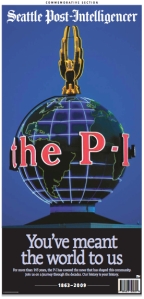 The 146-year-old Seattle Post-Intelligencer printed its last edition on Tuesday, becoming an Internet-only news source. In a report on its own Web site, the “paper” described the contours of the new, much smaller operation now in place. The P-I, as it’s called, is a “community platform” that will feature “breaking news, columns from prominent Seattle residents, community databases, photo galleries, 150 citizen bloggers and links to other journalistic outlets.” The New York Times notes that The P-I “will resemble a local Huffington Post more than a traditional newspaper,” with a news staff of about 20 people rather than the 165 it had, and with an emphasis more on commentary, advice and links to other sites than on original reporting.
The P-I venture may well fail — but in an essential way, that’s a good thing. Why that’s the case is explained in an indispensable essay posted by media-technology thinker Clay Shirky a few days ago. Glancing as far back as the 16th-century advent of the printing press, Shirky’s piece is an illuminating synthesis of the industry’s past and present — and, from where I’m sitting, brims with aphoristic insights pointing to a bright future for digital journalism. Original reporting in that realm — still much underdeveloped and ripe for innovation, in my view — will play a vital role in the further transformation.
Shirky writes: “People committed to saving newspapers [keep] demanding to know ‘If the old model is broken, what will work in its place?’ To which the answer is: Nothing. Nothing will work. There is no general model for newspapers to replace the one the internet just broke.”
To the old journalism guard, that’s a heartbreaking epilogue. Which of course misses the point. (Revolutions create a curious inversion of perception, Shirky notes.) “With the old economics destroyed, organizational forms perfected for industrial production have to be replaced with structures optimized for digital data,” he continues. “It makes increasingly less sense even to talk about a publishing industry, because the core problem publishing solves — the incredible difficulty, complexity, and expense of making something available to the public — has stopped being a problem.”
Revolution is a dramatic word, but it’s exactly what we’re witnessing, if in slow motion. It began a little more than a decade ago and perhaps will require another decade before reaching a level of maturity and stability with new form. Shirky describes the familiar process: “The old stuff gets broken faster than the new stuff is put in its place. The importance of any given experiment isn’t apparent at the moment it appears; big changes stall, small changes spread. Even the revolutionaries can’t predict what will happen.”
(On recognizing “the importance of any given experiment,” see Shirky’s great distillation of the rise of Craigslist. Experiments are only revealed in retrospect to be turning points, he observes. And regarding “big changes stall” — the fashionable HuffPo model, anyone? With all due respect and admiration for its achievements during an epic election year, who really believes HuffPo’s almost-zero-reporting approach is the future of journalism?)
On with the greater experimentation and innovation, then. Many new attempts like The P-I probably will fail, and, in effect, we need them too. “There is one possible answer,” Shirky says, “to the question ‘If the old model is broken, what will work in its place?’ The answer is: Nothing will work, but everything might.”
Sex commune and the city
Filed under: California, culture | Tags: California, politics, San Francisco
Comments (1) Ah, San Francisco, you gotta love this town. And loving it must include acknowledging that from time to time certain of its, um, cultural stimulations can seem a bit absurd. This was on display yesterday in the Sunday Styles section of the New York Times, which reported on the One Taste Urban Retreat Center, a 38-member live-play arrangement housed in “a shabby-chic loft building” in the city’s South of Market district. Its men and women (their average age the late 20s, the Times says) make meals together, practice yoga and meditation, and run communication workshops for groups of visitors. Oh, and also:
At 7 a.m. each day, as the rest of America is eating Cheerios or trying to face gridlock without hyperventilating, about a dozen women, naked from the waist down, lie with eyes closed in a velvet-curtained room, while clothed men huddle over them, stroking them in a ritual known as orgasmic meditation — “OMing,” for short. The couples, who may or may not be romantically involved, call one another “research partners.”
Apparently there are benefits to this of all sorts. One recently divorced man, “a baby-faced 50-year-old Silicon Valley engineer,” told the Times that “the practice of manually fixing his attention on a tiny spot of a woman’s body improves his concentration at work.”
Past practices at the center, which has been operating for over four years, include naked yoga. Anyone who has ever participated in a public yoga class knows this would be a remarkably ill-advised idea, no matter the direction in which it might be stretched. One Taste reportedly discontinued it after word got around and “many voyeuristic non-yogis showed up.” (Ya don’t say.)
San Francisco and surrounds has a well-known heritage, of course, of communal sexual experimentation and spiritual seeking. As far as I know per the history books, combining the two has never led to any particularly enlightening results.

What I find intriguing about this story isn’t a matter of morals or taste — it’s that the language and marketing themes are age-old, and not newly convincing. One Taste’s web site says that “Orgasmic meditation is a technique that develops mindfulness, concentration, connectedness and insight in a paired practice that focuses on sensation generated through manual stimulation of the genitals.” The practice can “facilitate greater physical and mental health, deeper connection to relationship” and can even be “a method for spiritual aims.”
In the Times report, a once timid patron turned instructor speaks of “the lingering velocity of my desire and my hesitation to give into it.” The proprietor and leader, Nicole Daedone, admits “a high potential for this to be a cult.” And while the article notes toward the end that Daedone’s current boyfriend, a wealthy software entrepreneur, “makes financial resources available” in support of the business, curiously, one stone remains unturned: cash flow. One Taste’s own program listings are also conspicuously absent information about what its participants are required to pay.
About that big Jim Cramer beatdown
Filed under: culture, media, politics | Tags: economy, recession, television, Wall Street
Comments (7) Jon Stewart is getting showered with praise for his showdown with CNBC’s Jim Cramer Thursday night on “The Daily Show.” The culmination of a week-long “feud” (egged on by the salivating media at large) was riveting to watch. (The video is here.) Stewart, long a savvy media critic, brutalized Cramer both for his own and the financial news network’s direct role in the economic meltdown that has vaporized untold wealth and hobbled the United States of America.

If that sounds a tad overdone, well, indeed. There is plenty of truthiness in Stewart’s point. It’s easy to sift through footage from various CNBC shows and find no shortage of their hosts making wrong calls about the financial markets, cheering on suspect CEOs and exuding what in hindsight was obviously misguided optimism about the economy and the stock market. Not to mention analyst Rick Santelli’s puerile, faux-populist tirade last month about the mortgage crisis.
But there is also some intellectual dishonesty suffusing the big CNBC takedown so in vogue right now. It’s easy to level simplistic snark at the network per above. But few seem willing, Stewart included, to acknowledge what the popular financial news network is mostly about, as I wrote about here recently: daily infotainment, emphasis on tainment.
Let’s be honest, we’re all plenty hungry at present for the villains of Wall Street to be strung up in the town square. But blame-the-media is the easy way out. It’s a bit silly to assign the degree of culpability that Stewart just did to a guy who, on his daily stock picking show, bounces around detonating obnoxious sound effects and exclaiming “Booyah!” like a frat guy on meth.
Stewart has other smart thinkers in the media following right along. David Brancaccio, host and senior editor of “Now on PBS,” told CNN that Thursday night’s show marked an important moment in journalism, especially for financial reporting, and that it may serve as a cautionary tale for those in the media who would fail on due diligence. “I don’t think any financial journalist wants to be in Cramer’s position,” Brancaccio said. “I think [journalists] may redouble their efforts to be dispassionate reporters asking the tough questions.”
That’s just goofy. Jim Cramer is not a financial journalist. He’s a self-cultivated nut-job host of a popular sideshow for Wall Street wonks. His script brims with speculative investment ideas, clumsy jokes and useless if marginally entertaining financial prattle.
The truth of the matter is that while CNBC certainly is ripe to take some lumps in this new era of Great Recession, the network is the easiest of targets. It’s also worth noting that there is substantive reporting in its mix. Last month, in fact, I spent some time interviewing CNBC anchor Maria Bartiromo and correspondent Bob Pisani at the New York Stock Exchange for a forthcoming magazine article about the financial media. Mostly I found them to be informed, thoughtful and dedicated to their work as reporters. For one example, see the high marks Bartiromo got for grilling ex-Merrill Lynch CEO John Thain on her show back in January. For another, watch this recent Frontline documentary, which recounts how in spring 2008 CNBC reporter David Faber helped pull the curtain back on Bear Stearns and impacted the timing of the investment bank’s collapse.
No doubt they and others on the network also had craven moments of their own during the boom times. As did so many in American government, business and, yes, out there in TV-viewing land. A dramatic and bloody round of the blame game is quite satisfying to watch right now, especially in the able hands of Mr. Stewart, but the culpability for our economic predicament extends far, far beyond the spectacle of one television channel.
This just in: No newspaper at all
Filed under: California, media | Tags: California, economy, future-of-journalism, media, recession, San Francisco, technology
Leave a comment More American newspapers appear to be accelerating toward demise. For anyone who’s been paying attention to the industry, it’s been clear at least since last fall that 2009 would be a year of considerable destruction. Take the spreading flame of digital technology, pour on a vicious economic downturn and quickly you have a raging forest fire. In the New York Times today Richard Pérez-Peña reports on which U.S. cities soon might not have a major daily print paper at all. Perhaps it’ll be Seattle or Denver. Or maybe San Francisco. Just a short while ago the prospect would’ve been inconceivable.
I like the forest fire metaphor here because it suggests an essential part of the picture that in many quarters still isn’t getting its proper due: The fertile rebirth that follows the destruction. I’ve been surprised to see a degree of pessimism even from some who’ve already been toiling on the frontier:
 “It would be a terrible thing for any city for the dominant paper to go under, because that’s who does the bulk of the serious reporting,” says Joel Kramer, the editor and CEO of Minneapolis-based MinnPost.com, in the Times today. (Kramer was formerly editor and publisher of The Star Tribune.) “Places like us would spring up, but they wouldn’t be nearly as big. We can tweak the papers and compete with them, but we can’t replace them.”
Really? There’s a tendency to equate the withering of the old medium (newsprint) with the demise of what it has delivered (news reporting). But increasingly it’s going to be delivered digitally. If the old media companies don’t do it, others will, because the demand (and therefore market) for it is undeniable. Sooner than we probably realize, we’re all going to be walking around carrying some kind of digital newspaper in our hands. Organizations will arise and mobilize to provide the reporting in it. And people will pay for it. (Businesses are also likely to advertise around it.)
Indeed, formidable challenges remain to working out viable business models. But the field is increasingly wide open and waiting to be seeded. (New tracts soon available!—see above.) You can look at the crisis as a tragedy, or you can look at it as an opportunity.
As Pérez-Peña notes, the Washington Post had a newsroom of more than 900 people six years ago, with fewer than 700 now. The LA Times newsroom is half the size it was in the 1990s, with a staff of about 600 today.
Call me crazy, but that’s still an awful lot of resources with which to gather and produce stories. Without the major printing and distribution costs of their antique brethren, digital ventures still will probably need to be considerably smaller and more nimble to succeed. (In the near-term economy, at least.) Even if some early experiments haven’t been so impressive, my sense is that those who survive and thrive will do so especially via robust local and regional reporting, fast dwindling in many places now. (Apparently the LA Times has some other strategy in mind.)
Self-described “newsosaur” Alan Mutter offers some intriguing advice for those who reportedly may launch the first digital-only newspaper in a major U.S. city, from the ashes of the Seattle Post-Intelligencer. “Be different” and “cop an attitude,” he suggests. “Think of the site as more of a blog than a newspaper.”
Hmm, it seems there’s no shortage of that to go around… but I like his closing thoughts: “The work you do will play a major role in helping to define the future – and the future economics – of local news coverage. Take risks, try everything and have fun. Whatever you do, don’t look back.”
 Mark Follman
You must be logged in to post a comment.