Archive for April, 2009|Monthly archive page
A fevered case of swine flu hype
Filed under: California, culture, media | Tags: California, foreign affairs, globalization, health, media, Mexico, television, Wall Street
 Leave a comment
 Will the outbreak of the H1N1 virus get historically serious? According to global health experts, the answer is that nobody really knows. Pandemics tend to hit in waves, and the biggest danger could come this winter.
 For now the news media is maintaining its fever pitch as long as possible, of course, hungry to feast at the ratings trough. As one analyst told Howard Kurtz yesterday, “Cable news has 24 hours to fill, and there isn’t 24 hours of exciting news going on. If you scare people, they’ll tune in more.” Still, when flipping past CNBC on Monday afternoon I was a bit shocked to encounter the blaring graphic “Pandemic Pandemonium” accompanying a discussion about reaction on Wall Street. (In fact, the market barely budged early this week.)
Naturally, some news consumers are caught up in the hallucinatory chatter. From an inquiry to Bay Area physician and blogger Doc Gurley — posted, I kid you not, under the headline Swine Flu Sex? — on SFGate today:
Dear Doc,
My husband and I are trying to get pregnant. We’ve just recently “put the pedal to the floor” and are undergoing fertility treatment. Now I’m concerned that I may be putting myself and an unborn fetus at extra risk for the Swine Flu that is wending its way down the pipeline. Included in this concern is the fact that I’ve heard that anti-virus medications can adversely affect a developing fetus, which means it would be a lose/lose case scenario if I had the opportunity to prevent an imminent case in the future. Should we shelve this project for a few months or what?
Gurley replies that pregnant women do have “very mildly” suppressed immune systems. However, she continues, “The fact is, given the way the world (and media coverage) works, there will, undoubtedly, never be a time when the world looks rosy, all-welcoming, and risk-free. Yesterday’s potential nuclear annihilation is today’s swine flu. It’s a wonder, in fact, that any baby ever sticks its head out.”
If they only knew about the likes of AC360 or Countdown with Keith Olbermann.
Mexico, meanwhile, now suffers from a confluence of maladies. As GlobalPost’s Ioan Grillo reports from Tijuana: “Amid a U.S. recession, a fever pitch fear of the Mexican drug war and now an epidemic of swine flu sweeping across Mexico, Humberto Beltran says business at his border city store has nosedived 85 percent this April compared to the same time last year.”
From North America to the Far East, another pressing question has arisen amid the swine flu scare: Is it still OK to love bacon?
UPDATE: As of Wednesday afternoon the World Health Organization has raised its alert level, determining that a “pandemic is imminent.” So too is plenty more cable news yammer.
Google, Kindle and The Library of Babel
Filed under: California, culture, media | Tags: books, California, future-of-journalism, language, law, media, poetry, San Francisco, technology, writing
Comments (1) Technological innovation seems almost strangely commonplace these days, from say, contact lenses that could layer data directly onto your view of the world to robots fighting far-flung wars to computer systems perhaps smart enough to compete on “Jeopardy!” All astonishing developments in their own right, and yet the most profound change of our times may yet be purely informative in nature: The digitization of all that we read.
At the University of San Francisco on Sunday I participated in a symposium on “Life after the MFA” for students graduating the writing program. Unsurprisingly, the technological upending of books, magazines and newspapers was a particular focus. Fellow panelist Patrick Dunagan, a poet who works as a specialist at the USF library, spoke with some alarm about the rate at which books and print periodicals there are going the way of the dodo. The idea is that many are being replaced digitally. I expressed a bit of surprise to him about this afterward, whereby he asked me when I last conducted any research in a library. Point taken. If only Borges were still hanging around and could rejoin the discussion.

One theme I hoped to suggest in my part of the talk was that print vs. digital isn’t a zero-sum equation. We can still love books and newspapers while getting charged about the possibilities of digital publishing. In many ways the latter remains a Wild West — and without a doubt has blown holes in some old ways of doing business. But in my view the rising digital infosphere is far more expansive and generative than it is destructive.
In a recent essay published in the Wall Street Journal, author Steven Johnson explores both the thrill and potential chill of electronic books, a fast-growing realm thanks to Amazon’s innovative e-book reader, the Kindle, and Google’s Book Search service, home to approximately 10 million scanned titles and counting. One exciting aspect Johnson flags with regard to ideas and research:
Before too long, you’ll be able to create a kind of shadow version of your entire library, including every book you’ve ever read — as a child, as a teenager, as a college student, as an adult. Every word in that library will be searchable. It is hard to overstate the impact that this kind of shift will have on scholarship. Entirely new forms of discovery will be possible. Imagine a software tool that scans through the bibliographies of the 20 books you’ve read on a specific topic, and comes up with the most-cited work in those bibliographies that you haven’t encountered yet.
But there will be pitfalls, too, especially with respect to evolving market forces. The all-powerful search engine that is Google, and the ways in which it guides users to digital content of all sorts, could impact how books actually get written:
Writers and publishers will begin to think about how individual pages or chapters might rank in Google’s results, crafting sections explicitly in the hopes that they will draw in that steady stream of search visitors.
Individual paragraphs will be accompanied by descriptive tags to orient potential searchers; chapter titles will be tested to determine how well they rank. Just as Web sites try to adjust their content to move as high as possible on the Google search results, so will authors and publishers try to adjust their books to move up the list.
What will this mean for the books themselves? Perhaps nothing more than a few strategically placed words or paragraphs. Perhaps entire books written with search engines in mind. We’ll have to see.
A strength of Johnson’s essay is that he doesn’t pass judgment on these possibilities; he concentrates on laying out in lucid terms what he sees coming. (Another recent piece of his, on how the web’s information ecosystem changes how we get our news, is also well worth reading.)
The latter segment above, under the subhead “Writing for Google,” got me thinking about a worn adage heard in MFA programs everywhere: “Write what you know.” If that advice translates fundamentally to writing from a place of experience and passion, it could take on fresh meaning in the digital future — when the suggestion to “Write what you can search engine optimize” may well become a growing temptation.
UPDATE: Some wonder if Google already has too much sway with its Book Search service, including the U.S. Department of Justice.
More truth about Dick Cheney and torture
Filed under: media, politics | Tags: CIA, Dick Cheney, FBI, foreign affairs, intelligence, national security, politics, terrorism, war
Comments (2) In yesterday’s “Why Dick Cheney keeps torturing us,” I chose not to address the immorality of interrogation by torture because I wanted to focus on the true purpose of the former vice president’s cynical political tactics. But as commenter ‘Briar’ rightfully noted, a utilitarian argument against torture is in some sense too narrow. Even in the rare theoretical instance in which torture might produce useful results (we have yet to learn of a single one in the prolonged war on terror, as I wrote yesterday), its use would still be wrongheaded and reprehensible.
 There are numerous reasons for this, of course, not least what it does to the person being tortured. Also deeply disturbing, although less often discussed, is what it does to the people who carry out the torture or who witness it being carried out. The New York Times article I cited yesterday with regard to intelligence extracted from Al Qaeda operative Abu Zubaydah also reported that “watching his torment caused great distress to his captors.” Even for those who believed that brutal treatment could produce results, according to a former intelligence official with direct knowledge of the case, “seeing these depths of human misery and degradation has a traumatic effect.”
In an in-depth article on torture I reported for Salon back in 2005 (also cited in yesterday’s post), this point was made particularly well by U.S. Army Captain Ray Kimball, who spoke with me about reports of Special Operations Forces brutalizing prisoners in Iraq:
“Torture not only degrades the victim, it also ultimately degrades the torturer,” said Kimball, who served in Iraq and now teaches history at West Point. “We already have enough soldiers dealing with post-traumatic stress disorder after legitimate combat experiences. But now you’re talking about adding the burden of willfully inflicting wanton pain on another human being. You tell a soldier to go out there and ‘waterboard’ someone” — strap a prisoner to a board, bind his face in cloth, and pour water over his face until he fears death by drowning — “or mock-execute someone, but nobody is thinking about what that’s going to do to that soldier months or years later, when it comes to dealing with the rationalizations and internal consequences. We’re talking about serious psychic trauma.”
The moral imperative not to torture is manifold, powerful and obvious to most. The single greatest weapon against it is the argument that using torture saves American lives — so in that respect Cheney’s demonstrably false argument, that torture has worked, deserves to be called out for its cold political calculus.
Especially now, as the ongoing media campaign from Cheney and others who share his views appears to be working to a degree. From an analysis on the torture debate by reporter Scott Shane appearing in today’s New York Times:
Many intelligence officials, including some opposed to the brutal methods, confirm that the program produced information of great value, including tips on early-stage schemes to attack tall buildings on the West Coast and buildings in New York’s financial district and Washington. Interrogation of one Qaeda operative led to tips on finding others, until the leadership of the organization was decimated. Removing from the scene such dedicated and skilled plotters as Mr. Mohammed, or the Indonesian terrorist known as Hambali, almost certainly prevented future attacks.
It becomes more difficult to doubt the efficacy of torture after reading a paragraph like that from a respected national security reporter. (Even in an article containing a hefty dose of skepticism favoring the other side of the debate.) But if the above is accurate, why, for more than seven years, have no specific details been made public as to how and what “information of great value” was gained through brutal interrogations?
As Shane notes, “which information came from which methods, and whether the same result might have been achieved without the political, legal and moral cost of the torture controversy, is hotly disputed, even inside the intelligence agency.”
In light of all the known evidence to date, though, one thing is crystal clear: The political — and moral — onus rests squarely on the backs of the torturers.
UPDATE: Ali Soufan, an FBI agent directly involved in the interrogation of Abu Zubaydah, speaks out publicly today for the first time on the torture issue. His Op-Ed is well worth reading in its entirety; here’s what stands out in particular per above:
There was no actionable intelligence gained from using enhanced interrogation techniques on Abu Zubaydah that wasn’t, or couldn’t have been, gained from regular tactics. In addition, I saw that using these alternative methods on other terrorists backfired on more than a few occasions — all of which are still classified. The short sightedness behind the use of these techniques ignored the unreliability of the methods, the nature of the threat, the mentality and modus operandi of the terrorists, and due process.
It’s also worth noting that Soufan is the central figure in Lawrence Wright’s account of a pivotal interrogation prior to 9/11, which I cited here yesterday.
Why Dick Cheney keeps torturing us
Filed under: media, politics | Tags: CIA, Dick Cheney, FBI, intelligence, law, national security, politics, terrorism, war
Comments (6) Nobody should be surprised that the former vice president keeps returning from the political wilderness to defend the brutal treatment of suspected terrorists. Without providing any specifics, Cheney continues to intone that torturing Al Qaeda suspects yielded information vital to protecting America. Countless news reports have suggested strongly that claim is false.
 Make no mistake: What Cheney is doing isn’t about protecting America, it’s about protecting political power. (Anyone who needs a refresher on his views of amassing and wielding that commodity should go back and read this Pulitzer Prize-winning series from the Washington Post.) With President Obama’s courageous decision to declassify Bush administration legal memos and return the unfinished torture debate to the headlines, Cheney and those who helped do his bidding in the Bush administration’s war on terror still have a lot to lose in terms of legacy and liability.
Once again we watch Cheney double down on an ugly bet: “I haven’t announced this up until now,” he said on Fox News on Monday, “but I know specifically of reports that I read, that I saw that lay out what we learned through the interrogation process and what the consequences were for the country.” The U.S. government should declassify those reports, too, he said, so that Americans can see “how good the intelligence was.”
Obama is unlikely to do that, and Cheney knows it. That’s because the chances are that most if not all documentation of actual intelligence operations — as opposed to memos laying out the Bush administration’s legal justification for them — contains information too sensitive to disclose regarding sources and tactics. Obama should call Cheney’s bluff not only by noting that distinction, but also with a full-throated rejection of Cheney’s false argument: He should remind Americans that torture simply does not work.
That truth has been borne out in reams of media reporting on the war on terror, and has been reiterated time and time again by senior U.S. military and intelligence officials, several of whom I spoke with when covering the issue at length for Salon back in 2005. It was on full display again in late March, in a Washington Post report further examining the treatment of the terrorist Abu Zubaida, who was waterboarded by the CIA at least 83 times:
The methods succeeded in breaking him, and the stories he told of al-Qaeda terrorism plots sent CIA officers around the globe chasing leads. In the end, though, not a single significant plot was foiled as a result of Abu Zubaida’s tortured confessions, according to former senior government officials who closely followed the interrogations. Nearly all of the leads attained through the harsh measures quickly evaporated, while most of the useful information from Abu Zubaida — chiefly names of al-Qaeda members and associates — was obtained before waterboarding was introduced, they said.
A New York Times report last weekend underscored that valuable intelligence gleaned from Zubaida did not come via torture:
His interrogation, according to multiple accounts, began in Pakistan and continued at the secret C.I.A. site in Thailand, with a traditional, rapport-building approach led by two F.B.I. agents, who even helped care for him as his gunshot wounds healed. Abu Zubaydah gave up perhaps his single most valuable piece of information early, naming Khalid Shaikh Mohammed, whom he knew as Mukhtar, as the main organizer of the 9/11 plot.
Lawrence Wright’s definitive volume about the 9/11 terrorist attacks, “The Looming Tower,” recounts in vivid detail another example of how the measured, savvy manipulation of a captured terrorist suspect — not the beating and simulated drowning of him — yielded critical intelligence. No doubt there are other such examples that have not been made public.
But in seven years, not a single example has emerged of specific information vital to U.S. national security that was obtained through torture — not even when protected from public view. As the Post reported late last month, “Since 2006, Senate intelligence committee members have pressed the CIA, in classified briefings, to provide examples of specific leads that were obtained from Abu Zubaida through the use of waterboarding and other methods, according to officials familiar with the requests. The agency provided none, the officials said.”
Of course, Cheney and his supporters will continue muddying the waters — including through leaks of nonspecific claims — in hopes of warding off political and legal vulnerability as the nation realizes the truth about torture.
UPDATE: More here on Dick Cheney’s defense of torture.
A blogger breaks news on waterboarding
Filed under: media, politics | Tags: CIA, FBI, future-of-journalism, intelligence, media, national security, NYT, politics, technology, terrorism, war
Comments (2) Pondering the rise of new media and the decline of the traditional newsroom, skeptics still tend to cling to either-or thinking: You’ve either got shrill partisan hacks or experienced professional reporters, and never the twain shall meet. The failure of imagination involved is pretty obvious. Digital media has unlocked great potential for nontraditional approaches to the gathering and analysis of information — a vast middle ground of additional possibilities.
Let’s say the government releases a bunch of documents related to a controversial, secretive activity. Now anybody with a computer, an Internet connection and a little motivation can dig in. (Of course, this has already been going on for quite a while.)
 Today brings a fresh example of how reporting by bloggers can contribute to, or even lead, a major news cycle. In a front-page story today, the New York Times announces that the CIA used waterboarding, a torture technique provoking fear of death by drowning, hundreds of times on two Al Qaeda suspects — far more than was previously known. It’s newsworthy information on several levels, including for how it punches holes in past testimonials from U.S. officials about covert interrogations conducted by the Bush government.
This was not a scoop from the nation’s largest newsroom. The information underpinning the Times report came via blogger Marcy Wheeler, who discovered over the weekend that Khalid Sheikh Mohammed was waterboarded 183 times in one month when she examined the fine print in a newly declassified Bush administration memo from 2005. Wheeler also used the memo to look at a telling clash between the FBI and CIA over the interrogation program and to examine the key question of whether waterboarding actually is effective, as has been claimed by Dick Cheney et al.
The Times report underscores that this story remains far from over (also see Mark Danner for an in-depth political discussion of the unresolved torture issue) — and the public has an enterprising blogger to thank for pushing it ahead.
America loves doga! (Or, a brief meditation on the dubious trend story)
It’s a kind of yoga. You do it with your dog. No, seriously. Together with your pooch you stretch, you meditate, you pose. The New York Times reported on this recently. Maybe you’d already heard about it, but probably not. (More on that in a minute.) For an hour or so on the evening of April 8 the story was featured, replete with large photo, atop the leading news site. It was number one on the Times’ list of most e-mailed stories for a couple days thereafter. Apparently doga is a rising trend in America, worthy of much attention.
Or is it? Indeed, there’s a bit of a journalism issue here, but first things first: Sure, the pictures of the dogs were pretty cute and/or pretty funny, and who doesn’t love cute-funny dogs, and who wouldn’t click gleefully on a slide show with additional pictures of cute-funny dogs, thereby contributing to what certainly must’ve been a big spike in page views for nytimes.com.
There’s probably not much reason to add that partner yoga with your dog may sound like one of the more inane things you’ve ever heard of, because others are likely to say that (yogis among them), as well as to suggest that the dogs involved may well be feeling less than enlightened by the activity, and anyway, the photos (by Michael Nagle) from the Times’ slide show really do speak for themselves:



There is good reason to add, however, that claims about doga’s growing popularity across the land seem howlingly suspect. Behold the all too common trend story that offers no real evidence of a trend.
After a brief opening anecdote about a few people in Chicago, New York and Seattle variously contorting with their Jack Russell terriers and Shih Tzus, the Times report says this of doga (emphasis mine):
Ludicrous? Possibly. Grist for anyone who thinks that dog-owners have taken yoga too far? Perhaps. But nationwide, classes of doga — yoga with dogs, as it is called — are increasing in number and popularity. Since Ms. Caliendo, a certified yoga instructor in Chicago, began to teach doga less than one year ago, her classes have doubled in size.
That’s it, folks. The rest of the article contains no further quantitative information about the purported legions of spiritually enlightened pet owners caught up in the craze.
Perhaps the Times reporter spotted some sort of trend in other stories about the alleged trend: The Associated Press covered it back in 2007, and ABC News published a story on April 1 (whose date apparently was a coincidence, although you could be forgiven for thinking the story was fake.) ABC included San Francisco and Jacksonville, Fla., on the list of locales and described a few doga accessories being sold. But no hard numbers there, either. Instead, the story leaned on “pet trend expert” Maggie Gallant to claim that doga “has the potential to be a very widespread trend.” As Gallant panted, “There are 75 million homes in America that have dogs and about 13 million people practicing yoga.”
Kudos to Chicago Tribune columnist Mary Schmich for sniffing out the truth. With a little follow-up reporting, she discovered that the Chicago locale cited in the Times article — the one where classes “have doubled in size” — now offers one doga class a week, with three to 12 students in each.
Aside from whatever benefits may lie in store for dog owners who team up with their beloved furry ones for stretching and meditation, it seems that America’s big embrace of doga turns out to be, well, a particular kind of scoop indeed.
This is David Foster Wallace
Filed under: culture, politics | Tags: books, DFW, language, original reporting, poetry, politics, writing
Comments (1) On Tuesday, Little, Brown and Company publishes a book version of “This Is Water: Some Thoughts, Delivered on a Significant Occasion, about Living a Compassionate Life,” the celebrated commencement speech David Foster Wallace gave to the 2005 graduating class at Kenyon College. The pocket-sized book breaks up the nearly 4,000-word speech into digestible pieces on the page, some as brief as a single phrase. It’s an intriguing approach: In one sense, practical to publishing the essay in book form while drawing out its epigrammatic layers. At the same time, it seems rather un-DFW — contrary to the hyper-digressive, cascading prose for which he is so well-known.

Wallace giving a reading in 2006 in San Francisco. (Wikimedia Commons.)
Whether Wallace would approve of the presentation we probably can’t know. But it highlights a radiant directness that was often in danger of obscuring beneath his towering intellect. (It’s worth noting that there are some subtle differences to be found in other versions of the commencement speech floating out there; I contacted the publisher seeking clarification on how the text was prepared, but a publicist responded that Wallace’s longtime editor, Michael Pietsch, was declining to be interviewed about the book.)
Wallace’s focus was on the far from easy task of living life consciously in the adult world. He begins with a “didactic little parable-ish story,” as he puts it, about young fish who are oblivious to the environs through which they swim. More than just challenging the conventions of the commencement genre, Wallace makes use of them with a fierce sincerity: “I submit that this is what the real, no-bullshit value of your liberal arts education is supposed to be about: How to keep from going through your comfortable, prosperous, respectable adult life dead, unconscious, a slave to your head and to your natural default setting of being uniquely, completely, imperially alone, day in and day out.”
Segments like these carry an added poignancy in the wake of Wallace’s death by suicide last fall at the age of 46. Rather than a matter of morality or religion or the afterlife, he went on to tell the young graduates, “the capital-T Truth is about life before death. It is about making it to thirty, or maybe even fifty, without wanting to shoot yourself in the head.”
More striking, though, is his evocative insight and humor. If the students really do learn how to think and pay attention in life, he tells them, “It will actually be within your power to experience a crowded, hot, slow, consumer-hell-type situation as not only meaningful, but sacred, on fire with the same force that made the stars — compassion, love, the subsurface unity of all things. Not that that mystical stuff’s necessarily true: The only thing that’s capital-T True is that you get to decide how you’re going to try to see it.”
The pleasure of experiencing Wallace’s speech again underscored a realization I had when reading D.T. Max’s lengthy look back at Wallace’s life: The world deserves a published collection of David Foster Wallace’s correspondences, too. Various bits of it appearing in the recent New Yorker article — with fellow writer Jonathan Franzen, his literary agent Bonnie Nadell and others — cast additional light on Wallace’s humanity and highly emotive lexicon.
While I’ve admired some of his fiction, I’ve always thought Wallace was at his best with essays and literary journalism; as I wrote about here recently, gems found in his private correspondences show how the epistolary form (actual letters as well as email) brought out a more direct spirit of his, too.
The back cover of “This Is Water” asserts that the essay was Wallace’s answer to “the challenge of collecting all he believed about life and lasting fulfillment into a brief talk.” The inflated language of marketing copy, it would seem — Wallace’s prolific, restive consciousness probably could never be so perfectly distilled. A deeper look at his personal correspondences, meanwhile, could only add to the picture of a life and work tragically cut short and revered by so many.
On Mark Bowden’s NYT takedown
Filed under: culture, media | Tags: books, economy, future-of-journalism, Iran, media, NYT, recession, writing
Comments (4) The so-called crisis in the news industry sure has generated some sensational stories of late. “American journalism is in a period of terror,” announces Mark Bowden in a tome of an article appearing in the May issue of Vanity Fair. Mostly a deft hatchet job on Arthur Sulzberger Jr., the publisher of the New York Times, Bowden’s piece sent the media cognoscenti into a tizzy, although nobody seems to have noticed its one truly illuminating segment.
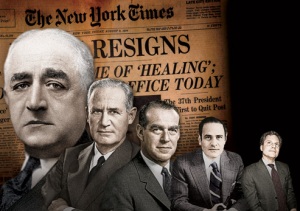
Photo illustration from Vanity Fair.
Even the mighty Times is facing financial peril these days, and Bowden’s premise is that the newspaper scion “has steered his inheritance into a ditch.” He abuses tools of the trade to help suggest his case. As one unnamed “industry analyst” tells us, “Arthur has made some bad decisions, but so has everyone else in the business. Nobody has figured out what to do.” Earth shattering. Perhaps Bowden should pick up a copy of the Times and read Clark Hoyt on the suitable use of anonymous sources. For a substantive take on contemporary debacles across the business, check out this recent piece by Daniel Gross.
In fact, I’m a big fan of Bowden’s. Right now I happen to be reading his 2006 book “Guests of the Ayatollah,” a riveting account of the Iran hostage crisis. Particularly in the realm of national security, few reporters are as exhaustive, persuasive — and downright exciting to read — as him.
On the media, not so much. There he has tended toward the self-involved, maybe a particular pitfall for great reporters covering their own vocation. (See the opening line of the Sulzberger article, which zooms in directly on… Bowden himself, as he receives a phone call from Sulzberger: “I was in a taxi on a wet winter day in Manhattan three years ago…” Especially telling, I think, given that in another recent piece orbiting the news business, a profile of David Simon, Bowden also wrote himself prominently into the narrative.) The Vanity Fair article is exquisitely timed with the accelerating upheaval in the newspaper industry, and reads mostly like, well, a salacious, insider-y Vanity Fair article.
And yet, buried deep in the 11,500 words is one of the best analogies I’ve encountered anywhere conveying the potential for digital journalism:
When the motion-picture camera was invented, many early filmmakers simply recorded stage plays, as if the camera’s value was just to preserve the theatrical performance and enlarge its audience. To be sure, this alone was a significant change. But the true pioneers realized that the camera was more revolutionary than that. It freed them from the confines of a theater. Audiences could be transported anywhere. To tell stories with pictures, and then with sound, directors developed a whole new language, using lighting and camera angles, close-ups and panoramas, to heighten drama and suspense. They could make an audience laugh by speeding up the action, or make it cry or quake by slowing it down. In short, the motion-picture camera was an entirely new tool for storytelling.
Bowden uses the comparison in the service of whacking Sulzberger — but it also points directly to a broader stagnation in media companies’ use of the digital platform. There is experimentation going on, but often without much imagination: Digital video clips are all the rage? OK, we’ll put reporters on camera describing the stories they’ve just published! Online communities and reader interactivity are the latest buzz? OK, we’ll feature the shouting matches in our comments threads as actual news!
The rising multimedia and publishing capabilities of the digital realm are charged with promise, and demand deeper thinking about their optimal use. With any given subject, which digital tools are most effective for gathering information and telling the story? How can the information-rich ecosystem of the Web enhance the knowledge gained? What new ways are there to produce reliable, authoritative and compelling content, taking maximum advantage of a decentralized and participatory technology like no other we’ve ever known?
Soon enough we may all be getting our news on a kind of flexible digital paper. The possibilities for what it could contain are big, and they’re just beginning.
UPDATE: Mark Bowden responds.
Waking up to America’s economic nightmare
Filed under: California, culture, politics | Tags: California, economy, politics, recession, San Francisco, Wall Street
Comments (2) 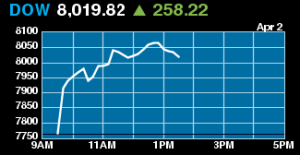 With the roughly 1,500-point rise in the Dow Jones average since early March, it seems investors have been dreaming about the good old days. This Bloomberg chart from last Thursday’s trading marks the apparent disconnect — you don’t have to be a stock market maven to sense that the dramatic rally will likely prove to be, in the parlance of Wall Street, the kaput kitty hitting the pavement.
Take your pick of grim indicators. For the last two months the Consumer Confidence Index has plumbed its lowest depths since its inception in 1967. As we learned Friday, the nation lost another 663,000 jobs in March, bringing the total to 5.1 million since the recession began in December 2007. Unemployment may be a lagging economic indicator, but there’s little to suggest that the wave is cresting or will be any time soon.
But the worst sign of all right now may be this: America is still stuck in the anger stage. Recently I overheard a classic strain of the outrage in a coffee shop in Noe Valley (hardly ground zero for hard times), in a conversation between two rather comfortable looking middle-aged adults. One was wailing away on America’s preferred punching bag, Mr. Wall Street Executive, for “raping the taxpayers” without remorse. His hair was so on fire that I feared his head might actually explode. Soon the talk hit on the hypocrisy of the Obama administration’s forcing General Motors chief Rick Wagoner to fall on his sword while Wall Street’s lords of finance so unfairly kept feasting on federal bailout funds. Somehow the disastrous story of the SUV-bloated American auto industry didn’t come up.
Indeed, we must also be in a recession of genuine awareness. While New York Times columnist Frank Rich can himself be shrill at times, he’s got it right regarding the continuing blame game:
Why is there any sympathy whatsoever for a Detroit C.E.O. who helped wreck his company, ruined investors and cost thousands of hard-working underlings their jobs, when there is no mercy for those who did the same on Wall Street? Might we, too, have a double standard? Could we still be in denial of the reality that greed and irresponsibility were not an exclusive Wall Street franchise during our national bender?
A prominent financial expert I interviewed last week for a forthcoming magazine piece on the economic crisis said to me at one point in our conversation, “Almost everybody who was part of the system failed.” He wasn’t only talking about Wall Street institutions, government regulators and the media.
Easily enough we get whipped into a frenzy over unjust executive bonuses or the sins of the media’s prime time ding-dongs. But what of America’s common financial lifestyle over the last two decades? As Rich continues, in answer to his own question: “Any citizen or business that overspent or overborrowed in the bubble subscribed to its reckless culture. That culture has crumbled everywhere now, and a new economic order will have to rise from its ruins.”
Even better put, it will have to be built from them. That will be painstaking, no doubt — block by block, brick by brick, as has been said by a certain someone. But right now, it seems, too many people are still standing on the outskirts shouting about who plundered the village, rather than heading into the collective rubble and really starting to pick up the pieces.
UPDATE: On a related note, Wall Street conspiracy theorists and/or Hollywood screenwriters will find plenty of grist in this Times front-pager on Larry Summers’ enriching hedge fund days at D.E. Shaw prior to joining Team Obama:
D. E. Shaw does not like to talk about what goes on inside its modish headquarters near Times Square. There, esoteric trading strategies are imagined, sketched on whiteboards and modeled on supercomputers by an elite corps of math wizards and scientists, most of them unknown to the outside world….
At Shaw, Mr. Summers, the professor, was often the student. The arrogant personal style that turned off some Harvard colleagues seemed to evaporate, Shaw traders say. Mr. Summers immersed himself in dynamic hedging, Libor rates and other financial arcana.
He seemed to fit in among Shaw’s math-loving “quants,” as devotees of math-heavy quantitative investing are known. Traders joked that Mr. Summers was the first quant Treasury secretary because he had once ordered dollar bills to be printed with the transcendental number pi — 3.14159… — as the serial number.
Paging Dan Brown and Ron Howard?
Osama bin Laden’s “man-caused disaster”?
Filed under: politics | Tags: CIA, FBI, foreign affairs, intelligence, language, national security, politics, terrorism, war
Leave a comment President Obama’s predecessor famously terrorized the English language. But lately, as the new, more fluent commander in chief and his team leave behind George W. Bush’s linguistic legacy on national security — jettisoning hard-line terminology such as “war on terrorism” and “enemy combatant” — they seem in danger of over-articulating.
In a recent interview with Der Spiegel, Janet Napolitano explained why, in her first testimony to Congress as Homeland Security chief, she used particular language to describe continuing perils. “In my speech, although I did not use the word ‘terrorism,’ I referred to ‘man-caused’ disasters,” she said. “That is perhaps only a nuance, but it demonstrates that we want to move away from the politics of fear toward a policy of being prepared for all risks that can occur.”
A worthy goal. But considering the mass casualties perpetrated in Manhattan or Madrid or London in recent years, is it really a good idea to deploy a phrase that’s in danger of suggesting accidental tragedy?
As Peter Baker reports in the New York Times, the Obama administration is opening itself to criticism that it doesn’t take the dangers of the world seriously enough. Says Shannen W. Coffin, who served as counsel to former Vice President Dick Cheney: “They seem more interested in the war on the English language than in what might be thought of as more pressing national security matters. An Orwellian euphemism or two will not change the fact that bad people want to kill us and destroy us as a free people.”
One can always count on a loaded partisan volley from the Cheney camp, but in this case one perhaps not easily deflected in the battle of political perception.
 Another national security legacy of the Bush era, deeply troubling, lingers. An internal report from late 2008 assessing the state of the U.S. intelligence system, made public this week, found precious little progress since 9/11 in terms of fixing serious bureaucratic risks. That’s despite the greatest overhaul since World War II of the system, including the creation of the Office of the Director of National Intelligence to oversee America’s spy agencies.
Many senior U.S. intelligence officials interviewed “were unable to articulate a clear understanding of the ODNI’s mission, roles, and responsibilities,” according to the report. U.S. spy agencies are still running “largely disconnected and incompatible” computer systems and have “no standard architecture supporting the storage and retrieval of sensitive intelligence.” And “intelligence information and reports are frequently not being disseminated in a timely manner.”
And while the concept of sharing information between agencies is “supported in principle” among some intelligence leaders, according to the report, “the culture of protecting ‘turf’ remains a problem, and there are few, if any, consequences for failure to collaborate.”
Hopefully the true consequences of such recent turf battles, and the excruciating story behind them, haven’t already gone forgotten.
Guardian’s Twitter move, GM’s bailout madness
Filed under: culture, media | Tags: California, comedy, media, recession, technology
Comments (3) It’s adding up to a strange day in the news, my friends, but then again these are no ordinary times.
The venerable 188-year-old Guardian, apparently seeing the ugly writing on the wall for the media business, has taken perhaps the boldest step yet to embrace digital technology. Will such an all-in bet on rapid-fire reporting pay off?
 Meanwhile, in the heart of Silicon Valley, a hotshot entrepreneur has moved to capitalize on social networking technology in a different cutting-edge way. If the producers of “The Bachelor” take notice, look out for a full convergence of reality TV and the Internets even sooner than already anticipated.
And in what can only really be considered a desperate move, General Motors apparently is grasping for a solution to its epic troubles by way of two well-known, if irritating, car experts.
More odd stuff going on across the pond.
 Mark Follman
You must be logged in to post a comment.