Archive for July, 2009|Monthly archive page
Cambridge cop accidentally arrests Gates again
Filed under: media, politics | Tags: comedy, law, media, politics
 Leave a comment
 The beer summit, it turns out, was a huge waste of time — it seems Obama had it right about Crowley all along. This just in, from America’s Finest News Source:
 WASHINGTON — Upon arriving late to his meeting with President Barack Obama and famed African-American intellectual Henry Louis Gates, Cambridge police officer James Crowley once again detained the distinguished Harvard scholar after failing to recognize the man he had arrested just two weeks earlier, White House sources reported Thursday. “When I entered the Oval Office, I observed an unidentified black male sitting near Mr. Obama, and in the interest of the president’s safety, I attempted to ascertain the individual’s business at the White House,” Crowley said in a sworn statement following the arrest. “The suspect then became uncooperative and verbally abusive. I had no choice but to apprehend him at the scene for disorderly conduct.” Witnesses said that Sgt. Crowley, failing to recognize Gates on their flight to Logan Airport, arrested the tenured professor in midair, once again at the baggage claim, and twice during their shared cab ride back to Cambridge.
Brevity, brainpower… and Obama’s beer hour
Filed under: culture, media, politics | Tags: CIA, foreign affairs, intelligence, Israel, media, national security, technology, television, terrorism, war
Leave a comment If attention spans these days are indeed being digitally obliterated, you may not get very far past this sentence. But if you’re looking for a few good places where you might actually go a little deeper (besides this blog, of course!), here are a few recommended links — a quick rundown of What Else I’ve Been Reading Lately.
Benedict Carey continues an engrossing series about the human brain, with the latest installment looking into the science of gut feelings. What is it that might give some U.S. soldiers in Iraq or Afghanistan exceptional ability to detect roadside bombs? It could be that cognitive abilities matter most — whether innate or gained potentially through training.
NPR has a look at how Bryant Neal Vinas, a 26-year-old aspiring jihadi from Long Island, made his way pretty darn close to Osama bin Laden. According to terrorism expert Sam Rascoff, “Vinas’ experience tends to undermine the story we’ve been telling about what it takes to get inside the hard-core al-Qaida.”
In “The Kill Company,” Raffi Khatchadourian further investigates the dark side of U.S. military action in Iraq. In the fog of this long war, where is the line between killing and murder on the battlefield?
With a thought-provoking Op-Ed in the Times, Haaretz’s Aluf Benn suggests Barack Obama has blown it by not talking to Israelis, while just about everyone else in the world has been hearing directly from the Diplomat in Chief. “This policy of ignoring Israel carries a price,” Benn says, especially with respect to the incendiary issue of the settlements.
After spending a chunk of time back in June writing about the election upheaval in Iran, it was inspiring to read this high-quality exchange between bloggers Ethan Zuckerman and Robert Mackey about the challenges of covering events in Iran. Would that this kind of open discussion, at the nexus of technology, politics and journalism, be much more commonplace.
 And last but not least… Gates-gate. Since you made it this far, I’ll go a tad deeper here. Obviously, a bunch of media folks have no choice but to waste a bunch of time obsessing about and over-analyzing what brands will be consumed during the imminent beer summit at the White House. (How revealing that the black Harvard professor is going for a Red Stripe! Etc.) It’s not as if there’s an array of daunting issues in the world on which to focus. Nonetheless, CNN’s “Situation Room” today has been featuring a “beer chat” countdown clock onscreen, along with graphic deconstructions of where the gathering will take place in the White House rose garden, and with Wolf Blitzer practically beside himself teasing the event every 60 seconds. (Jon Stewart no doubt is hailing the cable news gods ahead of tonight’s sendup.)
In the end, I think Obama “acted stupidly” himself by getting so directly involved in this whole kerfuffle. He has done wonders to help push America forward on intractable issues of race. (His March 2008 speech in Philadelphia on race was perhaps the high-water mark of his tidal wave of a presidential campaign.) But I agree with Glenn Loury that Obama spent his political capital poorly on this — even if, as Charles M. Blow recounted quite poignantly, America still has a long way to go.
 UPDATE: An important twist in the paramount beer summit story: It turns out that Gates recalculated and went with a Sam Adams instead. We can only ponder the significance… also see Michael Scherer, on how the White House press corps got played on this one.
A Supposedly Fun Thing That Seems to Kill Whales
Filed under: culture, politics | Tags: Canada, DFW, environment, original reporting, photography, travel, Vancouver
Comments (1) I took notice back when David Foster Wallace chronicled the cultural dark side of going on a cruise. But ultimately it’s the environmental dark side of the industry that makes me know I’ll Never Do It at All.
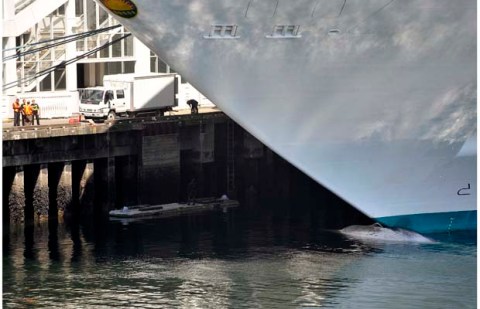
Over the weekend, an adult fin whale — a threatened species in Canada — turned up dead in the waters at a cruise ship terminal in Vancouver. The rare marine giant was impaled on the bow of the “Sapphire Princess,” a Princess Cruises’ ship arriving from Alaska:
(Jenelle Schneider/Vancouver Sun)
Tragic, gruesome and strange — the size of the ship really begins to sink in when you realize that the dead fin whale pictured above is approximately 70 feet long, a magnificent giant cruelly rendered small. (More photos here in the Vancouver Sun’s report, and more here on Flickr.) Consider, also, that soon the 2,670-passenger Sapphire Princess won’t even nearly measure up to the largest, most consumptive recreational beast riding the seas. That’ll be the stupefying Oasis of the Seas.
According to the Vancouver Sun, the Department of Fisheries and Oceans will conduct a necropsy to determine if the ship struck the fin whale while it was alive or if the whale had already been floating dead at sea and got caught on the bow. The latter seems the less likely scenario. A fisheries spokesperson, Lisa Spaven, appeared to acknowledge as much: “Vessel strikes are a very real threat to fin whales,” she told the Sun.
Moreover, an account I heard today from a source in Vancouver appears to contradict a statement put out by Princess Cruises this weekend regarding whales in the vicinity of the ship.
“It is unknown how or when this could have happened, as we have strict whale avoidance procedures in place when our ships are in the vicinity of marine life,” the statement from the cruise company said. “We are not aware that any whales were sighted as the ship sailed through the Inside Passage to Vancouver yesterday.”
But according to my source, two passengers who arrived on the Sapphire Princess in Vancouver this weekend said that several passengers on the ship had seen whales swimming around and under the ship as it traveled the Inside Passage cruise route just north of Vancouver Island.
Spaven, the DFO spokesperson, told the Vancouver Sun that she believes the whale was struck north of Vancouver Island, since fin whales aren’t normally found in the straits closer to Vancouver.
The Inside Passage is famously rich with marine wildlife and is a crucial habitat and migratory route for whales. As the Sun also reports: “This is the second time in the last 10 years that a cruise vessel has come into the Port of Vancouver with a whale caught on the bow. In that instance, in June of 1999, the Celebrity Cruise vessel MV Galaxy collided with an adult male fin whale, which likely happened as the ship transited the Hecate Strait north of Vancouver Island.”
For some compelling related reading, I strongly recommend Charles Siebert’s article “Watching Whales Watching Us,” published recently in the New York Times Magazine. It’s a deep, enthralling account that dives into some provocative thinking among marine biologists today about our evolving relationship with whales — which may yet hold hope, despite our terrible history of assault on one of the earth’s most sublime creatures.
PART 2:
There is more to Princess Cruises’ history with whales. In the summer of 2001, one of its ships slammed into a pregnant female humpback whale in the waters off Southeast Alaska, killing it. As Mother Jones reported two years ago via a National Park Service report, in January 2007 “Princess Cruise Lines pled guilty in U.S. District Court in Anchorage to a charge of knowingly failing to operate its vessel, the Dawn Princess, at a slow, safe speed in the summer of 2001 while near two humpback whales in the area of Glacier Bay National Park. The bloated carcass of a pregnant whale was found four days after the Princess ship sailed through the park. It had died of massive blunt trauma injuries to the right side of the head, including a fractured skull, eye socket and cervical vertebrae, all consistent with a vessel collision.”
You can read the rest of the report at the MoJo link above, including details of the six-figure penalty paid by Princess in a plea agreement. At the time of the agreement, the U.S. attorney’s office stated, “in this case we feel Princess has stepped up and made significant, voluntary operational changes that protect whales and the marine environment.”
Pending findings on the Sapphire Princess and the fin whale’s death, perhaps that assessment needs updating.
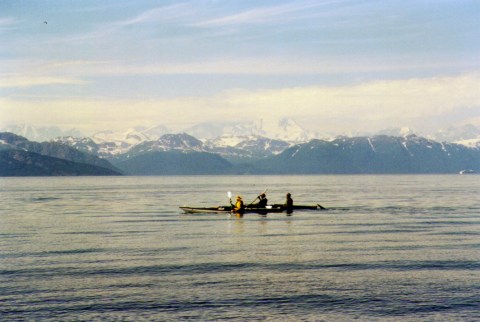
I’m compelled to add that I feel a particularly personal sense of investment in this story. Exactly a decade ago, I was fortunate to have an opportunity to travel into Glacier Bay, along with three good friends, on a 10-day sea kayaking trip. I’ve explored deep wilderness throughout my life, and Glacier Bay was among the most memorable places I’ve ever been. On a couple of days during the trip, we spotted cruise ships on the horizon. We were thankful to be far away from them. In this photo I took from my sea kayak in July 1999, you can see a large cruise ship in the distance (at the right-center edge of the image) heading north against the backdrop of the Fairweather Range.
We camped on nearby shoreline that night, where an exquisite sunset perhaps hinted at what was to come on day nine of our trip.
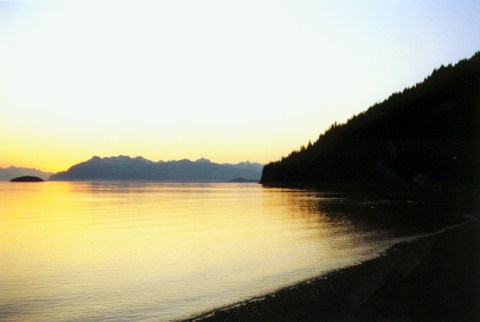

The next morning we paddled into the placid waters of Beartrack Cove to the east. We were sole representatives of humanity in a place that sees little of it. There were colorful marine birds, salmon returning to spawn in coastal streams… and suddenly that morning, one enormous humpback whale. It surfaced about 30 yards in front of our tiny, tiny boats.
The whale appeared to be feeding, its dark mass breaking the surface several times with its huge mouth open. We stopped paddling and tapped the rails of our boats gently to let it know our location. We watched in awe as it reappeared around us at various spots in the cove for about half an hour before it submerged for other waters.
It was the most glorious kind of nervous I think I’ve ever felt, a truly unforgettable experience.
On unsettling ground in Israel
Filed under: politics | Tags: art, foreign affairs, Israel, media, national security, politics
Leave a comment Even after working for years with several deeply knowledgeable, insightful writers to cover the morass known as the Israeli-Palestinian conflict, perhaps the only thing that’s really clear to me right now is this: It is ever atop the list of the world’s most daunting problems. And while no problem is more fraught with righteousness and political posturing (on all sides), at the heart of it is the long-running battle over facts on the ground. Sometimes that battle is more open, sometimes it is more clandestine — but always the struggle for the land, that seemingly tiny yet politically enormous sliver of it.
Despite my strong desire to see the region for myself, I’ve not yet had a chance to visit. And that’s one reason why Eric Orner’s recent piece, “The Land Grab out My Front Door: A Memoir of Jerusalem in Pictures,” grabbed my attention.

In a subject realm where anger and outrage are the norm, Orner’s work is an understated and intimate account of what’s happening on the ground in Jerusalem’s Abu Tor neighborhood, where Orner has been living.
“Israelis call Abu Tor ‘mixed’, meaning both Arabs & Jews live here,” he writes. “This doesn’t really capture the reality of the place, though. Well-off Jewish American ex-pats live in fancy condos at the top of the hill… while Arab families live further down the street as it makes a twisty descent towards the valley floor…”
He goes on to depict what appear to be dubious actions by Israeli authorities to demolish an Arab community that apparently stands in the way of developing “an archeological theme park” in a coveted part of Old Jerusalem. Such a development, Orner notes, is likely to draw lots more “Euro-Yankee tourist Shequels.” (Not to mention what it would add in terms of Israel-favorable facts on the ground.)

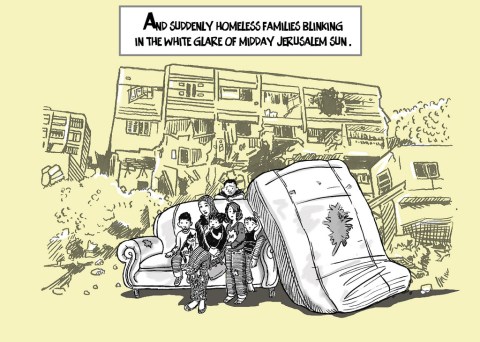
Check out the whole piece (at the above link), both visually engaging and eye-opening.
Meantime, while there seem to be some hopeful signs of progress for Palestinians in the West Bank these days, according to a report from the Times’ Isabel Kershner, few people believe that the right-wing government of Bibi Netanyahu is sincere when it comes to the Israeli prime minister’s recent talk of peace with the Palestinians. Netanyahu has been under pressure from the Obama administration, particularly on the issue of Israeli settlements.
But as Kershner reports, “even senior officials and prominent figures of his conservative Likud Party have been busy explaining, privately and publicly, why they think there is not likely to be a Palestinian state any time soon, in ways that raise even more questions about the current government’s commitment to reaching a final peace accord. And Mr. Netanyahu’s diplomatic turnaround was greeted by a notable silence among the Likud firebrands and hawks, widely interpreted here as a sign that they feel they have nothing to fear.”
According to the Israeli newspaper Haaretz, Netanyahu claimed this week that Jerusalem is an “open city” that permits all its inhabitants, Jewish and Palestinian, to purchase homes in both its eastern and western parts. “An examination by Haaretz, however, presented a rather different situation on the ground,” reports the paper, under the headline “Most Arabs can’t buy most homes in West Jerusalem.”
Haaretz also reports: “Deputy Foreign Minister Danny Ayalon said Tuesday that Israel had an ‘indisputable’ right to build anywhere in Jerusalem, including East Jerusalem, following international calls on Israel to halt construction in the disputed area.”
The political picture apparently has grown tense enough that a senior aide to Chancellor Angela Merkel of Germany — whose country usually displays staunch support for Israel — commented in a German publication that if the settlement building does not stop, Israel is running the risk of “gradually committing suicide as a democratic state.”
Warning: Do not attempt to launch nuke using your MacBook
 Just got a sparkling new MacBook Pro 13. This thing is smokin’. It handles like 007’s ride next to the ancient PowerBook G4 laptop with which I was barely coasting into yesterday. But this morning I stepped on the brakes when browsing the pocket-sized user booklet. While Apple’s branding gurus seem to have perfected the slickster-yet-friendly tone, buried in one of the snappy little chapters (e.g. “Ready, Setup, Go”) was quite a disclaimer. From “Last, but Not Least,” on page 68:
“High-risk activities – This computer is not intended for use in the operation of nuclear facilities, aircraft navigation or communications systems, air traffic control systems, or for any other uses where the failure of computer could lead to death, personal injury, or severe environmental damage.”

For real? I reckon the folks in Cupertino know too well that we dwell in an absurdly litigious society. Or maybe they’re just still haunted by Matthew Broderick’s fateful dalliance in 1983.
Medicine Bow: A tale of beauty and devastation
Filed under: culture, politics | Tags: books, climate change, environment, globalization, photography, politics, travel
Comments (3) Late last week, as world leaders were again failing to make progress on the rising threat of climate change, I was hiking to the top of Medicine Bow Peak in Wyoming. An unusually wet June produced a stunning sweep of wildflowers high upon the 12,000-foot mountain:

Combating global climate change is a complicated matter, to say the least, but I suspect that most people, attendees of G-8 summits included, would view the imperative in a whole new light if they were to witness the ecological devastation hitting this breathtaking region of the Mountain West. The fallout can be seen in the lush forests ringing Medicine Bow and other majestic snow-capped ranges in the area and in nearby Colorado — in the bleak, sprawling signature of an ongoing bark beetle epidemic. Warmer winters and drought in recent years allowed the insect population to explode, bringing destruction to more than 1.5 million acres.
“By about 2012, beetles will have killed nearly all of the mature lodgepole trees in northern Colorado and southern Wyoming,” reports the USDA Forest Service, “affecting water flows and watersheds, future timber production, wildlife habitat, recreation sites, transmission lines and scenic views. Beetle-killed trees also present a fuels build-up situation that could result in catastrophic wildland fires. These events pose threats to homes and property and could cause adverse economic impacts to communities.”
According to Erik Molvar, a wildlife biologist in Laramie, the beetle infestations have been roaring on unabated because of climate change. “These infestations take place naturally on 20- to 40-year cycles,” he said in a news article early last year. “In the past, they’ve run their course until a bitterly cold winter took place. Studies show that you need a two-week cold snap at minus 20 degrees Fahrenheit to kill off the beetles. Nothing else works.”
For several years now, it hasn’t gotten cold enough.
The forests seen here in the distance from the top of Medicine Bow…
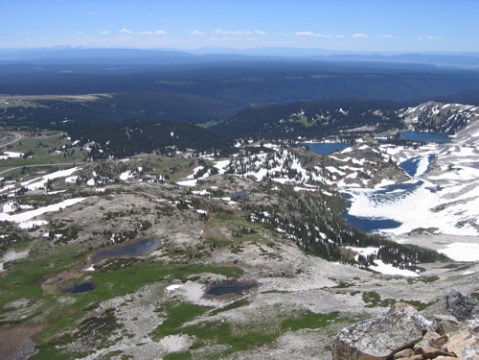
… could soon resemble these seen in this recent aerial photo, taken in northern Colorado, from the USDA Forest Service:
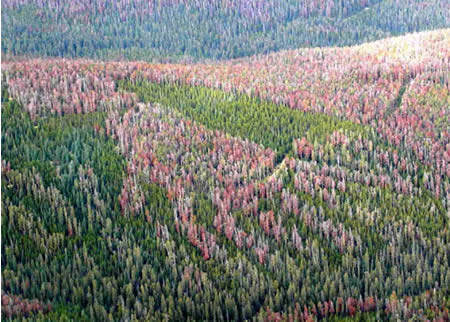
Some other forested areas I saw last week in the vicinity of Medicine Bow (especially at lower elevations that stay warmer) are already riddled with dead and dying trees. The friends I was with, who’ve been coming to the area for the last decade, described the accumulating damage in dramatic terms — some pristine expanses that existed just a couple of years ago won’t be seen again in our lifetime.
It’s hard to know how bad it might get (it’s already bad), or whether anything can actually be done to slow or stop this particular disaster. But it’s one stark example of what climate change can bring, and why we have to pay attention. Over the weekend Timothy Egan argued that Michelle Obama should throw her political weight behind America’s increasingly marginalized national parks. Egan’s perspective was more cultural than environmental, but from what I saw in Wyoming, there’s no lack of pressing reason on the latter front, either.
Or perhaps, as Emerson suggested in his famous essay on nature, what’s ultimately at stake is an essential interdependence:
“The tempered light of the woods is like a perpetual morning, and is stimulating and heroic. The anciently reported spells of these places creep on us. The stems of pines, hemlocks and oaks almost gleam like iron on the excited eye. The incommunicable trees begin to persuade us to live with them, and quit our life of solemn trifles.”
Postcard from Wyoming
Filed under: culture, politics | Tags: environment, guns, Israel, national security, photography, poetry, politics, travel
Comments (1) Did Joe Biden just give Israel the green light to attack Iran? Is Sarah Palin completely cuckoo? Have we reached the saturation point on Michael Jackson yet?
Apologies, dear readers, but I don’t have a lot to say about current affairs at the moment. (Anyway, Palin’s baffling resignation speech more than speaks for itself.) What I do have are a few photos I took during recent travels with friends in the great state of Wyoming. Enjoy…
*
July 4th festivities in the town of Saratoga:



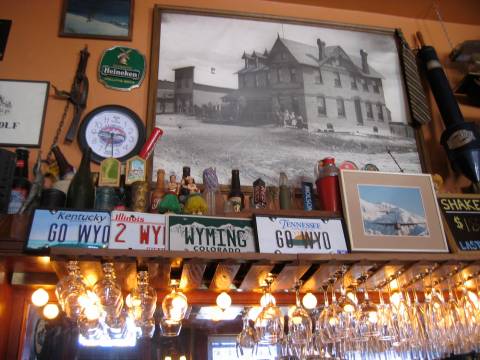
At the bar inside the Hotel Wolf:
Twilight commemoration involving ignition:



Thunderstorm approaching over Laramie:

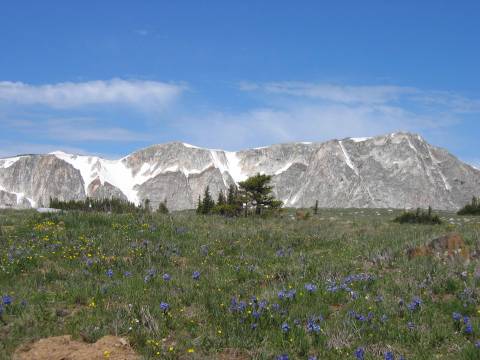
At the base of Medicine Bow peak:

Sharp turn on Wall Street
Filed under: culture, media, politics | Tags: economy, globalization, law, media, politics, recession, television, Wall Street
Leave a comment My cover story for the July/August issue of Arrive is now riding the northeastern rails, a look at the nation’s economic crisis and the role of the financial media. CNBC’s Maria Bartiromo, the Wall Street Journal’s David Wessel and others ponder the end of days on Wall Street and what the American economy will look like on the other side of its most vicious hangover in decades.
CNBC has taken some big lumps this year for the behavior of some of its on-air personalities, perhaps deservedly so. But during a lengthy chat for the story earlier this year, after pushing past a bit of canned stuff, I found Bartiromo to be quite knowledgeable, engaging and forthright. And I happen to agree with her take on Jon Stewart’s big beatdown of Jim Cramer and CNBC back in March.
 Will America’s investment banking sector soon be a miniature of its turn-of-millennium self? (And would that be a good thing?) Who are the most deserving villains in the blame game? Read on… Meanwhile, during a quick ATM stop at a Chase bank branch yesterday I witnessed an exchange that seemed in some small way encouraging — perhaps an indication that America has started to move beyond the denial/anger stage, and into the acceptance/change stage.
A bank employee was walking out just as a long-time customer was walking in. The customer asked the bank employee if in the past few weeks it had gotten any easier to get a loan. (The specific type wasn’t clear, though it was obviously either a home mortgage or small business loan.) “No, it hasn’t gotten any easier,” the bank employee said, with a cheery smile. “As you know, they’re asking a lot more questions now.” The customer smiled back, unfazed, and headed into the bank, paperwork in hand.
 Mark Follman

You must be logged in to post a comment.