Archive for January, 2010|Monthly archive page
“Bluetoothing” Iran’s revolution
Filed under: culture, media, politics | Tags: foreign affairs, globalization, Iran, media, national security, NYT, politics, technology, Twitter
 Leave a comment
 Though it’s grabbing fewer headlines these days, the upheaval in Tehran that began last summer continues to simmer. Apparently the Obama administration has some evolving ideas about how to exploit the domestic dissatisfaction, which has been rising, along with the local price of tomatoes, for quite some time. How long can Ahmadinejad hold on?
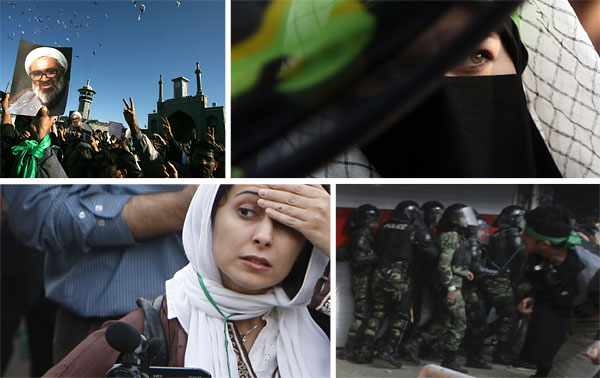
I finally had a chance to read Nazila Fathi’s recent essay about her experiences reporting from, and then fleeing from, Iran, where she’d been working for the New York Times. It’s chilling at turns, but also uplifting, particularly with its focus on the regime-busting role that technology has played in the historic unrest. Last summer I focused at length here on the unprecedented ways in which digital technology was shaping events from Tehran to Tiananmen Square. With events in Iran, Twitter suddenly had gone from trendy social networking toy to subversive diplomatic tool square on the State Department’s radar. But until reading Fathi’s essay I hadn’t known about another fascinating technological application in the fight—the use of Bluetooth by dissidents to dodge the crackdown. As Fathi writes of Iran’s continuing unrest in December:
Last month, during and after the funeral of the reformist Grand Ayatollah Hossain Ali Montazeri, one of the demonstrators’ most useful tools was the Bluetooth short-range radio signal that Americans use mainly to link a cellphone to an earpiece, or a printer to a laptop. Long ago, Iranian dissidents discovered that Bluetooth can as easily link cellphones to each other in a crowd. And that made “Bluetooth” a verb in Iran: a way to turn citizen reportage instantly viral. A protester Bluetooths a video clip to others nearby, and they do the same. Suddenly, if the authorities want to keep the image from escaping the scene, they must confiscate hundreds or thousands of phones and cameras.
The authorities have tried to fight back against such techniques and the Internet itself, but have fallen short. In November they announced that a new police unit, the “cyber-army,” would sweep the Web of dissent. It blocked Twitter feeds for a few hours in December, and an opposition Web site. But other blogs and Web sites mushroomed faster than the government could keep up.
Also be sure not to miss Frontline’s compelling documentary on the infamous killing of Neda Agha-Soltan.
UPDATE, 1/28/10: According to the New York Times, Iran reportedly has just executed two men in connection with the election protests. Nine others have been condemned to death for same.
Buried by the Haiti disaster
Filed under: culture, media, politics | Tags: economy, foreign affairs, health, media, politics, recession, Wall Street, war
Comments (1) Haiti’s devastation, now almost a week since the big quake, continues to saturate the media. It’s a lot to sift through and absorb; here’s where I’ve posted a handful of the most compelling links I’ve come across in recent days. For more, see Robert Mackey’s skillful curation over at The Lede blog.
One consequence of the historic disaster has been the burial of other developments that normally would’ve (and should’ve) been bigger front-page news:
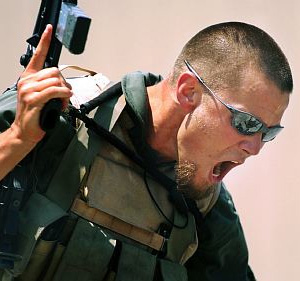 Blackwater still gets away with mass murder in Iraq, despite that three of its security personnel present at the notorious events three years ago testified to what they saw as wanton killing and cover-up. “All three were horrified by what they thought was an unprovoked attack in 2007 that left 14 Iraqi civilians dead,” according to previously sealed court documents described by the Washington Post. Their testimony further confirms the war zone “horror movie” reported by others long ago. Five Blackwater guards on trial for the attack walked at the beginning of this month, acquitted on procedural grounds.
 Wall Street’s top moguls sell Congress some shameless rationale for America’s historic financial meltdown. Testified Jamie Dimon of JPMorgan Chase: “My daughter called me from school one day and said, ‘Dad, what’s a financial crisis?’ And, without trying to be funny, I said, ‘This type of thing happens every five to seven years.’ And she said, ‘Why is everyone so surprised?’” (Without trying to be funny: Who the f—k is he kidding?) Testified Lloyd C. Blankfein of Goldman Sachs: “Whatever we did, it didn’t work out well. We regret the consequence that people have lost money.” (Hear them in their own words, here.) Meanwhile, pretty much everyone working for their bailed out firms is making out like a bandit.
Vancouver wins a key battle in its progressive war on drugs, with a top court preventing the Canadian federal government from shutting down the city’s officially sanctioned injection site for heroin and cocaine addicts. Probably not top story material, but a development of great interest to me personally; I reported extensively on the cutting-edge project from the streets of Vancouver — first in 2003, when the Bush administration angrily declared the policy “state-sponsored personal suicide,” and again three years later, when they were proven dead wrong by Insite’s indisputable success.
Also don’t forget that today is Martin Luther King Day; here’s a video clip of Robert F. Kennedy announcing King’s death by assassination in 1968. And always worth rereading, MLK’s landmark “Letter from Birmingham Jail,” from 1963. It continues to resonate in new ways with Barack Obama presiding in the White House.
Obama defines the war that will define him
Filed under: media, politics | Tags: CIA, Dick Cheney, economy, foreign affairs, intelligence, national security, politics, recession, terrorism, war
Leave a comment Another major wave of U.S. troops sent to Afghanistan. A Detroit-bound airliner imperiled by a terrorist on Christmas Day. A stunning blow to CIA operations targeting the Taliban and al Qaeda. A surge of political attacks against President Obama led by an aggressively partisan former vice president.
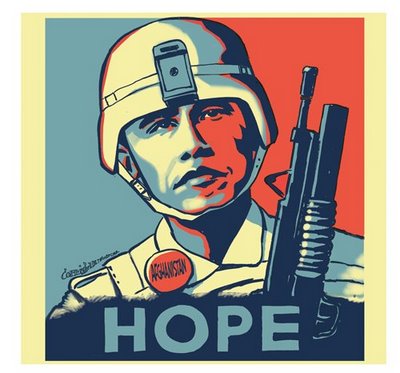 In recent weeks America’s current era of war has escalated to a next level. Obama didn’t preside over its inception, of course, but it is ever his to handle. Although the nation’s economic reckoning is far from over, what happens on the national security front is probably more likely to define Obama’s presidency than anything else.
His speech Thursday night addressing the U.S. intelligence debacle at Christmas reflected this. In his closing remarks, Obama made a point of disarming recent partisan attacks; although he didn’t name Dick Cheney specifically, some of his comments clearly were a retort to the former vice president’s assertion that Obama doesn’t take the terrorist threat seriously:
Over the past two weeks, we’ve been reminded again of the challenge we face in protecting our country against a foe that is bent on our destruction. And while passions and politics can often obscure the hard work before us, let’s be clear about what this moment demands. We are at war. We are at war against al Qaeda, a far-reaching network of violence and hatred that attacked us on 9/11, that killed nearly 3,000 innocent people, and that is plotting to strike us again. And we will do whatever it takes to defeat them.
In the New York Post, Rich Lowry beamed that Obama’s rhetoric could’ve been written by Dick Cheney himself.
Most striking was the president’s reiteration of the principles by which he will prosecute America’s long war:
Here at home, we will strengthen our defenses, but we will not succumb to a siege mentality that sacrifices the open society and liberties and values that we cherish as Americans, because great and proud nations don’t hunker down and hide behind walls of suspicion and mistrust. That is exactly what our adversaries want, and so long as I am President, we will never hand them that victory. We will define the character of our country, not some band of small men intent on killing innocent men, women and children. And in this cause, every one of us — every American, every elected official — can do our part.
On MSNBC Thursday night, veteran Washington columnist Howard Fineman pointed out how anxious George W. Bush had been to get through his final weeks in office without another terrorist attack taking place inside the U.S. Apparently Bush was plenty eager to get out of town with what he viewed as a clean post-9/11 record.
The equation Obama faces is not a matter of if, but when. American society would do well to accept that reality, as even David Brooks has now said. Fortunately, the current commander in chief appears driven to move ahead with a markedly different approach than his predecessor. “Instead of giving into cynicism and division, let’s move forward with the confidence and optimism and unity that defines us as a people,” Obama concluded on Thursday. “For now is not a time for partisanship, it’s a time for citizenship — a time to come together and work together with the seriousness of purpose that our national security demands. That’s what it means to be strong in the face of violent extremism. That’s how we will prevail in this fight.”
 Mark Follman
You must be logged in to post a comment.