Archive for May, 2009|Monthly archive page
The coming war on Sonia Sotomayor
Filed under: media, politics | Tags: immigration, law, media, politics, Twitter
 Comments (2)
 It’s already underway, of course. The attacks in fact began well before her nomination.
 Barack Obama’s selection of Sotomayor for the Supreme Court weaves another bright strand into an epic of American political transformation — both a groundbreaking and politically shrewd move by the president. But don’t think for a minute that’ll stop opponents from fighting dirty and doing whatever they can to block her path to the nation’s top bench.
Since the announcement of her selection on Tuesday morning, many pundits have parroted the same silly theory: The tattered Republican Party, the reasoning goes, just can’t afford to attack the first Hispanic woman ever nominated to the court — not least because the GOP in recent years has screwed itself royally with the pivotal voting bloc she represents.
“Unless the vetting process missed something big that will turn sentiment against her,” wrote Chicago Tribune blogger Eric Zorn, “Republicans who try to stall or block the first Hispanic nominee to the high court will be stepping into what looks almost like a political trap — a way to further marginalize the GOP and identify it as the party of angry white people.”
Across the cable news networks on Tuesday, this same wishful thinking was flowing from liberal guests holding forth with Keith Olbermann and Larry King. The folly can also be seen in this post from blogger David Kopel at The Volokh Conspiracy, who points out the herd-like denial of lefty bloggers on the subject:
A special poll of bloggers from The National Journal asked “Would it be politically smart for Republicans to try to block the confirmation of Judge Sonia Sotomayor?” Among the Left bloggers, the unanimous answer was “No.” On the Right, 53% said “No” and 47% said “Yes.”
I voted “Yes,” and wrote: “The Democrats who tried to block Roberts and Alito appear to have suffered no adverse consequences. [And, I should have added, neither did the Dems. who filibustered Miguel Estrada, who, like Sotomayor, is a Hispanic with an impressive life story.] Sotomayor is on the wrong side of fairness, empathy, the Constitution and the American people in regards to firearms ownership (Maloney v. Cuomo; United States v. Sanchez-Villar); wealthy people using the government’s eminent domain power to extort money from small business (Didden v. Village of Port Chester); and a racial spoils system for government employees (Ricci v. DeStefano).
Conservatives know full well that the stakes with Sotomayor’s nomination go far beyond the next election cycle or perhaps a couple more years in the political wilderness. While her place on the Supreme Court’s political continuum (presumably somewhere left of center) wouldn’t be clear for some time, if confirmed, the 54-year-old judge is likely to serve for decades.
The battle began even before she was nominated. In a preemptive strike published in the right-wing magazine FrontPage in early May, John Perazzo played to racial fears in an article titled “The Next Token Justice?”
“Sotomayor considers her ethnicity of paramount importance,” he wrote. “She began consciously developing a sense of her ethnic identity as a young woman and has allowed identity politics to act as a lens through which she sees her jurisprudence. During her student years at Princeton University in the 1970s, Sotomayor became actively involved in two campus organizations devoted chiefly to the celebration of an ethnicity distinct from that of the white majority.”
While most Senate Republicans so far seem to be feigning polite caution about the nomination, former GOP presidential candidate Mike Huckabee isn’t holding back:
Sotomayor comes from the far left and will likely leave us with something akin to the “Extreme Court” that could mark a major shift. The notion that appellate court decisions are to be interpreted by the “feelings” of the judge is a direct affront of the basic premise of our judicial system that is supposed to apply the law without personal emotion. If she is confirmed, then we need to take the blindfold off Lady Justice.
Rush Limbaugh wasted no time, of course, calling Sotomayor a “reverse racist” and “hack.” Newt is also in on that act, via Twitter. Others are running with “socialist,” thanks to an obviously sinister Norman Thomas citation Sotomayor used — for a college yearbook photo in 1976.

Without a doubt the attacks, from low-down to laughable, are just beginning.
No honeymoon for gay marriage in California
Filed under: California, culture, politics | Tags: California, law, politics, San Francisco
Comments (1) Everybody knew that Tuesday’s ruling on Proposition 8 from the California Supreme Court could only be another charged moment in a long and continuing battle. Even though the 18,000 marriages that followed a favorable court decision here last May will stand, Tuesday’s decision upholding the ban on gay marriage was a near-term victory for social conservatives.
The court had signaled back in March its reluctance to intervene in the ballot initiative process and overturn the will of the voters. But the lone dissenter in the 6-1 decision Tuesday, Justice Carlos Moreno, wrote eloquently (see pp.151-175) about just how much is at stake:
The rule the majority crafts today not only allows same-sex couples to be stripped of the right to marry that this court recognized in the Marriage Cases, it places at risk the state constitutional rights of all disfavored minorities. It weakens the status of our state Constitution as a bulwark of fundamental rights for minorities protected from the will of the majority.
If California invariably serves as America’s cultural vanguard, what seems odd now is how the state appears to be behind the times. Iowa, of all places, is looking more socially progressive. Moreno cited the recent decision striking down a ban on gay marriage by that state’s high court, whose justices pointed out “the long and painful history of discrimination against gay and lesbian persons” in many parts of the country.
Moreno continued: “I realize, of course, that the right of gays and lesbians to marry in this state has only lately been recognized. But that belated recognition does not make the protection of those rights less important. Rather, that the right has only recently been acknowledged reflects an age-old prejudice … that makes the safeguarding of that right by the judiciary all the more critical.”
Reactions on both sides of the ruling have been heated, to say the least, and San Francisco is abuzz with demonstrations.

“Well, looks like religiously inspired hatred has won the day over the values this formerly great nation was founded on,” said one of nearly 1,800 commenters on SFGate.com Tuesday afternoon.
“Its not about equality folks. It’s about bowing down to the homosexual agenda or being called a bigot,” said another.
And as another made clear, the costly battle is far from over: “As expected from a legal standpoint, but nevertheless disappointing from the larger view of justice for all. Back to the voters and if the trend continues Prop 8 will be repealed by a decent majority in 2010. Onward!”
Dick Cheney and the audacity of hostility
Filed under: media, politics | Tags: CIA, Dick Cheney, foreign affairs, intelligence, national security, politics, terrorism, war
Comments (4) The former vice president’s speech on Thursday at the American Enterprise Institute was little more than an exhaustive rehash of his hard-line views about the so-called war on terror. But it was notable for one thing: The degree to which it was shot through with antagonism.
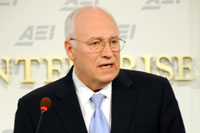 Cheney went beyond his usual monotone delivery. He set himself up as a “freer man” who ostensibly could now speak his mind outside the constraints of politics. The speech he then went on to deliver was fraught with nothing but politics — betraying how much he desires to extend his political influence beyond office and shore up his tortured legacy. The familiar litany of dubious assertions he made about covert Bush administration programs, from spying inside the United States to “enhanced interrogations” of captured terrorists, will be debunked yet again across the media.
But what of his naked disdain for one of the nation’s most respected news gathering institutions? Cheney emphasized that the Bush government’s Terrorist Surveillance Program “prevented attacks and saved lives,” despite that no clear evidence of that has ever emerged. “The program was top secret, and for good reason,” he said, “until the editors of the New York Times got it and put it on the front page.” He noted how, after September 11, 2001, the Times had spent months publishing the pictures and the stories of everyone killed by al-Qaeda in the terrorist attacks. “Now here was that same newspaper publishing secrets in a way that could only help al-Qaeda,” he sneered. “It impressed the Pulitzer committee, but it damn sure didn’t serve the interests of our country, or the safety of our people.”
(This was derision crafted in advance, no less; his prepared remarks, as posted on AEI’s web site, contained the emphatic “damn sure” phrase.)
Political opponents in general were the target of Cheney’s wrath for not seeing all the “exacting efforts to do a hard and necessary job and to do it right” when it came to CIA operatives subjecting captured terrorists to such measures as mock execution by drowning.
“We hear from some quarters nothing but feigned outrage based on a false narrative,” Cheney said. “In my long experience in Washington, few matters have inspired so much contrived indignation and phony moralizing as the interrogation methods applied to a few captured terrorists.”
At several turns Cheney directly attacked President Obama — by most counts unusual behavior from a top member of a preceding administration against a sitting president. Noting that Obama “reserved for himself the authority to order enhanced interrogation after an emergency,” Cheney scorned the president: “When they talk about interrogations, he and his administration speak as if they have resolved some great moral dilemma in how to extract critical information from terrorists. Instead they have put the decision off, while assigning a presumption of moral superiority to any decision they make in the future.”
Another terrorist attack on Americans is not a matter of if but when. It may come at a Bronx synagogue. It may come in Minneapolis.
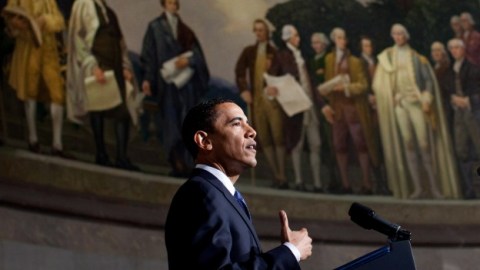 In his own speech on Thursday, Obama acknowledged the danger. “Neither I nor anyone can stand here today and say that there will not be another terrorist attack that takes American lives.” Yet, though his speech at the National Archives in Washington was delivered just prior to the former vice president’s on Thursday, it couldn’t have been a clearer rebuke of the Cheney doctrine:
The American people are not absolutist, and they don’t elect us to impose a rigid ideology on our problems. They know that we need not sacrifice our security for our values, nor sacrifice our values for our security, so long as we approach difficult questions with honesty and care and a dose of common sense. That, after all, is the unique genius of America. That’s the challenge laid down by our Constitution. That has been the source of our strength through the ages. That’s what makes the United States of America different as a nation.
I can stand here today, as President of the United States, and say without exception or equivocation that we do not torture, and that we will vigorously protect our people while forging a strong and durable framework that allows us to fight terrorism while abiding by the rule of law. Make no mistake: If we fail to turn the page on the approach that was taken over the past several years, then I will not be able to say that as President. And if we cannot stand for our core values, then we are not keeping faith with the documents that are enshrined in this hall.
The outcome of last November’s election was in part a popular rejection of the politics of fear. After eight years of Bush-Cheney governance, from the mess at Guantanamo Bay to the mess in Afghanistan, there are no clear or easy solutions. But on a day of charged, dueling speeches, at least there can be no confusion about which of the two voices has the power to act on the nation’s behalf.
Untold damage of Iraq and Afghanistan
Filed under: media, politics | Tags: Afghanistan, foreign affairs, health, media, national security, politics, terrorism, war
Leave a comment In recent months the war in Iraq had mostly retreated from the national headlines. It took the disturbing news of an American soldier apparently gunning down five of his fellow servicemen in a Baghdad “combat stress clinic” to jump-start any major media coverage. The killings provided the kind of sensational firepower the cable news networks seem to require for any sustained coverage — but the incident also highlighted a grave problem, one that America increasingly will have to confront as two long wars go on.
New York Times columnist Bob Herbert says that he “couldn’t have been less surprised” by the fratricide in Baghdad. “The fact that this occurred at a mental health counseling center in the war zone just served to add an extra layer of poignancy and a chilling ironic element to the fundamental tragedy,” he wrote on Tuesday. “The psychic toll of this foolish and apparently endless war has been profound since day one. And the nation’s willful denial of that toll has been just as profound.”

A Washington Post report on Sunday laid out the bleak metrics for anyone who might care to look:
Since 2001, nearly 1 million soldiers have deployed to Iraq and Afghanistan, and more than 300,000 of them have served multiple combat rotations, most lasting 12 to 15 months. Currently there are 160,000 soldiers in those war zones, and of those, nearly 30,000 are on at least their third or fourth tour, Pentagon data show.
An estimated 20 percent of service members return from the wars psychologically damaged, with depression or symptoms of post-traumatic stress disorder such as nightmares, hyper-vigilance and emotional numbing, according to a Rand Corp. study last year.
That’s tens of thousands of combat veterans with psychological damage.
And there is no end in sight for the predicament — for the near-term at least, the total number of troops in the war zones is going up, with President Obama deploying another 20,000 to Afghanistan.
That escalation sparked debate in a conversation I had with a couple of friends over the weekend regarding Afghanistan and Pakistan. The question we grappled with: Now under Obama’s leadership, what exactly is the U.S. trying to accomplish in the region? None of us could come up with a clear answer.
Steve Coll suggests that Obama’s aid-driven approach is focused on hearts and minds, that it “seeks to alter the daily experiences and thus the political outlooks of Afghan and Pakistani civilians” and thereby drain recruiting pools for the Taliban and Al Qaeda. But as I wrote about here recently, the concurrent heavy use of air power is exacting a counterproductive cost. As Coll also notes: “Four years ago, polls showed that eighty-three per cent of Afghans held a favorable view of the United States; today, only half do, and the trajectory is downward. Persistent civilian casualties caused by air strikes in rural Afghanistan are a major cause of this deterioration.”
That may help explain why a top U.S. military commander would try to mislead the public about U.S. air strikes gone wrong. The foolish thing about that tactic, of course, is that the illusion can’t last for long.
Why Obama is right about the torture photos
Filed under: media, politics | Tags: CIA, FBI, foreign affairs, intelligence, law, national security, politics, terrorism, war
Comments (1) The president’s decision this week not to make public additional graphic photos from U.S. military investigations into torture was the right one. I say that as someone who had a hand in helping make public a large collection of such photos three years ago.
In early 2006, I was part of a team of reporters and editors at Salon that spent many weeks scrutinizing, reporting on and carefully assembling a cache of raw evidence from a classified Army investigation that had been obtained by investigative reporter Mark Benjamin. The culmination of our work was “The Abu Ghraib Files,” a groundbreaking report documenting the notorious Iraq war scandal and its aftermath.
One purpose then of our publishing nearly 300 disturbing images from the Army’s criminal investigation was to help deepen the American public’s understanding of what some members of its military had done. The other essential purpose of our report was to underscore that, two years after the scandal had come to light, nobody above the level of foot soldier in the U.S. military or government had been held accountable — even though it had become clear that the criminal acts sprang from policies crafted and directed at the highest levels of the Bush government.
That failure of accountability remains in place today, to our national discredit. And that should be the primary focus now: The continued pursuit of those responsible for the policies that gave rise to the war crimes.



That’s not to say Obama’s choice was an easy one, particularly given his vows of greater transparency, but I think his cost-benefit analysis here is wise. The nature of the crimes has been documented extensively and is known the world over. Publication of the additional images, based on the contours we have of them from news reports, is not likely to add “any additional benefit to our understanding of what was carried out,” as Obama put it on Wednesday. Allowing past if newly revealed images of intimidation and degradation to be splashed across the media in an explosive news cycle, on the other hand, would likely enrage legions worldwide and do fresh damage to America’s reputation.
Beginning to repair the grave damage done to America’s standing in the world under Bush was part of the great promise of Obama’s election. He’s been off to a strong start, with his gestures of respect for the Muslim world and his reaching out to political adversaries from Tehran to Havana. Perhaps it would be worth the risk of undermining that shift if the torture perpetrated by Americans at Abu Ghraib, Guantanamo Bay and elsewhere somehow remained obscure. But that’s not the case.
Obama did miscalculate with part of his rationale, emphasizing that releasing additional photos could endanger U.S. troops. As Pentagon spokesman Geoff Morrell reiterated in the Washington Post, “With 20,000 additional forces coming into Afghanistan, an election in August and the fighting season in full swing right now, the timing is particularly bad.”
The commander in chief wants to show support for the troops, especially at a time of escalation — but it’s a misguided emphasis, because on its face it aligns Obama too closely with tactics used at the outset of the torture scandal by Bush, Cheney and Rumsfeld as they sought to cover it up. (Unsurprisingly, some on the political left have used this point to pounce on Obama.) Moreover, it’s an unconvincing argument — U.S. troops are already in danger on a daily basis in Iraq, Afghansitan and elsewhere.
More important to consider in all this is the president’s courageous decision recently to declassify Justice Department memos and reignite a national debate, false dogma of Dick Cheney and all, about the policy origins of the disaster. The important development of the week, then, was not Obama’s about-face but the congressional testimony of Ali Soufan, a former FBI agent directly involved in the interrogation of crucial terrorist captives early in the war. Soufan, a highly authoritative source on the matter by most counts, barely stopped short of testifying that George W. Bush and his top officials peddled lies apparently fed to them by the CIA about the interrogation of Abu Zubaydah. (Soufan called the former president’s statements “half truths.”)
Allegations that serious, atop further evidence concerning the authors of the brutal interrogation policy — and there are indications that other revealing memos may be forthcoming — seem to suggest real momentum toward greater accountability, possibly at a much higher level than we’ve seen. That of course is the goal here. Are more grim photos necessary to reach it?
I have friends in the human rights community, some of whom I worked with at length to help expose the troubling national security policies of Bush and Cheney. But I have to disagree with them on this one.
“This essentially renders meaningless President Obama’s pledge of transparency and accountability,” said the ACLU’s Amrit Singh this week, regarding the reversal on the photos. The Obama administration, she said, “has essentially become complicit with the torture that was rampant during the Bush years by being complicit in its coverup.”
It’s an advocacy group’s job to keep the heat on, but that’s rhetoric pretty far gone. It has long been clear that the torture debacle must be resolved to higher account. How best to do that remains up for debate. Meantime, what I see is a president working to navigate treacherous political waters, and doing it mostly with skill and conviction, in a prolonged and painful storm not of his making.
UPDATE 5/24/09: Heartening today to see that I’m in good company on the Op-Ed pages of the Sunday Times, where journalist Philip Gourevitch, who has explored the Abu Ghraib nightmare at great length, underscores why releasing additional photographs wouldn’t tell us anything we don’t already know. After all, as he points out, Dick Cheney has been glad to take credit lately for having terrorists under interrogation slammed against walls or waterboarded.
“Photographs can’t show us that the real bad apples were at the top of the civilian chain of command in Washington,” Gourevitch writes, “but that is what we need to know — or, rather, since we’ve known it and gone along with it for a long time, that is what we need to come to terms with now.”
Daphne Merkin’s literary depression
Filed under: culture, media | Tags: art, books, health, language, media, writing
Comments (2) There is a peculiar quality to “A Journey Through Darkness,” Daphne Merkin’s memoir of chronic depression published this week in the Times Magazine. Her intimate account of lifelong struggle with the disease, centered on her latest stint in a Manhattan psychiatric facility in 2008, evokes the perspective of a highly intelligent, sensitive, deeply troubled soul. Even if the trappings are familiar from numerous other written explorations of the subject, her story seems to shed light on the dark terrain of mental illness by way of an intense personal account.
But an intriguing question sits at the margins: Who, exactly, is telling this story?

Merkin is a skilled writer with a clear command of technique. Memory has been and always will be a writer’s imperfect tool. But something about her in-depth reflection feels a little too… artful. It begins and ends with the bright imagery of ocean beaches, neatly bookending the tale of her latest debilitating episode. There is elevated language and metaphor all over the place. “Soggy as my brain is from being wrenched off a slew of antidepressants and anti-anxiety medications in the last 10 days, I reach for a Coleridgian suspension of disbelief, ignoring the roar of traffic and summoning up the sound of breaking waves,” she writes of an attempt at mental escape from the hospital grounds.
And: “Depression — the thick black paste of it, the muck of bleakness — was nothing new to me.”
And: “When I was awake (the few hours that I was), I felt a kind of lethal fatigue, as if I were swimming through tar.”
And: “I felt as if I were being wished bon voyage over and over again, perennially about to leave on a trip that never happened.”
And: “In truth there was more uncharted time than not, especially for the depressives — great swaths of white space that wrapped themselves around the day, creating an undertow of lassitude.”
As with that last flourish, there are other assertions of truth telling. Which is not to say her story is untruthful.
Merkin has in the past written publicly about her experience with depression, and to her credit here she points at a vexing problem of distinction — it’s almost as if she’s questioning her own reliability as narrator:
Whatever fantasies I once harbored about the haven-like possibilities of a psychiatric facility or the promise of a definitive, once-and-for-all cure were shattered by my last stay 15 years earlier. I had written about the experience, musing on the gap between the alternately idealized and diabolical image of mental hospitals versus the more banal bureaucratic reality. I discussed the continued stigma attached to going public with the experience of depression, but all this had been expressed by the writer in me rather than the patient, and it seemed to me that part of the appeal of the article was the impression it gave that my hospital days were behind me. It would be a betrayal of my literary persona, if nothing else, to go back into a psychiatric unit.
Certainly a writer aims to convey an experience as vividly as possible. Merkin’s work gives the sense she is deeply invested in sorting out her experience, both for herself and for her audience. (Having that audience, as she seems to know, could be a particularly complicating factor.) Yet as carefully constructed as it is, something about her story feels distinctly blurred.
Maybe it’s of a piece with a vexing question about the treatment of mental illness, one I’ve often puzzled over when concerned for people I know who are afflicted: Where, exactly, is the line between the physical and the psychological?
In that respect Merkin’s deliberate prose does little to help us out of the dark.
A dream come true for Osama Bin Laden
Filed under: media, politics | Tags: Afghanistan, foreign affairs, intelligence, national security, osama bin laden, politics, terrorism, war
Comments (2) It may yet be too early to say whether the protracted conflict in Afghanistan is an American quagmire of the kind Osama Bin Laden dreamed, but recent developments seem not to bode well.
It’s rare for a top U.S. military commander in a war zone to be relieved of duty before his tour is even halfway complete, but that’s precisely what occurred Monday, in what the Washington Post described as “a hastily convened” Pentagon news conference. Gen. David McKiernan, the commander on his way out, just last week sought to persuade reporters that recent U.S. air strikes in Afghanistan were not responsible for numerous civilian deaths. Turns out they were responsible for at least some of the deaths. (It remains unclear whether insurgents also were responsible for some.) Secretary of Defense Robert Gates gave only a vague explanation for McKiernan’s ouster, citing the need for “fresh thinking” and “fresh eyes on the problem” of seven years and counting. Whatever the specific reasons, the unusual shakeup makes clear that behind the scenes there are serious doubts about current U.S. strategy.
 The prolific bombing component of it, however, appears to remain intact. Despite outcry over a long-term pattern of civilian casualties, including from Afghanistan’s own leader Hamid Karzai, President Obama’s National Security Advisor James L. Jones said on Sunday that the U.S. has no intention of ceasing air strikes.
If the recent trend is any indication, in the days to come Afghanistan can expect to be hit with an awful lot of U.S. firepower from above. As the Navy Times reported last week:
Air Force, Navy and other coalition warplanes dropped a record number of bombs in Afghanistan during April, Air Forces Central figures show. In the past month, warplanes released 438 bombs, the most ever.
April also marked the fourth consecutive month that the number of bombs dropped rose, after a decline starting last July. The munitions were released during 2,110 close-air support sorties.
The actual number of airstrikes was higher because the AFCent numbers don’t include attacks by helicopters and special operations gunships. The numbers also don’t include strafing runs or launches of small missiles.
The announcement of Lt. Gen. Stanley McChrystal to replace McKiernan would seem to indicate a rising emphasis on unconventional warfare. McChrystal is credited as the architect of successful special operations tactics in Iraq, including the storied operation that killed terrorist kingpin Abu Zarqawi in 2006. (See this captivating account of the mission by Mark Bowden that appeared in The Atlantic.) The problem of course is that in Afghanistan the U.S. is confronting an elusive enemy in far more forbidding terrain.
Congress, it seems, has plenty to ponder this week as it considers plowing additional stockpiles of money into a long war with no end in sight.
How Afghanistan could be Obama’s Vietnam
Filed under: media, politics | Tags: Afghanistan, foreign affairs, intelligence, national security, politics, terrorism, war
Comments (1) Let’s be honest: The presidential summit with the leaders of Afghanistan and Pakistan on Wednesday put only the thinnest gloss of hope on what America faces in the imperiled region. Behind the diplomatic show, immense challenges remain to dealing with a powerful extremist insurgency. What nobody dares to admit is that America may well be fighting another war that, at least in its current form, it cannot win.
One troubling pattern evoking quagmire — in progress for years now — is how the U.S. keeps seeking to bomb its way out of the mess. The high civilian death toll of U.S. air strikes earlier this week continues a disturbing trend — and media spin deployed by U.S. military commanders has included a kind of misdirection that should set off alarm bells. It’s reminiscent of messaging that was commonplace during the war in Southeast Asia four decades ago.
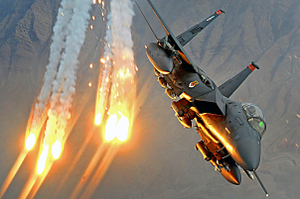
F15 over Afghanistan, Dec. 2008. (U.S. Air Force photo.)
With an investigation of the latest bombing incident underway on Wednesday, the senior U.S. commander in Afghanistan, Gen. David McKiernan, cautioned that the reports of civilian casualties might not withstand scrutiny. “It is certainly a technique of the Taliban and other insurgent groups to claim civilian casualties at every event,” he told reporters. In a follow-up report, McKiernan declined to give any details but said, “We have some other information that leads us to distinctly different conclusions about the cause of the civilian casualties.”
Perhaps that’s the case. The U.S. has made efforts to reduce civilian casualties in recent years with precision air strikes. The nonpartisan advocacy group Human Rights Watch has documented in the past how the civilian death toll caused by militant extremists in Afghanistan has far exceeded the toll caused by U.S. and NATO forces there.
But in another insurgent war in which identifying the enemy is often difficult at best, the grim reality is that U.S. military operations have resulted in many civilian deaths. More than 2,000 Afghan civilians were killed last year alone, according to the United Nations. It has produced a mood of “real hatred,” according to an unnamed Western diplomat quoted in the New York Times on Wednesday. “You have seen some incidents that produce a limited number of casualties but the resulting recruitment for the Taliban is enormous,” he said.
An in-depth analysis published in Foreign Policy earlier this year, coauthored by two veterans of America’s ongoing wars, confirms that view in stark terms:
In 2005, the coalition conducted 176 close air support missions (in which aircraft conduct bombing or strafing in support of ground troops) in Afghanistan. In 2007, it completed 3,572 such missions. Bombs — even “smart” bombs — are blunt instruments, and they inevitably kill people other than their intended targets. Each civilian death at the hands of the coalition further diminishes the finite amount of goodwill toward the United States among the Afghan people. Each civilian death undermines the legitimacy of the Afghan government the United States seeks to support. Each civilian death, when refracted through the Taliban’s propaganda campaign, strengthens the narrative of America’s enemies.
As Obama sends 20,000 additional troops to the war zone, how much longer can it really last?
Not even the best and the brightest seem prepared to say. Gen. David Petraeus, now in charge of U.S. military operations in the region, is widely considered to be among the most brilliant counterinsurgency strategists around. This was his view of U.S. involvement in Afghanistan as stated to Foreign Policy’s Susan Glasser in an interview earlier this year: “I told [then] Secretary Donald Rumsfeld in September 2005 that Afghanistan would be the longest campaign in the so-called ‘long war.’ That judgment was based on an assessment I conducted in Afghanistan on my way home from my second tour in Iraq.”
And three years later? “Having been back to Afghanistan twice in recent months,” Petraeus said, “I still see it that way.”
UPDATE: Regarding the initial comments above from Gen. McKiernan, we now have this from the Times late Thursday: “Initial American military reports that some of the casualties might have been caused by Taliban grenades, not American air strikes, were ‘thinly sourced,’ a Pentagon official in Washington said Thursday, indicating that he was uncertain of their accuracy. ‘It looks like at least some of the casualties were caused by the air strikes.'”
Sick with swine flu racism
Filed under: culture, media, politics | Tags: economy, foreign affairs, globalization, health, immigration, media, Mexico, national security, politics, terrorism
Comments (4) The threat of a deadly swine flu pandemic appears to be fading, despite an outbreak of hype that one former CNN reporter says stemmed from the media’s “economic vested interest in promoting the fear.”
But fear may well be lingering — fueled by animosity toward Mexicans — thanks to a rash of comments from some of America’s nastiest right-wing broadcast personalities.
Ignoring news reports that some swine flu victims inside the U.S. likely contracted the virus during recent trips to Mexico, Fox News regular Michelle Malkin asserted: “I’ve blogged for years about the spread of contagious diseases from around the world into the U.S. as a result of uncontrolled immigration.”
“No contact anywhere with an illegal alien!” radio host Michael Savage warned listeners about the contagion threat. “And that starts in the restaurants,” he said, where you “don’t know if they wipe their behinds with their hands.”
As Media Matters for America reported, radio host Neil Boortz stoked fears of a “bioterrorist” plot, asking, “What better way to sneak a virus into this country than to give it to Mexicans?”
Savage also ran with that idea: “There is certainly the possibility that our dear friends in the Middle East cooked this up in a laboratory somewhere in a cave and brought it to Mexico knowing that our incompetent government would not protect us from this epidemic because of our open-border policies.” He suggested terrorists may realize that Mexicans “are the perfect mules for bringing this virus into America.”
 Rush Limbaugh ranted about an Obama administration conspiracy to use both the swine flu scare and the renewed debate over torture “to cover up the mess that is the United States of America right now.” (One wonders if he’s including Dick Cheney’s prominent role in the latter.)
While such ugliness from this bunch is predictable, it’s worth remembering that these folks have sizeable to large audiences. Moreover, the rank xenophobia underscores an uneasy truth: America has yet to contend in a serious way with its enormous immigration problem.
Obama continues promising to do so, as when he campaigned for president. The task, like many others since last fall, has been swallowed up in the nation’s economic maelstrom — but it’s inextricable. (So is overhauling health care in Obama’s view.) As Colin Powell emphasized when I interviewed him back in 2007 — not long after immigration had commanded headlines in a national election cycle — dealing with the issue is at once a moral and economic imperative. In an hour-long conversation covering much political ground, Powell’s comments on the matter stood out. We should do everything we can, he said, to admit people legally, dry up the flow of illegals and defend our borders. “But let’s recognize that these folks, whether legal or illegal, are making an enormous contribution to America’s well-being. They do the jobs that others don’t want to do.”
He continued: “It’s outrageous for us to take advantage of this population of 12 million people, to use them to cut our grass and build our houses and repair our streets, but keep them illegal and subject to deportation. That’s not equitable — that’s not America. We have to find a dignified way to work through with this population.”
With the swine flu scare, the unpleasant opportunism of the far right reflects how incredibly far we still have to go.
This is your senator on Twitter
Filed under: culture, media, politics | Tags: language, media, poetry, politics, technology, Twitter
Comments (1) In a column last weekend Matt Bai argued that Capitol Hill’s growing infatuation with the micro-blogging service is the last thing D.C. needs. His analysis in terms of the political culture is persuasive. But poke around on a few politicians’ Twitter pages and there’s a simple reason the trend deserves to be voted down posthaste: Washington’s minute-by-minute musings are, for the most part, epically dull.


A universe more than 140 characters has been typed about the greater Twitter phenomenon. At this late date the triviality of bazillions of “tweets” is no secret. But additionally there’s even something micro-insulting about the daily minutiae dispatched by elected officials. It purports to be about transparency, or even intimacy, but essentially it’s a ceaseless stream of micro-campaigning. Even if it’s utterly uninteresting:
Sen. Chris Dodd:
Holding an Executive Session in the Banking Committee to vote on a few HUD, Treasury, and Export-Import Bank nominations.
7:17 AM Apr 28th from txt
Sen. Chuck Grassley:
4hr healthcare mtg turned into 6 hr mtg. Took up all day. Watch my cable show tonight on mediacom. 630pm CST. U can ask questions.
3:50 PM Apr 29th from txt
Rep. Steve Israel:
Heading to DC. This week’s legislative schedule: hate crimes bill and credit card consumer protections.
12:17 PM Apr 27th from twitterrific
Rep. Darrell Issa:
On the way home to San Diego sunshine (fingers crossed…but we need the rain!)
about 3 hours ago from TweetDeck
As a member of the opposition party, at least Issa is willing to add a tad of zing:
Had fun watching the staff photoshop. Let’s just say Obama could’ve saved us a cool million using that instead of buzzing manhattan in AF1!
2:42 PM Apr 28th from TweetDeck
There is indeed a certain awkwardness to some of it given the pretense of informal and personal. See John McCain, in an oddly self-aggrandizing moment:
Sec. Napolitano confirmed Swine Flu has spread to 4 new states including AZ. I call on the Admin to do more to prevent further outbreaks!
08:42 AM Apr 29
Of course, staffers are probably behind much of the messaging. Though apparently not in Claire McCaskill’s case:
I have strict policy. I write every tweet and tumblr blog. These are my thoughts and my words. Really. For good or for bad……
5:06 AM Apr 28th from web
For good or for bad, or, as Bai noted, for her fast food faves:
I get old style crunchy taco, and a chicken burrito supreme & Diet Coke at Taco Bell. Miss those tostados.
2:06 PM Mar 12th from web
 It seems Twitter functions much more effectively as a portal into the world of celebrity entertainment. There must be a good reason that CNN is locked in a popularity showdown with Ashton Kutcher. Or that Snoop Dogg has 195,862 followers:
been 4 dayz since been of here. Happy 420 ma twizzles may all your smokn dreams come true!! yeezzzziiirr!!
1:25 PM Apr 20th from web
Fa shizzle.
At times Twitter has proven strikingly useful as a tool for disseminating information; its profile shot up per a role in covering major news events such as when terrorists struck in Mumbai and when a jetliner ditched into the Hudson River. As an additional tool for journalists — or for anyone seeking to report or share information quickly — its potential is undeniable.
If you’re at a loss, though, to find much that’s culturally meaningful about the Tweet-geist at this point — I confess that I am, still preferring my short-form poetry on the page or in person — New York Magazine appears eager to help with its freshly posted Twitter Approval Matrix. Apparently not many pols have made the cut. Meanwhile, you’d think that someone commanding as much attention as Sarah Palin — who just jumped into the Twitter fray this week — might give the lot a boost. As of this post, her first six tweets aren’t even interestingly banal enough to quote.
You can find your favorite lawmaker’s latest by way of Tweet Congress.
Don’t all click at once.
 Mark Follman
You must be logged in to post a comment.