Archive for the ‘culture’ Category
Black clouds over Tehran
Filed under: culture, media, politics | Tags: foreign affairs, globalization, Iran, law, media, national security, politics, technology, Twitter
 Comments (1)
 There will be blood — much more of it, if need be — was the implicit message from Ayatollah Khamenei at Friday prayers in Tehran. “Struggling on the streets after elections is not acceptable,” the Iranian Supreme Leader said. “If they do not stop these actions, then any consequences will be their responsibility.”
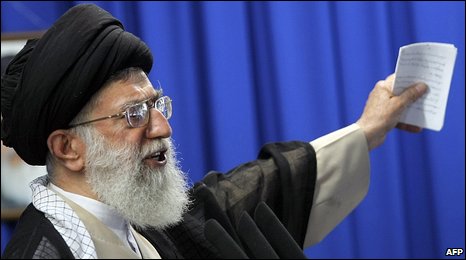
Khamenei emphasized that the Islamic republic would never “commit treason” by manipulating votes, that the country’s legal system does not allow vote-rigging. Mahmoud Ahmadinejad’s large margin of victory — supposedly by 11 million votes — proved that the election could not have been fixed, Khamenei said.
Many Iranians, and people around the world, understand that’s a lie. As Stanford University’s Abbas Milani noted on CNN Thursday night, numerous towns across Iran had reported vote totals for Ahmadinejad amounting to more than 100 percent of their resident populations.
But in Iran the fist, not the facts, likely will prevail.
 Neil MacFarquhar reports on the violence unleashed in Iranian cities at night since last Friday’s election, with the vigilante thugs known as Basijis beating, looting and sometimes gunning down protesters they tracked during the day. Says one Iranian exile who helped found the Revolutionary Guards during the 1979 Islamic revolution: “It is the special brigades of the Revolutionary Guards who right now, especially at night, trap young demonstrators and kill them.”
If mass protests continue, as seems almost certain, more violence will spill into broad daylight, whether or not any foreign media is left inside the country to document it.
UPDATE: The Times’ Lede blog has a source in Tehran describing the use of Twitter — apparently less instrumental in organizing street demonstrations, while “primarily being used to communicate with the outside world.”
Regarding prospects for greater violence and ultimate political outcome, Steve Clemons shares an interesting dispatch from “a well-connected Iranian internationalist” who has been in Tehran during the post-election unrest. The source describes witnessing young Mousavi supporters in the streets at night, fighting back by “hunting” Basijis. He describes them as agile “militia style” groups, including “a surprising number of girls.”
Iran election upheaval continues
Filed under: culture, media, politics | Tags: foreign affairs, globalization, Iran, media, national security, politics, technology, Twitter
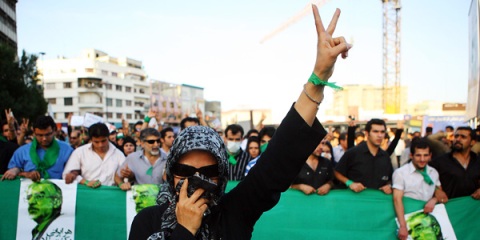
Comments (3) Trading in their bright green for black, hundreds of thousands of protesters marched again in Iran on Thursday, urged by presidential challenger Mir Hossein Mousavi to mourn the students killed during demonstrations earlier in the week. Photographer Saeed Kamali Dehghan documented the action for the Guardian in Tehran’s Imam Khomeini square:


 NPR’s Mike Shuster reports that members of the Basij, the feared Iranian paramilitary group, have instigated violence under cover of darkness — apparently to help justify a more forceful crackdown against the opposition movement, which by most accounts largely has remained peaceful. One eyewitness report includes a thug exploding an incendiary grenade under a car.
The extraordinary role of digital media in the upheaval remains a hot topic, now including some obligatory contrarianism from the veteran journo corps. (Any hot story in the media tends to provoke both herd-like hyperventilation and a subsequent above-the-fray backlash.) Slate’s Jack Shafer questions the noise-to-signal ratio of the gangbusters #IranElection Twitter stream and points to a potential dark side: “How long before the secret police start sending out organizational tweets — ‘We’re massing at 7 p.m. at the Hall of the People for a march to the Hall of Justice!’ — and busts everybody who shows up?”
Business Week’s Joel Schectman wonders if the “Twitter revolution” has been overblown: “Iran experts and social networking activists say that while Iranian election protesters have certainly used social media tools, no particular technology has been instrumental to organizers’ ability to get people on the street.”
Sure, it’s a worthwhile reminder not to get too utopian about the empowerment of digital technology, especially as the foreign media gets pushed out of the country — but the bottom line is clear: Media control has long been a powerful, essential weapon of the Iranian regime. Twitter, Facebook and blogs increasingly are powerful forces toward neutralizing that weapon. According to Abbas Milani, director of the Iranian Studies Program at Stanford University, Iran has the highest number of bloggers per capita in the world. No matter the outcome of Iran’s historic turmoil, they will continue to be heard.
Twitter as unstoppable diplomacy in Iran
Filed under: culture, media, politics | Tags: foreign affairs, globalization, Iran, language, media, national security, politics, technology, Twitter
Comments (5) The Guardian reports an estimated half million people protesting in Tehran on Wednesday, the fifth day of unrest. Despite President Obama’s cautious posture thus far, the Iranian regime has now begun to openly blame the United States for interfering in the election and inciting upheaval. As the vulnerabilities of the regime and its Supreme leader, Ayatollah Khamenei, have become more apparent, the tactic undoubtedly is aimed at undercutting an opposition movement in a country where anti-U.S. sentiment still exerts a powerful pull. It seems to have an out-of-touch air of desperation to it — blame the ol’ Great Satan, and maybe the masses will fall back in line with renewed nationalist fervor. The problem is, those masses now see Barack Obama, not George W. Bush, presiding in the White House. (Not to mention the price of tomatoes in Tehran.)
The situation on the ground appears to be growing more ominous. According to a Reuters report from Wednesday, Mohammadreza Habibi, the senior prosecutor in the central province of Isfahan, declared that demonstrators could be executed under Islamic law. “We warn the few elements controlled by foreigners who try to disrupt domestic security by inciting individuals to destroy and to commit arson that the Islamic penal code for such individuals waging war against God is execution,” Habibi reportedly announced.
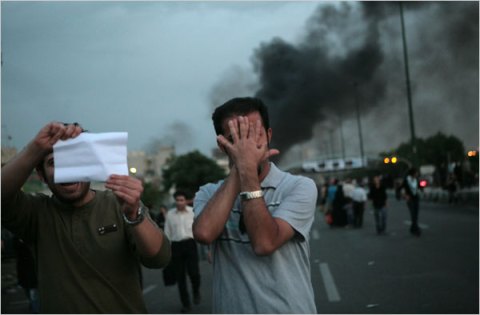
Protesters in Tehran, June 15. (Newsha Tavakolian/Polaris/New York Times)
Other dispatches from Wednesday described the regime further cracking down on digital communications. In one particular way, it’s an area where official U.S. involvement indeed appears to have been instrumental, in terms of the extraordinary role Twitter has played following the election upheaval. With the messaging network set to go offline temporarily earlier this week, the U.S. State Department stepped in. The Times reports:
On Monday afternoon, a 27-year-old State Department official, Jared Cohen, e-mailed the social-networking site Twitter with an unusual request: delay scheduled maintenance of its global network, which would have cut off service while Iranians were using Twitter to swap information and inform the outside world about the mushrooming protests around Tehran. The request, made to a Twitter co-founder, Jack Dorsey, is yet another new-media milestone: the recognition by the United States government that an Internet blogging service that did not exist four years ago has the potential to change history in an ancient Islamic country.
“This was just a call to say: ‘It appears Twitter is playing an important role at a crucial time in Iran. Could you keep it going?’” said P.J. Crowley, the assistant secretary of state for public affairs. Twitter complied with the request, saying in a blog post on Monday that it put off the upgrade until late Tuesday afternoon — 1:30 a.m. Wednesday in Tehran — because its partners recognized “the role Twitter is currently playing as an important communication tool in Iran.”
The global interconnection helping to electrify Iran’s history in the making has been on display in myriad ways over the last few days. This morning I was able to zoom in on one specific example of it: After I’d written here yesterday about a UK blogger’s “#Iranelection cyberwar guide” — which soon vanished from the Web and remains missing as of Wednesday morning Pacific time — I’d also put the link out via my Twitter page. By early this morning at least one person apparently located in Tehran had read and re-tweeted it. (See tweet there with: “http://bit.ly/mfo0i #iranelection”) That quickly led to a burst of referral traffic coming to my site from that person’s Twitter feed. You can imagine the exponential spread to follow. Multiply that by millions of other blog posts and tweets, and you start to see the extraordinarily powerful picture of communication.
As I noted yesterday, there isn’t necessarily any way to verify the particular Twitter user’s location or identity — is it really some young woman, a spark in her eyes, now leaving her dorm room for the massive demonstration in Tir square? — and it’s just one little example of precisely why the Iranian regime will not be able to stem the digital tide.
UPDATE 12:30pmPDT: As K.M. Soehnlein points out, the crackdown on foreign journalists inside Iran raises a disturbing contrast. The Times surveys the latest circumstances, and it’s chilling to read. Most journalists allowed into Iran only get one-week visas, and their numbers are fast dwindling:
“Visa extensions have been denied across the board,” says Times executive editor Bill Keller, who has himself been reporting from Tehran this week. “Some reporters have considered staying on without visas, working under the radar. There are two problems with that. First, this is a fairly efficient police state; the chances of anyone eluding arrest long enough to see how the story plays out are slim. More important, in my mind, is that it puts at risk the decent, hospitable Iranians who would be needed to put us up, translate and help us get the story out.”
Many Western journalists were effectively confined to their offices on Tuesday after the information ministry forbid them to report on protests or conduct interviews outside, according to the Times. Some were told they would be arrested if they were spotted on the streets with a camera.
Jim Sciutto, an ABC News correspondent in Tehran, said the Iranian government had “run out of patience” with the televised images of protests. Until Tuesday, he told the Times by email, “we sensed there was the slightest bit of wiggle room and so we took the risk of filming on our cellphones. But now the message seems to be ‘don’t even think about it.’”
And from Keller’s dispatch above:
For a sense of what may await Iran’s discontented when there is no one around to report on it, consider Monday night in Isfahan, Iran’s third largest city and a five-hour drive from the nearest foreign TV camera. As in Tehran, large parts of the city — the squares and boulevards — were scenes of smoke and flames, tear gas, stones crashing into windows, bloodied heads.
The uprising seemed more organic than organized — groups of a few dozen merging into groups of a few hundred, converging on lines of helmeted riot police officers, chanting “Death to the dictator!”
But in Isfahan the police response seemed far tougher.
At one point, a white S.U.V. with a red ambulance-style light raced up behind a knot of protesters and smashed into them, running one over before racing a few blocks to the protection of the riot police.
It may not be much longer before a lot more blood flows.
Iran’s Twitter revolution goes global
Filed under: culture, media, politics | Tags: foreign affairs, globalization, Iran, language, media, national security, politics, technology, Twitter
Comments (3) It’s been amazing to watch it spread.
“As the embattled government of President Mahmoud Ahmadinejad appears to be trying to limit Internet access and communications in Iran, new kinds of social media are challenging those traditional levers of state media control and allowing Iranians to find novel ways around the restrictions,” reports the New York Times. “Iranians are blogging, posting to Facebook and, most visibly, coordinating their protests on Twitter, the messaging service. Their activity has increased, not decreased, since the presidential election on Friday and ensuing attempts by the government to restrict or censor their online communications.”
The circuitry of the situation in Iran truly has gone global — not only is the world watching, but political and tech junkies everywhere are getting involved in the communications battle. One compelling example: A blogger in Wales, Esko Reinikainen, has posted a #iranelection cyberwar guide for beginners.
“The purpose of this guide is to help you participate constructively in the Iranian election protests through twitter,” Reinikainen says. He offers tips including how to disseminate proxy IP addresses for Iranian bloggers to use, how to help them target repressive Web sites and how to help give them cover: “change your twitter settings so that your location is TEHRAN and your time zone is GMT +3.30. Security forces are hunting for bloggers using location and timezone searches. If we all become ‘Iranians’ it becomes much harder to find them.”
 At the Atlantic, Andrew Sullivan is keeping a running log in bold green lettering of tweets ostensibly flowing from the streets of Tehran and beyond. There isn’t really a way to judge the source or authenticity of the material. (For one thing, there are regular mentions at this point of Iranian security operatives spreading disinformation digitally; meanwhile, if Twitter users worldwide increasingly are posing as Iranians per above, how to identify the real ones?) But assuming a majority of it remains authentic, it’s fascinating reading. A sampling from Tuesday morning:
Tehran hotels under high security to stop Iranians from contacting foreign press
anyone with camera or laptop is attacked in street
i am seeing tweets about a lot of disturbances, arrests, violence in Shahrak Gharb, any reports?
we hear 1dead in shiraz, livefire used in other cities RT
Very scared, I was talkin to myuncle in shiraz and he was so paranoid.
If you hear the forces talking in arabic..BE CAREFUL..these guys are imported in, they are not affraid of suicide bombing and killing
Police the reason of insecurity; Dead students buried by profs
Basij attacking Shiraz and Mashad universities, Shiraz U’s dean resigned
some student killed by the 4a blast in Babol Univ’s dorms; surrounded by Basij forces
Militia still attacking people in sidestreets but main roads are peaceful marchers.
All last night we hear shooting accross Tehran – everyone is full of rumours and stories – many arrests in night
stay safe and I will RT anything you write! The world is watching and history is being made–we bear witness!
UPDATE – 6/16/09, 9:55amPDT: Esko Reinikainen’s blog apparently is now having technical problems — overloaded with traffic, perhaps, or blocked or otherwise shut down. The above link currently leads to an “Account Suspended” page at Justhost.com. Unclear if or when his site will be back up. Reading the comments section on his page earlier this morning, I noted that his “cyberwar guide” had already been linked and copied widely, including translations in Spanish and German. I was working quickly and didn’t think to grab the whole thing, unfortunately. Reinikainen himself had warned of the potential for his site to go down, and encouraged copying it.
UPDATE 2: Wired’s Noah Shachtman digs into the complexities of the battle online, and has more of the copy from Reinikainen’s missing blog post. How all of this ultimately shapes events in Iran remains to be seen, but there can be little doubt about the rising potential of digital communications for political movements, from Tehran to Tiananmen.
Dave Eggers, Peter Orner and more
Filed under: California, culture | Tags: art, books, California, comedy, film, media, San Francisco, writing
Leave a comment I’m at work on a couple of freelance projects that will soon take me back to the great northwest. More bits here in a couple of days; in the meantime, I must recommend a visit to The Rumpus, a great online culture mag launched a few months back in San Francisco.

It’s got entertaining and informative and sexy stuff of all sorts. (Disclosure: A few of my posts have also been published there.) Editor Stephen Elliott recently interviewed Dave Eggers, who has a forthcoming nonfiction book, “Zeitoun,” about the aftermath of Hurricane Katrina as seen through the eyes of a Muslim-American family in New Orleans. I was struck by Eggers’ comments about his collaborative (and exhaustive) approach to the project:
With a book like this, I think you get the most accuracy when you involve your subjects as much as possible. I think I sent the manuscript to the Zeitouns for six or seven reads. They caught little inaccuracies each time. They have to live with the book, of course, as much as I do, so I needed their approval. With What Is the What and with this book, I consider the book as much theirs as mine. So they were intimately involved in every step, as were their extended families. We had many months to get everyone’s approval over everything, to make sure it was accurate.
Eggers recommends an edition of the Quran to read, discusses why he’s optimistic about print in the digital age (“Do we all want to look at screens from 8am to 10pm? There’s room in the world for both online and paper”) and describes some intriguing plans for McSweeney’s to put out a newspaper.
 Absolutely also check out Peter Orner’s new column, “The Lonely Voice.” His appreciative ruminations on the art of the short story are as engaging and illuminating as any literary writing you’ll find online. (Or in print, for that matter.) Not to be missed.
A Titanic for these times
Filed under: culture, politics | Tags: books, Canada, DFW, economy, environment
Comments (1) The June issue of the Atlantic has a look at the mind-blowing Oasis of the Seas, a gargantuan ocean liner forthcoming from cruise company Royal Caribbean International. Its unprecedented scale of apparent luxury surely required feats of engineering. But any awe that inspires would seem to wash away with apprehension of the ship’s untold economic and ecological hubris.
A decade ago, a large cruise ship typically carried in the neighborhood of 2,000 passengers and 1,000 crew members. But in an industry intently focused on swelling its profits no matter the non-fiscal costs, bigger is always better. Ordered in 2006 for $1.4 billion (on the crest ahead of the economic meltdown), the Oasis leaves those old numbers far in its wake. “In November,” writes Rory Nugent, “Royal Caribbean will take delivery of a true sea monster. Now in its final phase of construction, the Oasis of the Seas will be the biggest (longest, tallest, widest, heaviest) passenger ship ever built — and the most expensive. It will dwarf Nimitz-class aircraft carriers and cast shadows dockside atop 20-story buildings. A crew of 2,165 will tend the expectations of up to 6,296 passengers.” (Photos from the official Oasis site.)


According to the Atlantic, the ship has 21 swimming pools onboard, circulating more than 600,000 gallons of water. Passengers are expected to consume another 560,000 gallons per day, including daily production of 110,230 pounds of ice cubes — more than the weight of nine adult male elephants. The Oasis will also function as “its own utility company” with a 100-megawatt electrical grid — which will consume 12 tons of diesel fuel per hour and generate enough juice to power 105,000 homes.
There is a 1,380-seat playhouse onboard, though it’s not even the main attraction. That would be the outdoor “AquaTheater,” which apparently is “wrapped in its own wind-shielded microclimate” and uses nearly 2,000 nozzles to spray water in concert with a Las Vegas-style light show.

A good many people enjoy this kind of thing, the decadent vacation cruise. (Enough of them to support an industry with annual revenues in the tens of billions of dollars.) Based on the intuition that the experience might feel a bit like feasting on a nine-course meal in the middle of an Ethiopian refugee camp, I’ve never had any intention of trying it. David Foster Wallace famously once did. It’s a safe bet that the Oasis of the Seas would have left him royally retching. (His great essay “A Supposedly Fun Thing I’ll Never Do Again,” originally published in Harper’s in 1996 as “Shipping Out,” was made available online by the magazine after his tragic death last fall.)
From Florida to Alaska, the consumptive ships of Royal Caribbean have been in the news before. Seven years ago federal investigators determined that the cruise company had covered up massive environmental malfeasance, despite a case focusing on one of its ships, the Norway, that resolved with a $1 million slap on the wrist. As USA Today reported in November 2002:
Now, some of the federal agents who investigated the case say the company’s pollution went on for much longer and was much worse than the light fine suggests. Environmental Protection Agency agents say — and court records support — that the Norway not only poured hundreds of thousands of gallons of oily bilge water into the ocean. It also dumped raw sewage mixed with hazardous, even cancer-causing, chemicals from dry cleaning and photo development into the waters near Miami for many years.
In the late 1990s, according to that USA Today report, Royal Caribbean had eventually pleaded guilty to 30 criminal charges in Miami, New York, Puerto Rico, Los Angeles, the Virgin Islands and Alaska, and had paid $27 million in fines in 1998 and ’99. By the 2002 news report, it had “implemented a companywide environmental compliance program.”
About to embark with its new mega-ship (click on the first link in this post to zoom in on the above graphic), has it since cleaned up its act? A year ago this week, a Royal Caribbean cruise ship dumped 20,000 gallons of contaminated water just off the coast of Southeast Alaska.
No honeymoon for gay marriage in California
Filed under: California, culture, politics | Tags: California, law, politics, San Francisco
Comments (1) Everybody knew that Tuesday’s ruling on Proposition 8 from the California Supreme Court could only be another charged moment in a long and continuing battle. Even though the 18,000 marriages that followed a favorable court decision here last May will stand, Tuesday’s decision upholding the ban on gay marriage was a near-term victory for social conservatives.
The court had signaled back in March its reluctance to intervene in the ballot initiative process and overturn the will of the voters. But the lone dissenter in the 6-1 decision Tuesday, Justice Carlos Moreno, wrote eloquently (see pp.151-175) about just how much is at stake:
The rule the majority crafts today not only allows same-sex couples to be stripped of the right to marry that this court recognized in the Marriage Cases, it places at risk the state constitutional rights of all disfavored minorities. It weakens the status of our state Constitution as a bulwark of fundamental rights for minorities protected from the will of the majority.
If California invariably serves as America’s cultural vanguard, what seems odd now is how the state appears to be behind the times. Iowa, of all places, is looking more socially progressive. Moreno cited the recent decision striking down a ban on gay marriage by that state’s high court, whose justices pointed out “the long and painful history of discrimination against gay and lesbian persons” in many parts of the country.
Moreno continued: “I realize, of course, that the right of gays and lesbians to marry in this state has only lately been recognized. But that belated recognition does not make the protection of those rights less important. Rather, that the right has only recently been acknowledged reflects an age-old prejudice … that makes the safeguarding of that right by the judiciary all the more critical.”
Reactions on both sides of the ruling have been heated, to say the least, and San Francisco is abuzz with demonstrations.

“Well, looks like religiously inspired hatred has won the day over the values this formerly great nation was founded on,” said one of nearly 1,800 commenters on SFGate.com Tuesday afternoon.
“Its not about equality folks. It’s about bowing down to the homosexual agenda or being called a bigot,” said another.
And as another made clear, the costly battle is far from over: “As expected from a legal standpoint, but nevertheless disappointing from the larger view of justice for all. Back to the voters and if the trend continues Prop 8 will be repealed by a decent majority in 2010. Onward!”
Daphne Merkin’s literary depression
Filed under: culture, media | Tags: art, books, health, language, media, writing
Comments (2) There is a peculiar quality to “A Journey Through Darkness,” Daphne Merkin’s memoir of chronic depression published this week in the Times Magazine. Her intimate account of lifelong struggle with the disease, centered on her latest stint in a Manhattan psychiatric facility in 2008, evokes the perspective of a highly intelligent, sensitive, deeply troubled soul. Even if the trappings are familiar from numerous other written explorations of the subject, her story seems to shed light on the dark terrain of mental illness by way of an intense personal account.
But an intriguing question sits at the margins: Who, exactly, is telling this story?

Merkin is a skilled writer with a clear command of technique. Memory has been and always will be a writer’s imperfect tool. But something about her in-depth reflection feels a little too… artful. It begins and ends with the bright imagery of ocean beaches, neatly bookending the tale of her latest debilitating episode. There is elevated language and metaphor all over the place. “Soggy as my brain is from being wrenched off a slew of antidepressants and anti-anxiety medications in the last 10 days, I reach for a Coleridgian suspension of disbelief, ignoring the roar of traffic and summoning up the sound of breaking waves,” she writes of an attempt at mental escape from the hospital grounds.
And: “Depression — the thick black paste of it, the muck of bleakness — was nothing new to me.”
And: “When I was awake (the few hours that I was), I felt a kind of lethal fatigue, as if I were swimming through tar.”
And: “I felt as if I were being wished bon voyage over and over again, perennially about to leave on a trip that never happened.”
And: “In truth there was more uncharted time than not, especially for the depressives — great swaths of white space that wrapped themselves around the day, creating an undertow of lassitude.”
As with that last flourish, there are other assertions of truth telling. Which is not to say her story is untruthful.
Merkin has in the past written publicly about her experience with depression, and to her credit here she points at a vexing problem of distinction — it’s almost as if she’s questioning her own reliability as narrator:
Whatever fantasies I once harbored about the haven-like possibilities of a psychiatric facility or the promise of a definitive, once-and-for-all cure were shattered by my last stay 15 years earlier. I had written about the experience, musing on the gap between the alternately idealized and diabolical image of mental hospitals versus the more banal bureaucratic reality. I discussed the continued stigma attached to going public with the experience of depression, but all this had been expressed by the writer in me rather than the patient, and it seemed to me that part of the appeal of the article was the impression it gave that my hospital days were behind me. It would be a betrayal of my literary persona, if nothing else, to go back into a psychiatric unit.
Certainly a writer aims to convey an experience as vividly as possible. Merkin’s work gives the sense she is deeply invested in sorting out her experience, both for herself and for her audience. (Having that audience, as she seems to know, could be a particularly complicating factor.) Yet as carefully constructed as it is, something about her story feels distinctly blurred.
Maybe it’s of a piece with a vexing question about the treatment of mental illness, one I’ve often puzzled over when concerned for people I know who are afflicted: Where, exactly, is the line between the physical and the psychological?
In that respect Merkin’s deliberate prose does little to help us out of the dark.
Sick with swine flu racism
Filed under: culture, media, politics | Tags: economy, foreign affairs, globalization, health, immigration, media, Mexico, national security, politics, terrorism
Comments (4) The threat of a deadly swine flu pandemic appears to be fading, despite an outbreak of hype that one former CNN reporter says stemmed from the media’s “economic vested interest in promoting the fear.”
But fear may well be lingering — fueled by animosity toward Mexicans — thanks to a rash of comments from some of America’s nastiest right-wing broadcast personalities.
Ignoring news reports that some swine flu victims inside the U.S. likely contracted the virus during recent trips to Mexico, Fox News regular Michelle Malkin asserted: “I’ve blogged for years about the spread of contagious diseases from around the world into the U.S. as a result of uncontrolled immigration.”
“No contact anywhere with an illegal alien!” radio host Michael Savage warned listeners about the contagion threat. “And that starts in the restaurants,” he said, where you “don’t know if they wipe their behinds with their hands.”
As Media Matters for America reported, radio host Neil Boortz stoked fears of a “bioterrorist” plot, asking, “What better way to sneak a virus into this country than to give it to Mexicans?”
Savage also ran with that idea: “There is certainly the possibility that our dear friends in the Middle East cooked this up in a laboratory somewhere in a cave and brought it to Mexico knowing that our incompetent government would not protect us from this epidemic because of our open-border policies.” He suggested terrorists may realize that Mexicans “are the perfect mules for bringing this virus into America.”
 Rush Limbaugh ranted about an Obama administration conspiracy to use both the swine flu scare and the renewed debate over torture “to cover up the mess that is the United States of America right now.” (One wonders if he’s including Dick Cheney’s prominent role in the latter.)
While such ugliness from this bunch is predictable, it’s worth remembering that these folks have sizeable to large audiences. Moreover, the rank xenophobia underscores an uneasy truth: America has yet to contend in a serious way with its enormous immigration problem.
Obama continues promising to do so, as when he campaigned for president. The task, like many others since last fall, has been swallowed up in the nation’s economic maelstrom — but it’s inextricable. (So is overhauling health care in Obama’s view.) As Colin Powell emphasized when I interviewed him back in 2007 — not long after immigration had commanded headlines in a national election cycle — dealing with the issue is at once a moral and economic imperative. In an hour-long conversation covering much political ground, Powell’s comments on the matter stood out. We should do everything we can, he said, to admit people legally, dry up the flow of illegals and defend our borders. “But let’s recognize that these folks, whether legal or illegal, are making an enormous contribution to America’s well-being. They do the jobs that others don’t want to do.”
He continued: “It’s outrageous for us to take advantage of this population of 12 million people, to use them to cut our grass and build our houses and repair our streets, but keep them illegal and subject to deportation. That’s not equitable — that’s not America. We have to find a dignified way to work through with this population.”
With the swine flu scare, the unpleasant opportunism of the far right reflects how incredibly far we still have to go.
This is your senator on Twitter
Filed under: culture, media, politics | Tags: language, media, poetry, politics, technology, Twitter
Comments (1) In a column last weekend Matt Bai argued that Capitol Hill’s growing infatuation with the micro-blogging service is the last thing D.C. needs. His analysis in terms of the political culture is persuasive. But poke around on a few politicians’ Twitter pages and there’s a simple reason the trend deserves to be voted down posthaste: Washington’s minute-by-minute musings are, for the most part, epically dull.


A universe more than 140 characters has been typed about the greater Twitter phenomenon. At this late date the triviality of bazillions of “tweets” is no secret. But additionally there’s even something micro-insulting about the daily minutiae dispatched by elected officials. It purports to be about transparency, or even intimacy, but essentially it’s a ceaseless stream of micro-campaigning. Even if it’s utterly uninteresting:
Sen. Chris Dodd:
Holding an Executive Session in the Banking Committee to vote on a few HUD, Treasury, and Export-Import Bank nominations.
7:17 AM Apr 28th from txt
Sen. Chuck Grassley:
4hr healthcare mtg turned into 6 hr mtg. Took up all day. Watch my cable show tonight on mediacom. 630pm CST. U can ask questions.
3:50 PM Apr 29th from txt
Rep. Steve Israel:
Heading to DC. This week’s legislative schedule: hate crimes bill and credit card consumer protections.
12:17 PM Apr 27th from twitterrific
Rep. Darrell Issa:
On the way home to San Diego sunshine (fingers crossed…but we need the rain!)
about 3 hours ago from TweetDeck
As a member of the opposition party, at least Issa is willing to add a tad of zing:
Had fun watching the staff photoshop. Let’s just say Obama could’ve saved us a cool million using that instead of buzzing manhattan in AF1!
2:42 PM Apr 28th from TweetDeck
There is indeed a certain awkwardness to some of it given the pretense of informal and personal. See John McCain, in an oddly self-aggrandizing moment:
Sec. Napolitano confirmed Swine Flu has spread to 4 new states including AZ. I call on the Admin to do more to prevent further outbreaks!
08:42 AM Apr 29
Of course, staffers are probably behind much of the messaging. Though apparently not in Claire McCaskill’s case:
I have strict policy. I write every tweet and tumblr blog. These are my thoughts and my words. Really. For good or for bad……
5:06 AM Apr 28th from web
For good or for bad, or, as Bai noted, for her fast food faves:
I get old style crunchy taco, and a chicken burrito supreme & Diet Coke at Taco Bell. Miss those tostados.
2:06 PM Mar 12th from web
 It seems Twitter functions much more effectively as a portal into the world of celebrity entertainment. There must be a good reason that CNN is locked in a popularity showdown with Ashton Kutcher. Or that Snoop Dogg has 195,862 followers:
been 4 dayz since been of here. Happy 420 ma twizzles may all your smokn dreams come true!! yeezzzziiirr!!
1:25 PM Apr 20th from web
Fa shizzle.
At times Twitter has proven strikingly useful as a tool for disseminating information; its profile shot up per a role in covering major news events such as when terrorists struck in Mumbai and when a jetliner ditched into the Hudson River. As an additional tool for journalists — or for anyone seeking to report or share information quickly — its potential is undeniable.
If you’re at a loss, though, to find much that’s culturally meaningful about the Tweet-geist at this point — I confess that I am, still preferring my short-form poetry on the page or in person — New York Magazine appears eager to help with its freshly posted Twitter Approval Matrix. Apparently not many pols have made the cut. Meanwhile, you’d think that someone commanding as much attention as Sarah Palin — who just jumped into the Twitter fray this week — might give the lot a boost. As of this post, her first six tweets aren’t even interestingly banal enough to quote.
You can find your favorite lawmaker’s latest by way of Tweet Congress.
Don’t all click at once.
A fevered case of swine flu hype
Filed under: California, culture, media | Tags: California, foreign affairs, globalization, health, media, Mexico, television, Wall Street
Leave a comment Will the outbreak of the H1N1 virus get historically serious? According to global health experts, the answer is that nobody really knows. Pandemics tend to hit in waves, and the biggest danger could come this winter.
 For now the news media is maintaining its fever pitch as long as possible, of course, hungry to feast at the ratings trough. As one analyst told Howard Kurtz yesterday, “Cable news has 24 hours to fill, and there isn’t 24 hours of exciting news going on. If you scare people, they’ll tune in more.” Still, when flipping past CNBC on Monday afternoon I was a bit shocked to encounter the blaring graphic “Pandemic Pandemonium” accompanying a discussion about reaction on Wall Street. (In fact, the market barely budged early this week.)
Naturally, some news consumers are caught up in the hallucinatory chatter. From an inquiry to Bay Area physician and blogger Doc Gurley — posted, I kid you not, under the headline Swine Flu Sex? — on SFGate today:
Dear Doc,
My husband and I are trying to get pregnant. We’ve just recently “put the pedal to the floor” and are undergoing fertility treatment. Now I’m concerned that I may be putting myself and an unborn fetus at extra risk for the Swine Flu that is wending its way down the pipeline. Included in this concern is the fact that I’ve heard that anti-virus medications can adversely affect a developing fetus, which means it would be a lose/lose case scenario if I had the opportunity to prevent an imminent case in the future. Should we shelve this project for a few months or what?
Gurley replies that pregnant women do have “very mildly” suppressed immune systems. However, she continues, “The fact is, given the way the world (and media coverage) works, there will, undoubtedly, never be a time when the world looks rosy, all-welcoming, and risk-free. Yesterday’s potential nuclear annihilation is today’s swine flu. It’s a wonder, in fact, that any baby ever sticks its head out.”
If they only knew about the likes of AC360 or Countdown with Keith Olbermann.
Mexico, meanwhile, now suffers from a confluence of maladies. As GlobalPost’s Ioan Grillo reports from Tijuana: “Amid a U.S. recession, a fever pitch fear of the Mexican drug war and now an epidemic of swine flu sweeping across Mexico, Humberto Beltran says business at his border city store has nosedived 85 percent this April compared to the same time last year.”
From North America to the Far East, another pressing question has arisen amid the swine flu scare: Is it still OK to love bacon?
UPDATE: As of Wednesday afternoon the World Health Organization has raised its alert level, determining that a “pandemic is imminent.” So too is plenty more cable news yammer.
Google, Kindle and The Library of Babel
Filed under: California, culture, media | Tags: books, California, future-of-journalism, language, law, media, poetry, San Francisco, technology, writing
Comments (1) Technological innovation seems almost strangely commonplace these days, from say, contact lenses that could layer data directly onto your view of the world to robots fighting far-flung wars to computer systems perhaps smart enough to compete on “Jeopardy!” All astonishing developments in their own right, and yet the most profound change of our times may yet be purely informative in nature: The digitization of all that we read.
At the University of San Francisco on Sunday I participated in a symposium on “Life after the MFA” for students graduating the writing program. Unsurprisingly, the technological upending of books, magazines and newspapers was a particular focus. Fellow panelist Patrick Dunagan, a poet who works as a specialist at the USF library, spoke with some alarm about the rate at which books and print periodicals there are going the way of the dodo. The idea is that many are being replaced digitally. I expressed a bit of surprise to him about this afterward, whereby he asked me when I last conducted any research in a library. Point taken. If only Borges were still hanging around and could rejoin the discussion.

One theme I hoped to suggest in my part of the talk was that print vs. digital isn’t a zero-sum equation. We can still love books and newspapers while getting charged about the possibilities of digital publishing. In many ways the latter remains a Wild West — and without a doubt has blown holes in some old ways of doing business. But in my view the rising digital infosphere is far more expansive and generative than it is destructive.
In a recent essay published in the Wall Street Journal, author Steven Johnson explores both the thrill and potential chill of electronic books, a fast-growing realm thanks to Amazon’s innovative e-book reader, the Kindle, and Google’s Book Search service, home to approximately 10 million scanned titles and counting. One exciting aspect Johnson flags with regard to ideas and research:
Before too long, you’ll be able to create a kind of shadow version of your entire library, including every book you’ve ever read — as a child, as a teenager, as a college student, as an adult. Every word in that library will be searchable. It is hard to overstate the impact that this kind of shift will have on scholarship. Entirely new forms of discovery will be possible. Imagine a software tool that scans through the bibliographies of the 20 books you’ve read on a specific topic, and comes up with the most-cited work in those bibliographies that you haven’t encountered yet.
But there will be pitfalls, too, especially with respect to evolving market forces. The all-powerful search engine that is Google, and the ways in which it guides users to digital content of all sorts, could impact how books actually get written:
Writers and publishers will begin to think about how individual pages or chapters might rank in Google’s results, crafting sections explicitly in the hopes that they will draw in that steady stream of search visitors.
Individual paragraphs will be accompanied by descriptive tags to orient potential searchers; chapter titles will be tested to determine how well they rank. Just as Web sites try to adjust their content to move as high as possible on the Google search results, so will authors and publishers try to adjust their books to move up the list.
What will this mean for the books themselves? Perhaps nothing more than a few strategically placed words or paragraphs. Perhaps entire books written with search engines in mind. We’ll have to see.
A strength of Johnson’s essay is that he doesn’t pass judgment on these possibilities; he concentrates on laying out in lucid terms what he sees coming. (Another recent piece of his, on how the web’s information ecosystem changes how we get our news, is also well worth reading.)
The latter segment above, under the subhead “Writing for Google,” got me thinking about a worn adage heard in MFA programs everywhere: “Write what you know.” If that advice translates fundamentally to writing from a place of experience and passion, it could take on fresh meaning in the digital future — when the suggestion to “Write what you can search engine optimize” may well become a growing temptation.
UPDATE: Some wonder if Google already has too much sway with its Book Search service, including the U.S. Department of Justice.
 Mark Follman
You must be logged in to post a comment.