Archive for the ‘culture’ Category
Sex commune and the city
Filed under: California, culture | Tags: California, politics, San Francisco
 Comments (1)
 Ah, San Francisco, you gotta love this town. And loving it must include acknowledging that from time to time certain of its, um, cultural stimulations can seem a bit absurd. This was on display yesterday in the Sunday Styles section of the New York Times, which reported on the One Taste Urban Retreat Center, a 38-member live-play arrangement housed in “a shabby-chic loft building” in the city’s South of Market district. Its men and women (their average age the late 20s, the Times says) make meals together, practice yoga and meditation, and run communication workshops for groups of visitors. Oh, and also:
At 7 a.m. each day, as the rest of America is eating Cheerios or trying to face gridlock without hyperventilating, about a dozen women, naked from the waist down, lie with eyes closed in a velvet-curtained room, while clothed men huddle over them, stroking them in a ritual known as orgasmic meditation — “OMing,” for short. The couples, who may or may not be romantically involved, call one another “research partners.”
Apparently there are benefits to this of all sorts. One recently divorced man, “a baby-faced 50-year-old Silicon Valley engineer,” told the Times that “the practice of manually fixing his attention on a tiny spot of a woman’s body improves his concentration at work.”
Past practices at the center, which has been operating for over four years, include naked yoga. Anyone who has ever participated in a public yoga class knows this would be a remarkably ill-advised idea, no matter the direction in which it might be stretched. One Taste reportedly discontinued it after word got around and “many voyeuristic non-yogis showed up.” (Ya don’t say.)
San Francisco and surrounds has a well-known heritage, of course, of communal sexual experimentation and spiritual seeking. As far as I know per the history books, combining the two has never led to any particularly enlightening results.

What I find intriguing about this story isn’t a matter of morals or taste — it’s that the language and marketing themes are age-old, and not newly convincing. One Taste’s web site says that “Orgasmic meditation is a technique that develops mindfulness, concentration, connectedness and insight in a paired practice that focuses on sensation generated through manual stimulation of the genitals.” The practice can “facilitate greater physical and mental health, deeper connection to relationship” and can even be “a method for spiritual aims.”
In the Times report, a once timid patron turned instructor speaks of “the lingering velocity of my desire and my hesitation to give into it.” The proprietor and leader, Nicole Daedone, admits “a high potential for this to be a cult.” And while the article notes toward the end that Daedone’s current boyfriend, a wealthy software entrepreneur, “makes financial resources available” in support of the business, curiously, one stone remains unturned: cash flow. One Taste’s own program listings are also conspicuously absent information about what its participants are required to pay.
About that big Jim Cramer beatdown
Filed under: culture, media, politics | Tags: economy, recession, television, Wall Street
Comments (7) Jon Stewart is getting showered with praise for his showdown with CNBC’s Jim Cramer Thursday night on “The Daily Show.” The culmination of a week-long “feud” (egged on by the salivating media at large) was riveting to watch. (The video is here.) Stewart, long a savvy media critic, brutalized Cramer both for his own and the financial news network’s direct role in the economic meltdown that has vaporized untold wealth and hobbled the United States of America.
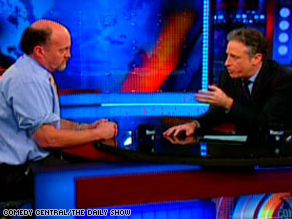
If that sounds a tad overdone, well, indeed. There is plenty of truthiness in Stewart’s point. It’s easy to sift through footage from various CNBC shows and find no shortage of their hosts making wrong calls about the financial markets, cheering on suspect CEOs and exuding what in hindsight was obviously misguided optimism about the economy and the stock market. Not to mention analyst Rick Santelli’s puerile, faux-populist tirade last month about the mortgage crisis.
But there is also some intellectual dishonesty suffusing the big CNBC takedown so in vogue right now. It’s easy to level simplistic snark at the network per above. But few seem willing, Stewart included, to acknowledge what the popular financial news network is mostly about, as I wrote about here recently: daily infotainment, emphasis on tainment.
Let’s be honest, we’re all plenty hungry at present for the villains of Wall Street to be strung up in the town square. But blame-the-media is the easy way out. It’s a bit silly to assign the degree of culpability that Stewart just did to a guy who, on his daily stock picking show, bounces around detonating obnoxious sound effects and exclaiming “Booyah!” like a frat guy on meth.
Stewart has other smart thinkers in the media following right along. David Brancaccio, host and senior editor of “Now on PBS,” told CNN that Thursday night’s show marked an important moment in journalism, especially for financial reporting, and that it may serve as a cautionary tale for those in the media who would fail on due diligence. “I don’t think any financial journalist wants to be in Cramer’s position,” Brancaccio said. “I think [journalists] may redouble their efforts to be dispassionate reporters asking the tough questions.”
That’s just goofy. Jim Cramer is not a financial journalist. He’s a self-cultivated nut-job host of a popular sideshow for Wall Street wonks. His script brims with speculative investment ideas, clumsy jokes and useless if marginally entertaining financial prattle.
The truth of the matter is that while CNBC certainly is ripe to take some lumps in this new era of Great Recession, the network is the easiest of targets. It’s also worth noting that there is substantive reporting in its mix. Last month, in fact, I spent some time interviewing CNBC anchor Maria Bartiromo and correspondent Bob Pisani at the New York Stock Exchange for a forthcoming magazine article about the financial media. Mostly I found them to be informed, thoughtful and dedicated to their work as reporters. For one example, see the high marks Bartiromo got for grilling ex-Merrill Lynch CEO John Thain on her show back in January. For another, watch this recent Frontline documentary, which recounts how in spring 2008 CNBC reporter David Faber helped pull the curtain back on Bear Stearns and impacted the timing of the investment bank’s collapse.
No doubt they and others on the network also had craven moments of their own during the boom times. As did so many in American government, business and, yes, out there in TV-viewing land. A dramatic and bloody round of the blame game is quite satisfying to watch right now, especially in the able hands of Mr. Stewart, but the culpability for our economic predicament extends far, far beyond the spectacle of one television channel.
Precisely the poet we needed
Filed under: California, culture | Tags: books, California, comedy, language, media, poetry, San Francisco, writing
Comments (2) Kay Ryan was in town for a reading on Friday night at the San Francisco Center for the Book. It was packed. It occurred to me it was absolutely right she’d become our U.S. Poet Laureate in a time of so much turmoil near and far. The universe has a way of balancing itself, even when it seems barely to be standing on one foot. Some comic concision to cut through all the gloomy cacophony—just the thing.
 I’ve been an admirer for years of Ryan’s pithy assessments. They seem even more necessary right now, and not just for their luminous resuscitation of dead language and reanimation of cliché. As she put it on Friday, one of her interests has been considering extremity and trying to “cool things down” a bit. Claims found in “Ripley’s Believe it or Not!” became the source for her latest collection The Jam Jar Lifeboat & Other Novelties Exposed. The poem “Murder at Midnight” departs from Ripley’s assertion that “If everyone who was told about it told two other people within 12 minutes, everybody on earth would know about it before morning.” Determines Ryan:
But people would begin getting it
a little bit wrong. Long before daylight,
the ‘murder at midnight’ would be
‘sugar stolen outright.’ The fate
of the dead man would not extend
beyond his gate. Only those
right now missing his little habits,
his footfall, his sleeping noises,
will know, and they can’t really tell;
news doesn’t really travel very well.
Whether Ripley’s math quite holds up under scrutiny I can’t say, but no matter. This morning a friend from a group of old high school buddies emailed to suggest that we all start using the trendy messaging service Twitter to banter and keep in touch on a more frequent basis. With three email accounts, IM, Facebook and a blog already running me apace on the digital information wheel, I’m thinking I’ll gently decline for now, and refer him to Sasha Cagen’s fine essay posted yesterday, This Is Your Brain on Twitter.
Breaking the addiction to the drug war
Filed under: culture, politics | Tags: Canada, economy, foreign affairs, globalization, law, Mexico, national security, Vancouver
Comments (2) In Vienna this Wednesday policy makers will convene once again to consider the United Nations strategy for battling illegal narcotics worldwide. It’s a war that is statistically impossible to win. A report today from the Guardian points to the massive cocaine trade out of Latin America to exemplify how the supply-side war on drugs is equivalent to shoveling water on an international scale:
The crucible is Colombia, the world’s main cocaine exporter. Since 2000 it has received $6 billion in mostly military aid from the US for the drug war. But despite the fumigation of 1.15m hectares of coca, the plant from which the drug is derived, production has not fallen. Across the whole of South America it has spiked 16%, thanks to increases in supply from Bolivia and Peru.
Says César Gaviria, Colombia’s former president and co-chair of the Latin American Commission on Drugs and Democracy: “Prohibitionist policies based on eradication, interdiction and criminalisation have not yielded the expected results. We are today farther than ever from the goal of eradicating drugs.”
Says Colonel René Sanabria, head of Bolivia’s anti-narcotic police force: “The strategy of the US here, in Colombia and Peru was to attack the raw material and it has not worked.”
 Halfway around the world it’s the same story with the heroin trade out of Afghanistan.
Respected U.S. economists and judges agree: Our long-running drug policy with ideological roots tracing to Reagan and Nixon has gotten us nowhere.
If, as Tom Friedman argued yesterday, we have crossed a historic inflection point for fundamentally recasting our global economic paradigm, then it seems the costly war on drugs should be of a piece. There are no easy solutions, but there are promising alternatives to the status quo. A few years ago I reported an in-depth series for Salon examining “harm reduction” policy implemented in Vancouver, whose emphasis at a local level was on curbing drug demand and its attendant social problems. It appeared to work remarkably well.
There are signs the Obama administration might take things in a different direction. For his new director of the Office of National Drug Control Policy, President Obama reportedly has nominated Seattle police chief Gil Kerlikowske, whose views on drug policy seem decidedly more moderate than those of Bush-appointed hardliner John P. Walters. As the Guardian also notes today, a report last fall by the Government Accountability Office concluded the war on drugs had failed in Colombia — a report that was commissioned by then Senator Joe Biden.
Faces of the recession in San Francisco
Filed under: California, culture | Tags: California, economy, original reporting, recession, San Francisco
Comments (8) I thought it would be illuminating to get past the abstract brutality of the reported figures, to match some real faces with the numbers. A short visit today to the California Employment Development Department on Turk Street provided about 40 of them.

“Unemployed Men sitting on the sunny side of the San Francisco Public Library” by Dorothea Lange. Feb. 1937. Courtesy of the San Francisco History Center.
At a “job focus workshop” for people collecting unemployment insurance, the EDD instructor directed the conversation around two crowded conference room tables. People of all kinds listed their occupational fields and spoke briefly about how their job search was going. Not at all well. A few remained upbeat, but the discouragement and resignation among many was palpable. To some degree it was a matter of the diverse Bay Area economy, but the breadth of the carnage was still astonishing. No age or job sector was immune.
There were as many mid to senior-level professionals as working class folks, if not more of them. David, a lawyer for an energy company. Linda, a commercial real estate broker. Michael, a manager from a biotech firm. Also present: several people in marketing and sales, two people in the printing business, two bank tellers, an accountant, a travel agent, a telecom maintenance worker, a warehouse manager, an ice cream delivery truck driver, a construction worker, a creative director for an advertising agency, an environmental consultant, a mental health worker and a professional photographer.
The health care industry is said to be one of the few bright spots right now in terms of prospects. But here, too, was Olga, a soft-spoken middle-age woman, recently laid off from her job at a nursing home. Next she tried to pick up work as a home-care provider, but that didn’t last either. Apparently people losing their jobs are also giving up on health insurance for themselves and their families.
“This week I’ve been going door to door at offices downtown, asking to see if they need a receptionist,” Olga said. “Nothing yet.”
Someone across the room let out a small sigh.
Recently, a friend of mine who works downtown noted that the buses headed there during morning rush hour have been noticeably less full. Some popular lunch spots have started to look sparse. On a recent afternoon she was in a sandwich shop when a Latino man walked in, approached the counter and simply began pleading in a broken accent.
“I need a job,” he said, “I need a job.”
Putting lipstick on a bear
Filed under: culture, media | Tags: economy, media, politics, recession, television, Wall Street
Leave a comment The Dow Jones average is swimming down around 6,800 today, hitting a new 12-year low. If in a basic sense the stock market represents a rough overall valuation of the U.S. economy, then the U.S. economy is now worth less than it was in April of 1997. Whether that’s realistic I have no idea, but either way it seems a rather stunning measure.
In recent days, by way of working on a forthcoming magazine article, I’ve been taking in a sizable dose of CNBC, the ubiquitous financial news network. The channel is watched obsessively by most on Wall Street (I saw this firsthand on a recent reporting trip to the New York Stock Exchange and surrounds), and its constant chatter can be found in airport lounges, urban corner stores and no doubt the many living rooms of America’s investor class. The personalities hosting CNBC’s various shows do produce substantive reporting on the financial world daily, but much of the air time is filled with infotainment, emphasis on tainment. In addition to the usual stream of industry banter and speculative investing ideas, these days there’s no shortage of finger-pointing commentary about the policy maneuvers of the Obama administration.

Still, you can’t run a popular cable network on a steady drip of downer, so today the hosts of CNBC’s “Power Lunch” have been trying their darn best to dress up another ugly day on Wall Street. Courtesy of their “smart strategies special,” cue the segment: Three ways to make money in value stocks!
“Apparently there are more value stocks out there than ever,” announces Sue Herera, preparing to welcome two money managers who’ll offer favored picks.
“Value stocks are being created right now,” declares a smiling Bill Griffith, glancing sidelong at the sinking averages.
Good luck, folks. As James Grant noted in a sobering roundup of financial experts in yesterday’s Times, the truth about vicious bear markets is that they end when investors finally give up hope. “Hope sustains life,” Grant writes, “but misplaced hope prolongs recessions.”
Truth and fantasy among the Slumdogs
Filed under: culture, media | Tags: film, foreign affairs, globalization, writing
Leave a comment Not surprisingly, “Slumdog Millionaire,” director Danny Boyle’s frenetic tale springing from the vast underbelly of Mumbai, swept the Academy Awards last night. The film was suited to the national mood, with its combustible mix of corruption and class warfare, despair and materialistic hope. The Academy has done worse in years past; on the whole “Slumdog” is an engaging ride, and at times an extraordinary visual postcard from a world mostly unseen by those in the West. The film’s biggest problem is a narrative one, as it struggles to reconcile competing forces of hard-hitting realism and romantic fantasia.


The same might be said of Katherine Boo’s timely feature story in the Feb. 23 issue of the New Yorker, “Opening Night.” Boo reports from Gautum Nagar, one of numerous large slums squeezed around Mumbai’s international airport. Set on the night of the Indian premiere of “Slumdog Millionaire,” her story traces the fortunes of a 13-year-old boy named Sunil, who has turned from airport garbage scavenger (a primary trade in the slum) to scrap metal thief after the global economic crisis has pummeled the local recycling business.
Boo is an award-winning journalist who has reported extensively from poverty-stricken front lines, and “Opening Night” is a compelling read dotted with insights about the effects of globalization. Yet, I couldn’t help but wonder about certain passages in which Boo ascribes intellectual and lyrical qualities to Sunil’s thinking that seem to strain belief. In several scenes she takes us deep inside his mind:
Sunil still did not feel much like a thief. When he took a bath in an abandoned pit at the concrete-mixing plant, he pushed away the algae to inspect his reflection. The change in his profession didn’t yet show on his face: same big mouth, wide nose, problem torso. He was too small all over.
And when recounting Sunil’s thievery at a newly constructed airport parking garage:
The roof had two kinds of space, really. One kind was what a boy got when he stood exactly in the middle and knew that even if his arms were ten times longer he’d touch nothing if he spun around. But that kind of space would be gone when the garage was open and filled with cars. The space that would last was the kind he leaned into, over the guardrails.
From a writing standpoint this is the recognizable stuff of fiction, prose concerned foremost with thematic imagery and character depicted in the service of narrative. That’s not to say that it isn’t truthful to what Boo may have learned during what clearly was a devoted and exhaustive journey into India’s underclass. (According to the magazine’s contributor notes, she has spent the past 14 months reporting from the Mumbai slums for a forthcoming book.) But particularly in an era when the blurring of nonfiction and fiction has turned up some serious stinkers, Boo takes some intriguing risks with her reportage in this respect. We do learn late in the piece that Sunil was to some degree “privileged,” having been taken in for a period by a Catholic charity for private schooling outside the city. Still, given his age and background it seems unlikely that he would have thought or been able to express himself in such sophisticated terms, even to a highly talented journalist who apparently spent much time in his company.
The New Yorker has also posted a video montage from Boo’s trip, a rather striking contrast to the high-gloss footage that just scored eight golden statues.
Not even sexy ladies will save them
Filed under: culture, media | Tags: future-of-journalism, media, technology
Leave a comment 
It’s no secret that the print magazine business, like the newspaper business, is in deep trouble, due primarily to a nosediving ad industry. The New York Times laid out the grim picture a few weeks ago. From Forbes to Time to the New Yorker, few have been immune. Playboy announced Wednesday that it lost $158 million in 2008 and may put itself up for sale. It expects a 27 percent decline in ad revenue in its publishing division in the first quarter of 2009.
It’s not just a matter of the plunge in ad sales, of course, it’s the fact that consumers are ever-more plugged in online, where the expectation remains that most content should be available for free. Last month Playboy stated it would cut costs by closing its New York offices and combining its print and online editorial operations. (Sources tell me that Hugh Hefner’s storied publication might face a particularly competitive environment in the online space, where reportedly there is upwards of 260 new alluring ventures launched each day.)
The print media industry has been under pressure for years per the rise of the Internet, but the economic crisis is causing it to implode. Dare I say there could be a silver lining in these circumstances. Because advertising is so depressed at a time when technology is rapidly changing media consumption, it could force more rapid innovation toward viable production and delivery of digital content.
Plenty of people are talking about what they think isn’t likely to work. (Howard Kurtz takes a turn running the list today.) But Slate’s Jack Shafer, arguing that not all information wants to be free, points to an interesting prospect — moving beyond the Web browser as we know it. Whether an autonomous online application such as Apple’s mega-successful iTunes, or Amazon’s Kindle book reader, or the New York Times’ experimental news reader, I agree with Shafer that it’s still early in a major transition period. Quality information eventually wants to be paid for — and produced with the right combination of creativity, authenticity and authority, in the digital future (when “Web browsing” may easily look antiquated) it may not have to ride on a bunch of SUV ads.
Against the gratuitous cheeseburger
Filed under: culture, media | Tags: food, media, music, Vancouver, writing
Comments (1) I’m a fan of cheeseburgers. I’m also a fan of the singer Neko Case. I haven’t the faintest idea, however, as to how the two are connected.
And yet, here they are, dished up together in the lead paragraph of a long profile of Case published in Sunday’s Times Magazine:
“I wish I had a tremolo,” Neko Case said. She looked at the Samburger she was wolfing down — Samburgers and Zinburgers being the specialties of a restaurant called Zinburger, in downtown Tucson, where Case lives, for now. With their maple bacon, American cheese and Thousand Island dressing, Samburgers are a cardiothoracic surgeon’s dream. Case had been talking about singers whose music and voices she admired — Iris DeMent and Roy Orbison prominent among them. She now banged her hand on the table, flounced her bright-red hair, leaned over and said, “I want a tremolo!” Then she looked up and laughed at herself.
Why do so many journalists insist on reporting what their subjects (or they themselves) were eating at the time of an interview? What do such cheeseburgers, delectable as they sound, have to do with the price of peanuts in Paducah? (Note that the reference to cardiothoracic surgery lends no real relevance to the cheeseburger, as the article gives no reason to think Case has suffered physical impediments to her singing.) What follows is a serviceable if somewhat overwrought 4,300-word portrait of the indie rock vocalist from the Pacific Northwest.
The above cheeseburger moment exemplifies one of the laziest tics in journalism, about as ubiquitous as In-N-Out Burger is along the California interstate. This may seem an esoteric criticism of the writer-editor sort, but I bring it up foremost in defense of the attentive reader. Describe to me the details of a cheeseburger, particularly at the outset, and I’m inclined to think that’s one rather important cheeseburger. Until I’m left only half-wondering, “Can I get some fries with that?”

Veteran journalist and author Sam Freedman contends with the problem in his incisive book, Letters to a Young Journalist. If an article begins with an appropriate anecdotal scene, he writes, it should lead inexorably into the broader themes and content. “I’ve read far too many leads over the years that described someone sitting back in a chair and taking a pensive drag on a cigarette. That scene only matters if you’re writing about lung cancer or tobacco litigation.”
Great journalism can be drizzled with evocative details. But its essence is still focused and lean. It gets to the point. Anything else in the mix is just indulgent calories, perhaps tasteful only to the person who served them up.
From decadent to ominous in Dubai
Filed under: culture, politics | Tags: economy, environment, globalization, national security
Leave a comment Laid-off foreigners are fleeing Dubai as the emirate’s economy collapses, according to Thursday’s New York Times. Thousands of their abandoned cars reportedly now sit at the Dubai airport, while dark rumors spread about luxury developments sinking (literally) and lavish hotels turning decrepit.

Long ago I was astonished by the development-cum-decadence of Dubai — the excess seemed nuts even in unprecedented oil-boom times. (The desert as home to the world’s largest indoor snow park? A 154-story skyscraper sired by a “cybersheik”? A giant artificial island whose palm-tree-shaped land cost north of $12 billion in reclamation alone?) It couldn’t end well.
Now it may well be ending. What’s most haunting about the Times report isn’t the opening tale of a young French expat who leveraged herself with a $300,000 apartment and may have to flee the country or face debtors’ prison. It’s the circumstances of Hamza Thiab, a 27-year-old Iraqi who relocated from Baghdad to Dubai in 2005, and who lost his job with an engineering firm six weeks ago:
Mr. Thiab was sitting in a Costa Coffee Shop in the Ibn Battuta mall, where most of the customers seemed to be single men sitting alone, dolefully drinking coffee at midday. If he fails to find a job, he will have to go to Jordan, where he has family members — Iraq is still too dangerous, he says — though the situation is no better there.
What happens with all of those frustrated young men when the shaky economies of the Middle East really implode? (It seems unlikely the price of oil will scale Burj Dubai-esque heights again any time soon.) In the early days of the Obama presidency we’ve been terribly preoccupied with our own reeling economy, and understandably so. But the peril clearly is global (never mind that silly theory of “decoupling” in vogue not long ago) and certain areas of the world are looking increasingly explosive just beneath the surface. It’s all stimulus bills and Obama’s economic team in the headlines of late, while only a few voices have drawn an explicit connection between economic and national security. But soon enough we may be hearing a whole lot more from Obama’s Director of National Intelligence and Joint Chiefs of Staff.
 Mark Follman
You must be logged in to post a comment.