Twitter fix
Filed under: culture, media | Tags: future-of-journalism, language, media, poetry, technology, Twitter, writing
 Comments (2)
 Dear Loyal Readers:
You’ve probably noticed a slower pace in this space recently; I’ve been immersed in a couple of projects, including getting MediaBugs off the ground. But if you’re on Twitter, you know how easy it is these days to keep the conversation going, at least 140 characters at a time, and indeed I’ve found it to be the best channel for sharing thoughts and links of interest in the interim. (I plan to return to more active blogging again soon.) Several times daily (on most days) you can follow my finger on the digital pulse here.
 If you’re a Twitter user you also know how easy it is to miss a million things in the collective news stream you’ve let flow; to try to take in everything would be like drinking from a fire hose all day long. You may not even realize your own effect on the flow, and it can be illuminating to take a look back over your collective contribution. The sum of the parts can almost start to take on a flarf-like quality. Here are some recent bits from my adventures in micro-blogging, with lots of links for your browsing delight and/or distraction…
***
well, there goes another “entire copy desk” at a major newspaper http://bit.ly/9wj5Sn about 3 hours ago
“The daily activity most injurious to happiness is commuting” http://nyti.ms/boSnGB about 4 hours ago
Seder at the White House sounds pretty cool http://nyti.ms/aKnvmv about 5 hours ago
Jesus was way hungry http://nyti.ms/diC4Hq 12:23 PM Mar 29th
war gaming Iran. Conclusion? Not a great idea. http://nyti.ms/a2cqsq 11:33 AM Mar 29th
vivid Jim Marshall photos: Jimi http://bit.ly/dD5ko3 … and Johnny http://bit.ly/b1Hcl0 10:09 PM Mar 25th
the dark side of nanotech? http://bit.ly/cHGvja 5:43 PM Mar 24th
global warming upshot: ocean swallows disputed island in Bay of Bengal http://bit.ly/chJyUr 4:21 PM Mar 24th
uh, not just anyone can hope to dodge home foreclosure with the help of PETA http://bit.ly/bhIXWU 4:13 PM Mar 24th
some say blogging is dead, respected bloggers included. @scottros says not so fast http://to.pbs.org/a94Cax 4:03 PM Mar 24th
you are watching your TV and surfing the Web at the same time, aren’t you. http://j.mp/aetKD7 11:09 AM Mar 22nd
finally got up the nerve to watch “The Cove” last night. Extraordinary film. Check it out, spread the word. http://www.takepart.com/thecove/ 10:02 AM Mar 22nd
7 years of war in Iraq today. Consider the names & faces of the dead: http://nyti.ms/c8p3tf 9:18 AM Mar 19th
Ailes to Fox staff unhappy w/insane Glenn Beck: “We prefer people in the tent not dumping on other people in the tent” http://bit.ly/9pzCFR 11:22 AM Mar 18th
RIP Alex Chilton http://bit.ly/9s6SGe 12:42 AM Mar 18th
from the dystopian California files: more than 23,000 school teachers get pink slipped http://dlvr.it/DRdg 6:00 PM Mar 15th
think twice before doing crimes at your keyboard http://bit.ly/bdIRVe 12:55 PM Mar 15th
French bread was spiked with LSD in CIA experiment: http://bit.ly/akIZn6 8:48 AM Mar 12th
Congrats to Haida artist Robert Davidson for receiving the 2010 Governor General’s Awards in Visual and Media Arts http://bit.ly/dgXJVv 1:43 PM Mar 11th
the ultimate crime deterrent: San Quentin reviewed on Yelp http://tcrn.ch/dgDp8N (Indeed, the food apparently is “horrible”) 1:49 PM Feb 23rd
how many Tweets per day now? Oh, about 50 million. That is, 600 *every second*… (via @robinsloan) http://is.gd/8X8NI 12:56 PM Feb 22nd
***
Go here to drink more from the fire hose!
Doguccino
A brief and irrelevant diversion: Yesterday afternoon when grabbing a shot of caffeine at Epicenter, I had no choice but to admire the barista’s foam styling skills — a doguccino unsolicited, but a fine one nevertheless, constructed simply using the tip of a beverage thermometer:

If doguccino doesn’t do it for you, perhaps Doga does.
Into the mind of David Foster Wallace

(First page of a handwritten draft of Infinite Jest by DFW, via HRC @ U of T.)
A few years back when I was working on craft at USF, I found inspiration in the idea that writers work in perpetual dialogue with their fellow scribes — not just immediate peers, but also those across geography and time. The books whose authors spoke to you — the ones that you kept returning to and sat with and spoke back to — granted insight and spurred productivity as much as any workshopping of manuscripts ever did. That kind of literary communion was something David Foster Wallace knew well. The archive at UT has already put some of his on display, with this look inside some of DFW’s intricately annotated books. (Click on the images at the above link to zoom in.) Inside his copy of The Puttermesser Papers, for example, you can see his studied list of Cynthia Ozick’s diction, from “telluric” to “pullulating” to “fructuous.” Notes scrawled inside the cover of Don Delillo’s Players reveal traces of his thinking about The Pale King, a novel he had yet to complete at his death: “Guy hired as lawyer for IRS. Sent to Peoria, but no one ever complains or contests audits in Peoria.”
Even just visually, as his copy of “Borges: A Life” shows, it’s easy to see that DFW’s immersions went deep:


There’s also a poignancy to seeing these snatches of handwritten script, an intimate reminder of his tragic, early exit. May the scholars soon get to work at UT and take us even deeper into the mind and methods of one of the great writers of his generation.
UPDATE: Lots more on the contents of the DFW archive from the New Yorker’s Book Bench blog.
Postcard from Vancouver
Filed under: culture | Tags: Canada, globalization, original reporting, photography, Vancouver
Comments (1) A few snapshots from the final weekend here at the 2010 Winter Games.
The Olympic Cauldron at the convention center in downtown Vancouver, early Saturday evening:

The Olympic Rings on a barge just off Stanley Park in Coal Harbour, early Saturday evening. Every time Canada won a medal, the Rings changed color for a little while accordingly, to gold, silver or bronze.

 By mid morning on Sunday, every single drinking establishment in the downtown area had a line around the block in anticipation of Canada facing off against the United States in the hockey gold medal finale. Some people were offering $100 just for a guaranteed spot to watch the game… in a bar. On Saturday night, some tickets to the game for sale online apparently were going for as much as $10,000.
A building at Georgia and Burrard streets draped in the Canadian flag:

Vancouver is an international city on a normal day, but for the past couple of weeks has transformed into a truly global village, with legions here from all over the world. It’s been fun just to walk the streets and mingle with the excited and friendly (and youthful) masses:

Bonus question: Is it really true that Russian skater Victor Plushenko was once an American rock star?
In the shadowy trenches of the Tea Party
Filed under: culture, media, politics | Tags: economy, guns, health, law, media, national security, politics, recession, terrorism, Wall Street
Leave a Comment America’s so-called Tea Party movement has been a fixation of pundits both left and right for many months now. It got considerable credit for one of the biggest electoral turnabouts in a long time. But elusive, it seems, is who or what exactly constitutes this gathering storm of grassroots rage. And is it worthy of serious attention?
If a recent spate of coverage digging deeper is an indication, the answer is yes, although nobody has quite been able to say what the movement portends. Angry populism is an age-old theme in American politics. What is intriguing about the contemporary manifestation is that it seems to be as incoherent as it is alarming.
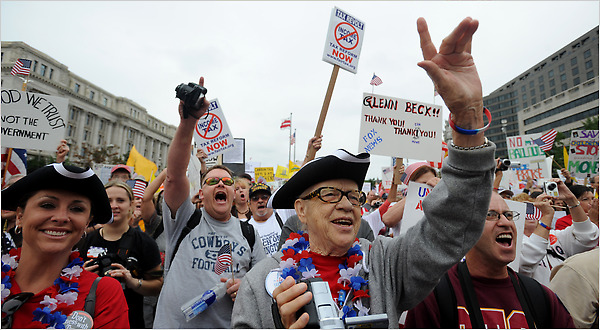
A Tea Party rally in Washington in September. (Photo: Amanda Lucidon/New York Times.)
In a lightning rod of an Op-Ed this week, Robert Wright pondered whether Joseph Stack, the anti-tax crusader who piloted a suicide mission into a Texas office building, could be considered “the first Tea Party terrorist.” He also wondered about how “purely conservative” the Tea Party movement actually may be. “Yes, it mobilized against a liberal health care bill and the stimulus package, but it also opposes corporate bailouts,” Wright noted. “Sure, Tea Partiers hate taxes, but that alone doesn’t distinguish them from many Americans. On social issues the Tea Partiers include some libertarians along with a larger number of family-values conservatives. And when you move to foreign policy, things don’t get more coherent. Though some Tea Partiers are hawks, many follow Ron Paul’s lead, combining a left-wing critique of military engagement with a right-wing aversion to the United Nations and other multilateral entanglements.”
A lengthy dispatch from New York Times investigative reporter David Barstow earlier this month cast light on the rising fringe of the movement: “Urged on by conservative commentators, waves of newly minted activists are turning to once-obscure books and Web sites and discovering a set of ideas long dismissed as the preserve of conspiracy theorists, interviews conducted across the country over several months show. In this view, [President] Obama and many of his predecessors (including George W. Bush) have deliberately undermined the Constitution and free enterprise for the benefit of a shadowy international network of wealthy elites.”
Maybe it’s just that tough times in America call for a tough kind of paranoia. As Barstow further considered:
A popular T-shirt at Tea Party rallies reads, “Proud Right-Wing Extremist.”
It is a defiant and mocking rejoinder to last April’s intelligence assessment from the Department of Homeland Security warning that recession and the election of the nation’s first black president “present unique drivers for right wing radicalization.”
“Historically,” the assessment said, “domestic right wing extremists have feared, predicted and anticipated a cataclysmic economic collapse in the United States.” Those predictions, it noted, are typically rooted in “antigovernment conspiracy theories” featuring impending martial law. The assessment said extremist groups were already preparing for this scenario by stockpiling weapons and food and by resuming paramilitary exercises.

(Photo: Lucian Read/MoJo.)
“In the months I’ve spent getting to know the Oath Keepers,” she reports, “I’ve toggled between viewing them either as potentially dangerous conspiracy theorists or as crafty intellectuals with the savvy to rally politicians to their side. The answer, I came to realize, is that they cover the whole spectrum.”
Robert Redford and the art of activism
Filed under: California, culture, politics | Tags: art, California, climate change, environment, film, original reporting, San Francisco
Leave a Comment Robert Redford usually draws media attention for his annual Sundance Film Festival in snowy Park City, where despite the accumulation of Hollywood hype he continues to champion the art of filmmaking. Less often remarked is his other great passion: the art of activism. Recently, Redford decided to make the Bay Area a new hub for his continuing work as a defender of social justice and the environment. Given the legacy of progressive politics in this region, it seems a natural choice for his new Redford Center, located in the heart of downtown Berkeley.
Earlier this month, during the center’s inaugural event at the Sundance Kabuki Theater in San Francisco, Redford honored two accomplished community leaders. Victor Diaz, the principal of Berkeley Technology Academy, spoke with a quiet kind of ferocity about his efforts to help at-risk minority kids get a better shot at education. Also impressive was teenager Avery Hale, who at age 13 started a project to deliver shoes to impoverished children in villages in Latin America and beyond.
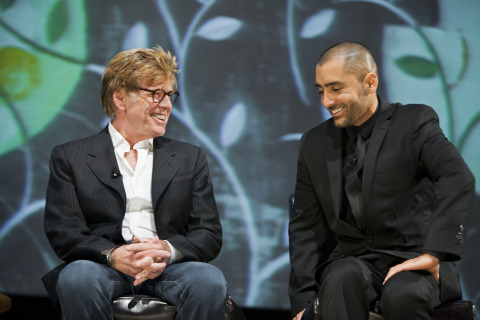
Redford and Diaz conversing onstage, Feb. 4, in San Francisco. (Photo by Peter Klueger.)
Redford spoke at length about the crossroads of grassroots activism and the arts. At 73, he’s been at it for four decades. He made clear that his bet is now on those many decades his junior, emphasizing the creative potential among youth and “the small acts that lead to big results.” In considering where progressive change can come from, he pulled no punches about the “cartoon behavior” going on at present in Washington: “There’s not a whole lot to be optimistic about today, politically. You see how constipated it is at the top and nothing is getting done — it’s an embarrassment to this country. We’ve lost so much already, we’re losing more by the day.”
Global warming continues to trouble him — as it did in 1987, when he first took it on, traveling to the Soviet Union during Perestroika for a conference on the then relatively unknown issue. He recounted inviting a high-powered Soviet delegation to Sundance for further talks, which eventually resulted in a joint document, in 1989, aimed at reducing pollution. In hindsight, it marked both a high point and a low point. “It was too early,” Redford said. “I made a terrible mistake: I was naïve to think that it was such a verifiable document, that all I had to do was send it in to [the first] George Bush and Gorbachev. It was, ‘Thank you very much’ and stuffed into a drawer, and no one ever really heard about it.”
But Redford’s stark views on national and global politics were tempered by a focus on inspiration and action at the local level — the raison d’etre of the Redford Center — and ultimately his message was a warmer one of rebirth. He pointed to the youngest generation, including his grandchildren in the audience. “They’re the ones that are about to inherit what’s left of this earth,” he said, “and I sense that this new generation of young people coming on really does want to do something. And I hope they will.”
Big bake sale for Cary Tennis and King Kaufman
Filed under: California, culture, media | Tags: art, books, California, health, photography, San Francisco, writing
Leave a Comment  Around the turn of the year, two friends and former colleagues of mine at Salon, Cary Tennis and King Kaufman, were hit with serious health emergencies. In November, Cary announced in his beloved advice column that he was diagnosed with a rare cancer, sacral chordoma, and would have to undergo surgery, which took place on December 17th. Vividly and eloquently, he has been keeping friends and fans apprised of his situation on his Open Salon blog.
 In early January, King was suddenly taken ill and hospitalized for a rare, devastating ailment, Guillain-Barré syndrome, the cause of which is essentially unknown. Fortunately, after three weeks in the hospital and a physical rehabilitation center, he is now back home with his wife and young kids, on his way to what his doctors say is likely to be a full recovery.
 For most people nowadays, a serious health crisis inevitably brings with it some financial strain. Friends of Cary and King have rallied to put together a terrific auction on eBay, the proceeds of which will go toward supporting these two great guys through their difficult times. A throng of talented and accomplished Salon alumni have contributed: Dave Eggers, Zach Trenholm, Heather Havrilesky, Keith Knight, David Talbot, Scott Rosenberg, Kate Moses, Larry Smith and Laura Miller, to name a few. The array of items up for bid include signed first editions of books, photographs, paintings and other original artwork. More details about the project on this Web site set up by the talented and generous Mignon Khargie.


The auction begins on Tuesday, February 9, and runs through the rest of the week; please check it out here and bid on any of this great stuff in support of Cary and King.
“Bluetoothing” Iran’s revolution
Filed under: culture, media, politics | Tags: foreign affairs, globalization, Iran, media, national security, NYT, politics, technology, Twitter
Leave a Comment Though it’s grabbing fewer headlines these days, the upheaval in Tehran that began last summer continues to simmer. Apparently the Obama administration has some evolving ideas about how to exploit the domestic dissatisfaction, which has been rising, along with the local price of tomatoes, for quite some time. How long can Ahmadinejad hold on?
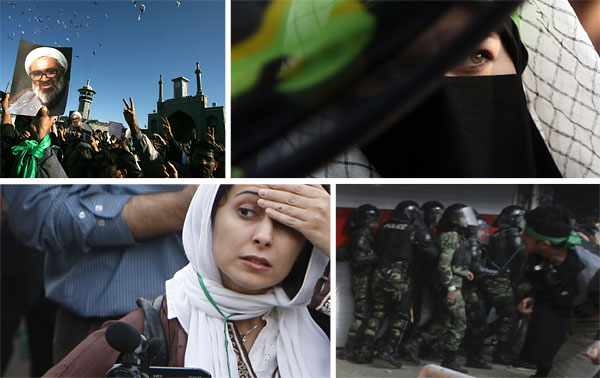
I finally had a chance to read Nazila Fathi’s recent essay about her experiences reporting from, and then fleeing from, Iran, where she’d been working for the New York Times. It’s chilling at turns, but also uplifting, particularly with its focus on the regime-busting role that technology has played in the historic unrest. Last summer I focused at length here on the unprecedented ways in which digital technology was shaping events from Tehran to Tiananmen Square. With events in Iran, Twitter suddenly had gone from trendy social networking toy to subversive diplomatic tool square on the State Department’s radar. But until reading Fathi’s essay I hadn’t known about another fascinating technological application in the fight—the use of Bluetooth by dissidents to dodge the crackdown. As Fathi writes of Iran’s continuing unrest in December:
Last month, during and after the funeral of the reformist Grand Ayatollah Hossain Ali Montazeri, one of the demonstrators’ most useful tools was the Bluetooth short-range radio signal that Americans use mainly to link a cellphone to an earpiece, or a printer to a laptop. Long ago, Iranian dissidents discovered that Bluetooth can as easily link cellphones to each other in a crowd. And that made “Bluetooth” a verb in Iran: a way to turn citizen reportage instantly viral. A protester Bluetooths a video clip to others nearby, and they do the same. Suddenly, if the authorities want to keep the image from escaping the scene, they must confiscate hundreds or thousands of phones and cameras.
The authorities have tried to fight back against such techniques and the Internet itself, but have fallen short. In November they announced that a new police unit, the “cyber-army,” would sweep the Web of dissent. It blocked Twitter feeds for a few hours in December, and an opposition Web site. But other blogs and Web sites mushroomed faster than the government could keep up.
Also be sure not to miss Frontline’s compelling documentary on the infamous killing of Neda Agha-Soltan.
UPDATE, 1/28/10: According to the New York Times, Iran reportedly has just executed two men in connection with the election protests. Nine others have been condemned to death for same.
Buried by the Haiti disaster
Filed under: culture, media, politics | Tags: economy, foreign affairs, health, media, politics, recession, Wall Street, war
Comments (1) Haiti’s devastation, now almost a week since the big quake, continues to saturate the media. It’s a lot to sift through and absorb; here’s where I’ve posted a handful of the most compelling links I’ve come across in recent days. For more, see Robert Mackey’s skillful curation over at The Lede blog.
One consequence of the historic disaster has been the burial of other developments that normally would’ve (and should’ve) been bigger front-page news:
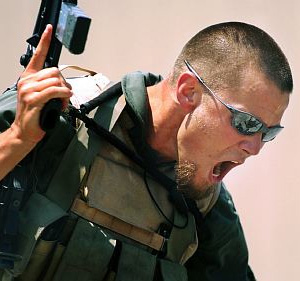 Blackwater still gets away with mass murder in Iraq, despite that three of its security personnel present at the notorious events three years ago testified to what they saw as wanton killing and cover-up. “All three were horrified by what they thought was an unprovoked attack in 2007 that left 14 Iraqi civilians dead,” according to previously sealed court documents described by the Washington Post. Their testimony further confirms the war zone “horror movie” reported by others long ago. Five Blackwater guards on trial for the attack walked at the beginning of this month, acquitted on procedural grounds.
 Wall Street’s top moguls sell Congress some shameless rationale for America’s historic financial meltdown. Testified Jamie Dimon of JPMorgan Chase: “My daughter called me from school one day and said, ‘Dad, what’s a financial crisis?’ And, without trying to be funny, I said, ‘This type of thing happens every five to seven years.’ And she said, ‘Why is everyone so surprised?’” (Without trying to be funny: Who the f—k is he kidding?) Testified Lloyd C. Blankfein of Goldman Sachs: “Whatever we did, it didn’t work out well. We regret the consequence that people have lost money.” (Hear them in their own words, here.) Meanwhile, pretty much everyone working for their bailed out firms is making out like a bandit.
Vancouver wins a key battle in its progressive war on drugs, with a top court preventing the Canadian federal government from shutting down the city’s officially sanctioned injection site for heroin and cocaine addicts. Probably not top story material, but a development of great interest to me personally; I reported extensively on the cutting-edge project from the streets of Vancouver — first in 2003, when the Bush administration angrily declared the policy “state-sponsored personal suicide,” and again three years later, when they were proven dead wrong by Insite’s indisputable success.
Also don’t forget that today is Martin Luther King Day; here’s a video clip of Robert F. Kennedy announcing King’s death by assassination in 1968. And always worth rereading, MLK’s landmark “Letter from Birmingham Jail,” from 1963. It continues to resonate in new ways with Barack Obama presiding in the White House.
Obama defines the war that will define him
Filed under: media, politics | Tags: CIA, Dick Cheney, economy, foreign affairs, intelligence, national security, politics, recession, terrorism, war
Leave a Comment Another major wave of U.S. troops sent to Afghanistan. A Detroit-bound airliner imperiled by a terrorist on Christmas Day. A stunning blow to CIA operations targeting the Taliban and al Qaeda. A surge of political attacks against President Obama led by an aggressively partisan former vice president.
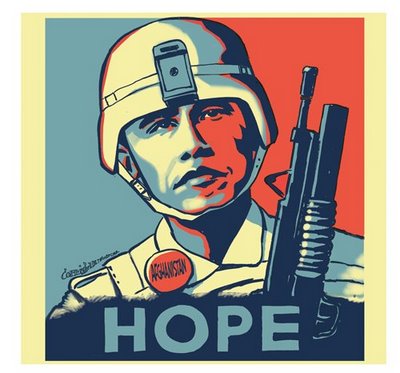 In recent weeks America’s current era of war has escalated to a next level. Obama didn’t preside over its inception, of course, but it is ever his to handle. Although the nation’s economic reckoning is far from over, what happens on the national security front is probably more likely to define Obama’s presidency than anything else.
His speech Thursday night addressing the U.S. intelligence debacle at Christmas reflected this. In his closing remarks, Obama made a point of disarming recent partisan attacks; although he didn’t name Dick Cheney specifically, some of his comments clearly were a retort to the former vice president’s assertion that Obama doesn’t take the terrorist threat seriously:
Over the past two weeks, we’ve been reminded again of the challenge we face in protecting our country against a foe that is bent on our destruction. And while passions and politics can often obscure the hard work before us, let’s be clear about what this moment demands. We are at war. We are at war against al Qaeda, a far-reaching network of violence and hatred that attacked us on 9/11, that killed nearly 3,000 innocent people, and that is plotting to strike us again. And we will do whatever it takes to defeat them.
In the New York Post, Rich Lowry beamed that Obama’s rhetoric could’ve been written by Dick Cheney himself.
Most striking was the president’s reiteration of the principles by which he will prosecute America’s long war:
Here at home, we will strengthen our defenses, but we will not succumb to a siege mentality that sacrifices the open society and liberties and values that we cherish as Americans, because great and proud nations don’t hunker down and hide behind walls of suspicion and mistrust. That is exactly what our adversaries want, and so long as I am President, we will never hand them that victory. We will define the character of our country, not some band of small men intent on killing innocent men, women and children. And in this cause, every one of us — every American, every elected official — can do our part.
On MSNBC Thursday night, veteran Washington columnist Howard Fineman pointed out how anxious George W. Bush had been to get through his final weeks in office without another terrorist attack taking place inside the U.S. Apparently Bush was plenty eager to get out of town with what he viewed as a clean post-9/11 record.
The equation Obama faces is not a matter of if, but when. American society would do well to accept that reality, as even David Brooks has now said. Fortunately, the current commander in chief appears driven to move ahead with a markedly different approach than his predecessor. “Instead of giving into cynicism and division, let’s move forward with the confidence and optimism and unity that defines us as a people,” Obama concluded on Thursday. “For now is not a time for partisanship, it’s a time for citizenship — a time to come together and work together with the seriousness of purpose that our national security demands. That’s what it means to be strong in the face of violent extremism. That’s how we will prevail in this fight.”
And the Best Album of 2010 goes to…
Filed under: California, culture | Tags: art, California, music, politics
Comments (1) How uninspired, all the obligatory end-of-year rehash — the Best of 2009 This and the Top 10 Yada-yada of That. It’s all so… last year. But, the good news: This dog from the future just did a quick dash to December 2010, and I’ve brought back with me the easy winner for the Best Album of Next Year. It’s already here.
 One of the benefits of having your own blog (aside from some capacity for time travel) is that you can favor whatever you want, with impunity. Even so, that the acclaimed psychedelic-country-folk-rock band I See Hawks in L.A. are good friends of mine has nothing to do with the fact that their forthcoming album, “Shoulda Been Gold,” takes the aforementioned honor. Hands down. It’s a dazzling collection from their deep trove of music produced and performed over the past decade — a greatest hits record, as they like to put it, that contains no hits. It comes out officially on January 26 from Collector’s Choice Music, but you can be one of the first to get a hold of it right now, right here.
And you most definitely should. The album contains 17 tracks of vivid aural history, its harmonies and insights drawn from an American decade of relative desolation. The Hawks are one of the great original bands you shoulda heard by now, if you haven’t already. Don’t just take my word for it, you can look ’em up on The Google: There have been volumes of critical acclaim for their four albums dating back to 2000, from the Los Angeles Times to Spin to USA Today. (The latter notably sidestepped cliché in praising the band’s “versatility, variety and power” and “intriguing dystopian science-fictional bent in the lyrics” — that is, this ain’t your garden variety country-rock band, folks.) There are cult favorite non-hits here such as “Humboldt” and “Highway Down,” but I’m particularly partial to several of the new and newly released tunes, among them the plaintive yet incandescent title track “Shoulda Been Gold” and the Cajun-inflected twirler “Laissez Les Bon Temps Roulet.” You’ll definitely start your new year out happy if you get your hands on this stuff.
Dick Cheney’s 9/11 conspiracy
Filed under: media, politics | Tags: books, Dick Cheney, foreign affairs, intelligence, national security, politics, television, terrorism, war
Comments (1) The former vice president took a break from hunting and fishing this week to return home to Fox News and fire away once again at Barack Obama. Headline-grabbing potshots this time included characterizing the sitting president as “radical” and calling the Obama administration’s decision to put Khalid Sheik Mohammed on trial in New York City “a huge mistake.” Cheney stopped just shy of labeling Obama’s policy as treason. “It’ll give aid and comfort to the enemy,” he said of the pending terrorist trial.

The retired veep is as entitled to his opinions as the next guy, one supposes, however politically motivated they may remain. But particularly since Cheney’s arguments depart ad nauseam from his views about the 9/11 terrorist attacks (see the saturated transcript linked above), it seems an apt moment to point out some news that bubbled up a few weeks ago regarding Cheney and that fateful September day. Newsworthy indeed, although it seemed barely to register in the media: A new book by John Farmer, a former attorney general of New Jersey who served as senior counsel to the 9/11 Commission, says flat out that Cheney lied about how the U.S. government handled the Al Qaeda strikes on New York and Washington as they unfolded.
As someone involved in producing much coverage on the story of 9/11 (including this wide-ranging series for Salon in 2006), I can say that this is one conspiracy worthy of attention. (Numerous others, not so much.)
According to Jacob Heilbrunn’s recent review in the Sunday Times of “The Ground Truth: The Untold Story of America Under Attack on 9/11,” Farmer handily debunks the Bush administration’s storyline that the White House acted decisively and effectively that day. He describes how both Cheney and Deputy Defense Secretary Paul Wolfowitz “provided palpably false versions that touted the military’s readiness to shoot down United 93 before it could hit Washington,” according to Heilbrunn. “Planes were never in place to intercept it. By the time the Northeast Air Defense Sector had been informed of the hijacking, United 93 had already crashed.”
Moreover: “Farmer scrutinizes F.A.A. and Norad records to provide irrefragable evidence that a day after a Sept. 17 White House briefing, both agencies suddenly altered their chronologies to produce a coherent timeline and story that ‘fit together nicely with the account provided publicly by Deputy Defense Secretary Wolfowitz and Vice President Cheney.’”
Farmer’s damning conclusion? “History should record that whether through unprecedented administrative incompetence or orchestrated mendacity, the American people were misled about the nation’s response to the 9/11 attacks.”
It gets one thinking about a comment Cheney made to Fox’s Sean Hannity on Tuesday night, discussing the memoirs he’s currently writing about his 41 years in Washington, dating back to the Nixon administration: “There are some fascinating stories and interesting things I was involved in.”
Do tell, Mr. Vice President.
 Mark Follman


You must be logged in to post a comment.