The killing of Neda
Filed under: media, politics | Tags: CIA, film, foreign affairs, Iran, media, national security, politics, technology, Twitter
 Comments (2)
 The new documentary “A Death in Tehran” continues the stellar investigative work of Frontline, casting light on the fate of Neda Agha-Soltan, the young woman whose murder during Iran’s election chaos last summer commanded historic attention. On the PBS/Frontline web site you can watch the documentary in its entirety. It’s well worth the time. The film illuminates the circumstances of the shooting and its aftermath through extensive use of amateur video from the street protests and interviews with people close to Neda — including the doctor who tried to save her as she quickly bled to death on the street.
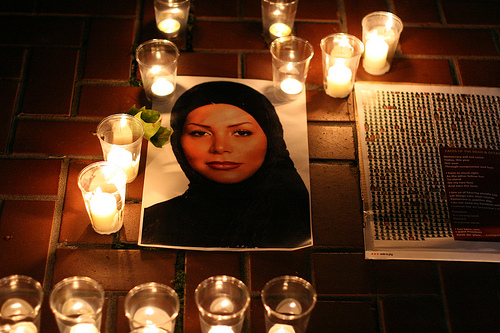
The chilling footage of Neda’s death in late June zipped around the globe on an unprecedented digital wave, instantly making hers the face of the rising reformist movement in Iran. One compelling segment of the documentary details how the Iranian hardliners reacted to this threat against their grip on power.
In response to the international outcry over Neda’s death — including President Obama’s confirmation that he’d seen the “heartbreaking” video on YouTube — the regime set about attempting to rewrite the story, pointing a finger at the CIA and outside agitators, the same forces they blamed for the mass street protests and allegations of vote rigging that led to the greatest upheaval in Iran since the revolution of 1979.
The film also uncovers some remarkable footage of Neda’s killer, “a member of the Basij militia who’d been brought into Tehran by the regime’s Revolutionary Guards to stamp out the ‘Green Revolution.'” In an interview with Frontline, Arash Hejazi, the doctor who tried to save Neda as she lay dying in the street, describes watching the crowd’s reaction to the man who had fatally shot her. “They started to discuss what to do with him,” Hejazi recalls. “They grabbed his wallet, took out his ID card and started shouting, ‘He is a Basiji member; he is one of them,’ and started swearing and cursing him, and he was begging for people not to harm him or kill him.”
Incredibly, the killer walked. “They believed the police wouldn’t do anything to him as the Basiji are really powerful and he would have easily have got away,” Hejazi says, “so in all of the chaos they decided to release him.”
The documentary describes how the regime sought further to cover up a brutal crackdown: “The Iranian government admits 11 protesters were killed on June 20, but doctors from three Tehran hospitals confirmed at least 34 deaths. Other bodies were buried by security forces without first being identified.”
New York Times blogger Robert Mackey, who has cranked out much excellent coverage of the fallout from the Iranian election, has more here. In late June, I wrote extensively about the unprecedented role digital media played during the upheaval on the streets of Tehran; that’s available here.
Helping fix the error-filled news
Filed under: California, media | Tags: California, future-of-journalism, language, media, San Francisco, technology
Comments (1) I’m very happy to announce my involvement in a new startup called MediaBugs, where I’ll be serving as associate director and community manager. I’m joining with project founder and director Scott Rosenberg (with whom I had the great pleasure of working during my years at Salon) for what we anticipate will be an exciting and, hopefully, groundbreaking effort. We are now in the process of building out our Web site, with plans to start rolling out the service in early 2010. The two-year project is funded by the Knight Foundation, and will focus on all manner of media in the San Francisco Bay Area.
In a nutshell, MediaBugs will provide a neutral, civil forum where the public can report errors they encounter in the news and try to get them fixed. The idea is to leverage the open-source power of the Web to achieve greater transparency and dialogue among media institutions and the public, and thereby improve the quality of the news.
We see it as a winning proposition for everyone involved — a way to begin rebuilding public confidence in the media, while offering our fellow journalists a compelling tool they can use to enhance their work in this ever-dynamic digital age.
Why focus on fixing errors in the news? For one, public trust in the media wallows at a historic low. As Scott explained in a recent blog post, there are several reasons for this — perhaps chief among them that the news is riddled with mistakes, and an extraordinary percentage of them go uncorrected.
There are different kinds of errors, but even the seemingly trivial ones matter. (And there are a great many of them, as detailed at the above links, a status quo surely not helped by today’s painful editorial cutbacks.) If the local paper or news site regularly publishes misspelled names or inaccurate dates, how can its readers trust that it got the really important stuff right?
The problem afflicts small and big players alike. This week, the Washington Post’s public editor Andrew Alexander was compelled to explain why a respected sports columnist at the paper whiffed big time with some of his World Series coverage.
“By my count,” Alexander wrote, “the column contained at least 20 typos, grammatical errors or misspellings.”
Curiously, the Post treated a cleaned-up version of the piece, posted online after the shoddy print version went out, as separate. That’s a questionable distinction, with the lines between blog posts, columns and articles rapidly blurring these days, and with digital and print newsroom operations fast merging. There is still no correction appended to the online version of the World Series column, so unless you’d already caught wind of Alexander’s write-up you wouldn’t even know about the flurry of mistakes that appeared in print. Doesn’t seem like the best way to win over skeptical readers.
For more details on how MediaBugs will work, visit our site here, and stay tuned for more soon.
Bay Bridge boondoggle
Filed under: California, media, politics | Tags: California, economy, future-of-journalism, San Francisco, Twitter
Leave a Comment The San Francisco-Oakland Bay Bridge has been “closed indefinitely” after a rod installed during last month’s emergency repairs snapped during rush hour on Tuesday evening, according to the San Francisco Chronicle. I’m extra thankful this morning that in 15 years of living and working in this city I’ve been able to commute almost exclusively by public transportation or bicycle. Compared with the 280,000 daily car commuters suffering today’s fallout (not to mention all the train riders getting further jammed in by them), that probably makes it too easy for me to say this: There are at least a couple of reasons to be thankful (relatively speaking) for this latest meltdown.
First, it’s a live exercise in what could happen when the most important transportation artery in the region gets knocked out under more perilous circumstances — a terrorist attack, another catastrophic earthquake, etc. Nobody can say there wasn’t an opportunity to prepare. Second, it again puts a glaring light on key questions about the boondoggle that is the new eastern span of the bridge — namely, why is it billions of dollars over budget, beset with quality-control problems and years behind schedule?

Aerial view of an empty Bay Bridge on Wednesday. (Marcio Jose Sanchez/AP)
It’s an understatement to say that the project has long been ripe for serious journalistic investigation. If the beleaguered Chronicle can’t get it together, perhaps others will rise to the task. According to Baynewser, an interesting collaboration is underway from SF Public Press and McSweeney’s. “Our reporters have been digging up documents for close to two months on the massive construction project, one of the most challenging, costly and complex bridge projects in U.S. history, and have found some surprising new facts about how and why the costs, currently projected at $6.3 billion, continue to rise,” says Public Press chief Michael Stoll. With this latest setback, perhaps the new Berkeley-based California Watch will get interested as well.
“Preparing for a tough day with Bay Bridge closure,” tweeted Mayor Gavin Newsom this morning. He recommended following @BayBridgeInfo to stay informed. As of about 6:30am, the prognosis there was not good: “Repairs are now under way, still unknown how long repairs will take or when bridge will reopen.”
UPDATE: Given the rapidly changing media landscape here, how did initial coverage of the Bay Bridge crisis flow?
In the hands of the Taliban
Filed under: media, politics | Tags: Afghanistan, foreign affairs, intelligence, media, national security, NYT, politics, terrorism, war
Leave a Comment As Barack Obama continues wrestling with decisions about a war that could define his presidency, veteran reporter David Rohde’s account of his seven-month ordeal as a captive of the Taliban in Afghanistan and Pakistan makes for some compelling reading. Along with two Afghan colleagues, Rohde was kidnapped in November 2008 while attempting to meet a Taliban commander for an interview. This June, upon reading the surprising news of his escape to freedom — the kidnapping had been kept quiet by the New York Times and other media organizations out of fear for Rohde’s safety — I was anticipating the narrative account surely to follow.
Months later, Rohde’s retelling does not disappoint. In an ongoing five-part series in the Times, his dispassionate tone combines with thoughtful attention to detail to give the reader confidence that, although some of his recollections may be imprecise, his harrowingly close view of America’s elusive enemy was also a profoundly revealing one. In political terms, Rohde’s subsequent analysis cuts in several directions.

In the first installment of the series, war hawks will find some forceful affirmation in Rohde’s seasoned assessment of the enemy:
Over those months, I came to a simple realization. After seven years of reporting in the region, I did not fully understand how extreme many of the Taliban had become. Before the kidnapping, I viewed the organization as a form of “Al Qaeda lite,” a religiously motivated movement primarily focused on controlling Afghanistan.
Living side by side with the Haqqanis’ followers, I learned that the goal of the hard-line Taliban was far more ambitious. Contact with foreign militants in the tribal areas appeared to have deeply affected many young Taliban fighters. They wanted to create a fundamentalist Islamic emirate with Al Qaeda that spanned the Muslim world.
For those who decried the Bush administration’s conduct of its so-called war on terrorism, there is also persuasive evidence here. “My captors harbored many delusions about Westerners,” Rohde writes. “But I also saw how some of the consequences of Washington’s antiterrorism policies had galvanized the Taliban. Commanders fixated on the deaths of Afghan, Iraqi and Palestinian civilians in military airstrikes, as well as the American detention of Muslim prisoners who had been held for years without being charged. America, Europe and Israel preached democracy, human rights and impartial justice to the Muslim world, they said, but failed to follow those principles themselves.”
From Guantanamo to Abu Ghraib, this would come back to haunt Rohde directly — a consequence of which many intelligence and military leaders had long warned. In the second installment out today, Rohde describes how his pleas for release were rebuffed:
When I told them I was an innocent civilian who should be released, they responded that the United States had held and tortured Muslims in secret detention centers for years. Commanders said they themselves had been imprisoned, their families ignorant of their fate. Why, they asked, should they treat me differently?
Among the dramatic turns in Rohde’s tale is a remarkable deception perpetrated by his primary captor. (Also see Monday’s piece.) More than just a gripping account, though, his writing further illuminates a Gordian conflict with no end in sight — and on the eve perhaps of some momentous choices in Washington. It’ll be interesting to see what more perspective Rohde offers as the series continues through Thursday.
UPDATE: Some New York Times readers are taking issue with the presentation and placement of the Rohde series (titled “Held by the Taliban”). As I make clear above, I’m with executive editor Bill Keller on this one:
When David Rohde escaped after more than seven months in captivity, it was clear even as we celebrated that his experience was one more window into a long and complicated war. No other journalist, as far as I know, has had such an experience of the Taliban from the inside. As I hope the series makes clear, this is not a story about David Rohde, it is a story about the character, strength and organization of the people the U.S. is fighting in Afghanistan and Pakistan. It provides detailed insights into the minds and motives of the Taliban’s footsoldiers. It also reveals the extent to which the Taliban has, with impunity, colonized a swath of Pakistan. Yes, it is a hell of a story, but it also adds rich detail to our understanding of the Taliban.
Part three of the series is now available here.
The “Mcfarthest” spot, mass air traffic and a Minnesota-size memory
Filed under: culture, media | Tags: art, economy, environment, globalization, maps, politics, technology, travel
Leave a Comment I’ve always loved maps. They reward the longer gaze. Especially in these digitally frenetic times. Whether depicting authentic truths or questionable claims, or one of many shades in between, they tend to provoke expansive thinking about the world. Or they zoom you in on something unexpected and compelling. Their borders inherently are porous to the imagination. And they can be just plain cool to look at — hand me a copy of Oxford’s Atlas of the World and I’ll be entertained for a healthy chunk of time flipping through those oversized pages. No iPhone necessary.
Of course, digital media allow mapmakers and collectors to take things to a next level. The Strange Maps blog is one great place to browse. A recent post featured the work of blogger Stephen Von Worley, who decided to chart America as fast-food dystopia by depicting McDonald’s ubiquity from coast to coast. The nagging question that was his point of departure: What’s the “McFarthest” one can possibly get from a Big Mac? Unsurprisingly, not very far at all, even in the relatively unpopulated West:

According to Von Worley’s calculations (per the summary at Strange Maps):
There are over 13,000 McDonald’s restaurants in the U.S., or about 1 for every 23,000 Americans. But even market penetration this advanced doesn’t mean that McDonald’s is everywhere. Somewhere in South Dakota is the McFarthest Spot, the place in the [continental] U.S. geographically most removed from the nearest McD’s. If you started out from this location, a few miles north of State Highway 20 (which runs latitudinally between Highways 73 in the west and 65 in the east), you’d have to drive 145 miles to get your Big Mac. (If you could fly, however, it’d be only 107 miles).
If you did decide to fly, you’d be contributing to some incredibly congested air traffic, especially if it’s during daylight. See this nifty depiction of 24 hours worth of planes flying the global skies:
Also worth watching is this feat of mapmaking by Senator Al Franken, who from memory composed one of the United States (while taking questions, no less) at the Minnesota State Fair:
Now if he and his comrades could only draw up a health care plan with such facility…
The world according to Flarf
Filed under: culture | Tags: art, language, poetry, technology, Twitter
Comments (1) After I posted about the strange poetry of search yesterday, I was happy to receive an email from my friend Alex Davis, a poet and former classmate in the MFA program at University of San Francisco, with some clarification about the realm into which I had stumbled. Turns out there is a whole literary “movement” built on search engine detritus. (Of course there is.) It’s known as Flarf. It dates all the way back to the beginning of the millennium.
Apparently the method of the flarfists “was to mine the Internet with odd search terms and then distill the results into often hilarious and sometimes disturbing poems, plays, and other texts.” This was hardly a new artistic impulse. But its digital extension — a kind of Cut-up 2.0, if you will — certainly seemed to capture the tenor of these times. According to flarf’s Wikipedia entry, “Early or ‘old-school’ flarf is marked by a certain distinctive tonal ‘dialect’: it is often peppered with phrases like ‘aw YEEEAHH,’ intentional typos, mildly offensive language (e.g., childish references to bodily functions), oblique political ‘statements,’ and incongruous animal imagery.”
Indeed. Or, as one early practitioner put it, the dominant tenor of flarf could be described as “a kind of corrosive, cute, or cloying awfulness. Wrong. Un-P.C. Out of control. ‘Not okay.'”
(Lordy, I don’t really even want to touch the later breaking phenomenon of Twitter poetry: “Situations of stimulation often climax I just cant handle your seed Love is held like hidden treasure – 3:41 PM Aug 16th from web”)
 But let us leap from the realm of theory. Back in 2006, issue 3 of Switchback, the fine literary publication from USF, featured “The Ways to Switchback,” which made flarfingly grand use of phrases that people had entered into search engines to reach the publication’s site. (The image to the left, featured in that issue, is “Eventual Slide,” by artist Jeremiah Stansbury.) See such points of departure as “japanese toilet noise disguise” and “addicted to picking ear wax” and the essay-inspiring “does a chimpanzee dream?”
The strange poetry of search
 WordPress.com, host of this site, has a pretty handy stats tool for tracking how denizens of the World Wide Web find their way to one’s little corner of cyberspace. It includes a daily rundown of search terms used to get there. On one level, this seems to provide a certain poetic measure of one’s blogging orbit. On another, it provides a peek into the human psyche of the digital age: Late at night, in the privacy of their homes, what do folks really go looking for when they type a few words into Google’s search box and click? (OK, beyond the most obvious.)
Here are a few odd favorites, a stanza of phrases that apparently led readers here recently. What it says about this blog and/or the people navigating to it, I’m not exactly sure.
air strike on own street address
tallest wave ever
of course i am sexual
caught smuggling weapons into mexico
computer damage marks
winter park beetlekill
journalism future truth
shi tzus no canada
images of torture of the grave
aerial marijuana national forest
unmarked s.u.v. at michael jacksons home
big english street signs
mumbai international airport pics
future cruise ships
hot mexicans
political power in the usa
thunderstorm
enlightenment
Roger Federer’s impossible shot
Filed under: culture | Tags: DFW, sports, television, writing
Leave a Comment The dazzling play of tennis titan Roger Federer does not cease to amaze. Following his U.S. Open semifinal victory on Sunday against Novak Djokovic, Federer said in a TV interview that he had practiced the between-the-legs return many times, but that “it never worked.” In case you missed what he called “the greatest shot I ever hit in my life” — that’s a bit like Michael Jordan trying to point out his single greatest dunk — take a look:
It must be noted that Djokovic himself played rather phenomenally, and likely would’ve vanquished just about any other opponent in the hard-fought three sets.
But when Federer is on, he seems to reach a truly singular plane of performance. David Foster Wallace captured it artfully in his 2006 essay, “Federer as Religious Experience.” (Which I wrote about here recently.) After stating that a top athlete’s beauty is “impossible to describe directly” or “to evoke,” DFW did just that, in one of his most memorable pieces of nonfiction. With Federer on the cusp of his sixteenth career Grand Slam title, it’s worth (re)reading the essay in its entirety. One line that has always stuck with me: “Federer’s forehand is a great liquid whip.” It’ll likely be on cracking display again in a couple of hours at Arthur Ashe Stadium, as he takes on 20-year-old Juan Martin del Potro of Argentina in the championship match.
UPDATE: Indeed, Federer hit no shortage of zingers in the five-set battle, but his serving fell short while the youthful (and towering, at 6-foot-6) del Potro dug deep to pull off one of the bigger upsets in U.S. Open history.
Mark Bowden battles the bloggers
Filed under: media, politics | Tags: future-of-journalism, media, NYT, politics, technology, television, writing
Comments (1) The esteemed journalist Mark Bowden is back with another thought-provoking article on the digital media revolution. It is at once deeply reported, crisply written — and strangely myopic in its conclusions.
In the October issue of the Atlantic, Bowden tracks the story of how a partisan blogger armed Fox News and the rest of the TV noise machine with the primary attacks used against Supreme Court nominee (and now Justice) Sonia Sotomayor. (As I wrote in May, an early riff suggesting that conservative Republicans would wisely refrain from attacking Sotomayor — another echo in the chamber — would prove plain silly.) Bowden shows how a blogger by the name of Morgen Richmond dug up and helped disseminate obscure video clips that would soon have every talking head focused on Sotomayor’s “wise Latina” and judicial “policy making” comments from the past.
 Bowden asserts that the deployment of those comments was “the work not of journalists, but of political hit men.” Although he acknowledges that partisans supplying material for TV news broadcasts is nothing new, he sees a dark trend, one to be blamed squarely on the proliferation of blogging. “With journalists being laid off in droves, savvy political operatives have stepped eagerly into the breach. What’s most troubling is not that TV-news producers mistake their work for journalism, which is bad enough, but that young people drawn to journalism increasingly see no distinction between disinterested reporting and hit-jobbery.”
The problem here is twofold. First, Bowden levels blame at the wrong target. As blogging expert Scott Rosenberg writes, “Surely the failure here is on the part of the TV news organizations that turned it into a marquee soundbite without looking more deeply into it. Wasn’t that their job, their process, their vetting — the safeguard that ostensibly distinguishes them from the unwashed blogging masses? Aren’t they the ones who are supposed to be after truth rather than scalps?”
That may be giving cable news a little too much credit, but as Rosenberg also points out, most bloggers don’t even purport to contribute journalism. And the failure to appreciate what blogs do contribute — especially collectively — is the other shortcoming in Bowden’s discussion. Morgen Richmond himself explains this clearly, in his response to Bowden’s piece:
[W]hile I wholeheartedly disagree with Bowden’s ultimate assessment that the Sotomayor “court is where policy is made” and “wise Latina” comments were non-controversial when taken in full context, the truth of the matter is that literally within hours (if not minutes) of posting both of these, there were an assortment of bloggers across the political spectrum dissecting and analyzing these finds. And not just the short clips which ultimately played on TV. I posted a link to the full Duke Law video almost immediately, and embedded as much of the “wise Latina” speech as I could in my initial post, so anyone who was interested had access to as much context as they wanted. Many highly-regarded blogs, such as the Volokh Conspiracy, concluded as Bowden did that these statements were not as controversial as they seemed on their face. And of course many others were not so willing to give Sotomayor the benefit of the doubt. The point is that this started taking place within hours on the internet, long before any of this made it’s way into the broader media. (Remember that I posted both of these statements before Sotomayor was even nominated.)
Bloggers often are lazy about providing useful context for readers — political agenda or no, it’s not easy to do well in the short space the genre typically requires. Yet, the linking that so often serves as a blogger’s shorthand points up the powerful information ecosystem of the Web. It is the information consumer’s charge, as much as ever, to dig deeper, to explore widely and to question orthodoxy. (Including his own.) The digital medium allows this far more readily than a television broadcast or print article does.
This isn’t the first time I’ve criticized Bowden for his media analysis — see my recent writing on his takedown of New York Times publisher Arthur Sulzberger, as well as Bowden’s response.
He’s one of the best and most respected in the business, and I couldn’t agree more with Richmond when he says the world needs more journalists like Bowden, not fewer. Surprisingly, though, Bowden’s own legwork on the role of blogging in the Sotomayor story didn’t help him to get past his seemingly jaundiced view of the digital medium and its democratizing power. I think he tips his hand when toward the end he says: “There’s more here than just an old journalist’s lament over his dying profession, or over the social cost of losing great newspapers and great TV-news operations. And there’s more than an argument for the ethical superiority of honest, disinterested reporting over advocacy.”
But that’s precisely his thrust. With no small whiff of nostalgia he reiterates that an old-school reporter, proceeding from curiosity over political conviction, is more likely to discover the unexpected and reap the rewards of “speaking wholly for himself, without fear or favor.” Maybe so. Yet, Bowden could just as easily be describing bloggers when he concludes that reporters have “the power to stir up trouble wherever they go. They can shake preconceptions and poke holes in presumption. They can celebrate the unnoticed and puncture the hyped. They can, as the old saying goes, afflict the comfortable and comfort the afflicted.”
The spirit of Haida Gwaii
Filed under: culture, politics | Tags: art, Canada, environment, globalization, Haida Gwaii, language, music, original reporting, photography, politics, travel, Vancouver
Comments (2) In late August I returned to the archipelago of Haida Gwaii, a place whose ancient, complex culture and astonishing natural beauty are inextricable. Earlier this week, in the village of Old Massett, the renowned Haida artist Robert Davidson hosted an epic two-day celebration commemorating the totem pole he carved here 40 years ago. The pole was raised in the village on August 22, 1969, replanting a vital Haida tradition that had nearly disappeared by the end of the 19th century. It was a privilege and joy to attend the festivities and to participate in documenting them. Here are a few images I captured (please do not reproduce them without permission), though they only begin to suggest the layers of landscape, art and ceremony that were on display.
The many performers included singers, drummers and dancers from Skidegate:

Spruce-root woven and painted hats filled the community hall:

The Tsimshian group Git-hoan, or People of the Salmon, were among the guests invited to perform:

Eagle Transformation Mask, carved by Robert Davidson and danced publicly for the first time by the Rainbow Creek Dancers:


Robert Davidson’s 40-foot Bear Mother pole (partial view), raised in Old Massett in August 1969:

Despite devastation from decades of industrial logging, some majestic old trees still stand on Haida Gwaii. (Thanks to the tireless efforts of local advocates and defenders, the land increasingly has come under protection in recent years.) The temperate rain forests are home to towering cedar, hemlock and spruce:


Along the banks of the Yakoun River, near where K’iid K’iyaas, the legendary Golden Spruce stood until its untimely demise in 1997. Every year the salmon come back to this essential river artery of Haida Gwaii. At least for now.

Desperate for some digital magic
Filed under: culture, media | Tags: art, books, film, future-of-journalism, media, music, technology, Twitter
Comments (1) It seems quite odd at this late date that Damon Darlin thinks serendipity has been lost in the digital deluge of the Internet. In a column in the Sunday Times, Darlin acknowledged that “we’ve gained so much” in the way of information and entertainment. “But we’ve lost something as well,” he says: “the fortunate discovery of something we never knew we wanted to find. In other words, the digital age is stamping out serendipity.”
Huh? When was the last time you went online and didn’t end up encountering things unexpected and interesting?
 Darlin laments what he sees as the fading possibility of perusing friends’ book shelves and CD and video collections in search of new discoveries, with those goodies increasingly obscured inside laptops, iPods and Kindles. It’s a strange line of reasoning to resuscitate, one long ago dispatched by Web thinkers, including author/blogger Steven Johnson three years ago. Back then, was the diminishing use of libraries as engines of discovery something to mourn?
“I find vastly more weird, unplanned stuff online than I ever did browsing the stacks as a grad student,” Johnson wrote in May 2006. “Browsing the stacks is one of the most overrated and abused examples in the canon of things-we-used-to-do-that-were-so-much-better. (I love the whole idea of pulling down a book because you like the ‘binding.’) Thanks to the connective nature of hypertext, and the blogosphere’s exploratory hunger for finding new stuff, the web is the greatest serendipity engine in the history of culture.”
Darlin’s loss-of-serendipity riff is akin to one that pops up regularly among those warning about the extinction of newsprint. If you’re getting all of your news online, the argument goes, you’ll be deprived of stumbling across a cool story inside those oversized inky pages, one that you might not otherwise ever read.
I still enjoy the ritual of immersing in the Sunday paper to which Darlin contributes, and I usually find interesting stuff in it to soak up, some of it even unexpected. But the fact is, that kind of fortunate discovery happens about a bazillion times more often in the digital realm. As Johnson also wrote:
I read regularly about 20 different blogs or other filters, and each day through them I’m exposed to literally hundreds of articles and clips and conversations and songs and parodies that I had no idea about when I woke up that morning. Many of them I just skim over, but invariably a handful of them will send me off on some crazy expedition from site to site, ushered along with the help of other bloggers, Google, del.icio.us, wikipedia, etc. I’m constantly stumbling across random things online that make me think: what is the deal with that anyway? And then an hour later, I’m thinking: how did I get here? I can’t tell you how many ideas that eventually made it into published books and articles of mine began with that kind of unexpected online encounter.
The big challenge these days seems to be figuring out how to better handle the fire hose of content flow. It can indeed be frustratingly easy to forget what you set out for in the first place, to get lost down the endless digital byways. (Hah — how, exactly, did you end up here?) Yet, whatever nostalgia aside, when it comes to print vs. digital (or albums vs. iTunes, etc.), I don’t think we’re facing a zero-sum equation.
Cambridge cop accidentally arrests Gates again
Filed under: media, politics | Tags: comedy, law, media, politics
Leave a Comment The beer summit, it turns out, was a huge waste of time — it seems Obama had it right about Crowley all along. This just in, from America’s Finest News Source:
 WASHINGTON — Upon arriving late to his meeting with President Barack Obama and famed African-American intellectual Henry Louis Gates, Cambridge police officer James Crowley once again detained the distinguished Harvard scholar after failing to recognize the man he had arrested just two weeks earlier, White House sources reported Thursday. “When I entered the Oval Office, I observed an unidentified black male sitting near Mr. Obama, and in the interest of the president’s safety, I attempted to ascertain the individual’s business at the White House,” Crowley said in a sworn statement following the arrest. “The suspect then became uncooperative and verbally abusive. I had no choice but to apprehend him at the scene for disorderly conduct.” Witnesses said that Sgt. Crowley, failing to recognize Gates on their flight to Logan Airport, arrested the tenured professor in midair, once again at the baggage claim, and twice during their shared cab ride back to Cambridge.
 Mark Follman
You must be logged in to post a comment.