Iran’s Twitter revolution goes global
Filed under: culture, media, politics | Tags: foreign affairs, globalization, Iran, language, media, national security, politics, technology, Twitter
 Comments (3)
 It’s been amazing to watch it spread.
“As the embattled government of President Mahmoud Ahmadinejad appears to be trying to limit Internet access and communications in Iran, new kinds of social media are challenging those traditional levers of state media control and allowing Iranians to find novel ways around the restrictions,” reports the New York Times. “Iranians are blogging, posting to Facebook and, most visibly, coordinating their protests on Twitter, the messaging service. Their activity has increased, not decreased, since the presidential election on Friday and ensuing attempts by the government to restrict or censor their online communications.”
The circuitry of the situation in Iran truly has gone global — not only is the world watching, but political and tech junkies everywhere are getting involved in the communications battle. One compelling example: A blogger in Wales, Esko Reinikainen, has posted a #iranelection cyberwar guide for beginners.
“The purpose of this guide is to help you participate constructively in the Iranian election protests through twitter,” Reinikainen says. He offers tips including how to disseminate proxy IP addresses for Iranian bloggers to use, how to help them target repressive Web sites and how to help give them cover: “change your twitter settings so that your location is TEHRAN and your time zone is GMT +3.30. Security forces are hunting for bloggers using location and timezone searches. If we all become ‘Iranians’ it becomes much harder to find them.”
 At the Atlantic, Andrew Sullivan is keeping a running log in bold green lettering of tweets ostensibly flowing from the streets of Tehran and beyond. There isn’t really a way to judge the source or authenticity of the material. (For one thing, there are regular mentions at this point of Iranian security operatives spreading disinformation digitally; meanwhile, if Twitter users worldwide increasingly are posing as Iranians per above, how to identify the real ones?) But assuming a majority of it remains authentic, it’s fascinating reading. A sampling from Tuesday morning:
Tehran hotels under high security to stop Iranians from contacting foreign press
anyone with camera or laptop is attacked in street
i am seeing tweets about a lot of disturbances, arrests, violence in Shahrak Gharb, any reports?
we hear 1dead in shiraz, livefire used in other cities RT
Very scared, I was talkin to myuncle in shiraz and he was so paranoid.
If you hear the forces talking in arabic..BE CAREFUL..these guys are imported in, they are not affraid of suicide bombing and killing
Police the reason of insecurity; Dead students buried by profs
Basij attacking Shiraz and Mashad universities, Shiraz U’s dean resigned
some student killed by the 4a blast in Babol Univ’s dorms; surrounded by Basij forces
Militia still attacking people in sidestreets but main roads are peaceful marchers.
All last night we hear shooting accross Tehran – everyone is full of rumours and stories – many arrests in night
stay safe and I will RT anything you write! The world is watching and history is being made–we bear witness!
UPDATE – 6/16/09, 9:55amPDT: Esko Reinikainen’s blog apparently is now having technical problems — overloaded with traffic, perhaps, or blocked or otherwise shut down. The above link currently leads to an “Account Suspended” page at Justhost.com. Unclear if or when his site will be back up. Reading the comments section on his page earlier this morning, I noted that his “cyberwar guide” had already been linked and copied widely, including translations in Spanish and German. I was working quickly and didn’t think to grab the whole thing, unfortunately. Reinikainen himself had warned of the potential for his site to go down, and encouraged copying it.
UPDATE 2: Wired’s Noah Shachtman digs into the complexities of the battle online, and has more of the copy from Reinikainen’s missing blog post. How all of this ultimately shapes events in Iran remains to be seen, but there can be little doubt about the rising potential of digital communications for political movements, from Tehran to Tiananmen.
Panetta ices Cheney, but CIA skates
Filed under: media, politics | Tags: CIA, Dick Cheney, FBI, foreign affairs, intelligence, law, media, national security, politics, terrorism, war
Leave a Comment  A long article about CIA director Leon Panetta in the June 22 issue of the New Yorker has prompted a flurry of media attention for comments Panetta made in reaction to Dick Cheney’s latest fear mongering over terrorism and U.S. national security. “It’s almost as if he’s wishing that this country would be attacked again, in order to make his point,” Panetta said of Cheney, according to the article. “I think that’s dangerous politics.”
Cheney pushed back on his “old friend Leon” on Monday, according to Fox News. John McCain also jumped in, defending Cheney’s motivations and playing up discord among rank-and-file spooks: “By the way, I hear morale is not at an all-time high over at the CIA under Mr. Panetta’s leadership,” McCain said. Joe Biden weighed in on the talk-show circuit.
The back and forth is politics in the wake of dueling speeches from Obama and Cheney, but it’s a sideshow. Perhaps the famously secretive Cheney’s inner thoughts can’t really be known, but his hand in brutal interrogation policy couldn’t be better known. As I wrote about here recently, paramount for Cheney is protecting his political legacy and seeing his national security policies vindicated. (The essence of Panetta’s point.) The real news in the New Yorker article, buried deep into its 7,600 words, is the continuing absence of accountability for those who carried out Cheney’s vision to horrific ends.
No criminal charges have ever been brought against any C.I.A. officer involved in the torture program, despite the fact that at least three prisoners interrogated by agency personnel died as the result of mistreatment. In the first case, an unnamed detainee under C.I.A. supervision in Afghanistan froze to death after having been chained, naked, to a concrete floor overnight. The body was buried in an unmarked grave. In the second case, an Iraqi prisoner named Manadel al-Jamadi died on November 4, 2003, while being interrogated by the C.I.A. at Abu Ghraib prison, outside Baghdad. A forensic examiner found that he had essentially been crucified; he died from asphyxiation after having been hung by his arms, in a hood, and suffering broken ribs. Military pathologists classified the case a homicide. A third prisoner died after an interrogation in which a C.I.A. officer participated, though the officer evidently did not cause the death. (Several other detainees have disappeared and remain unaccounted for, according to Human Rights Watch.)
That’s just the tip of the black iceberg, if you add in the numbers involving U.S. military operations — entwined with CIA operations — under Bush and Cheney. As I reported for Salon back in 2005, by then 108 detainees were known to have died in U.S. military and CIA custody since the start of the so-called war on terror. At least 26 deaths were deemed criminal homicides. Who knows if additional bodies piled up since.
As was also reported long ago, medical doctors and mental health professionals were involved in the torture, too, although the extent of their roles remains buried. Citing recently declassified Justice Department memos, Nathaniel Raymond, who works with the advocacy group Physicians for Human Rights, says that medical personnel working for the CIA were “the designers, the legitimizers and the implementers” of interrogation using torture. “We still don’t know how many detainees were in the black sites, or who they were,” Raymond says in the New Yorker. “We don’t fully know the White House’s role, or the C.I.A.’s role … This is arguably the single greatest medical-ethics scandal in American history. We need answers.”
If the accountability picture remains grim (both in terms of the operators and the policy overlords) there is one positive development detailed in the New Yorker piece: Panetta has ambitious plans for a new kind of legally acceptable interrogation capability. A task force led by Harvard Law professor Philip Heymann has been advising Panetta on a proposal to create an elite U.S. government interrogation team, staffed by some of the best CIA, FBI and military officers in the country, and drawing on the advice of social scientists, linguists and other scholars. According to the New Yorker, Heymann describes it as an effort to create “the best non-coercive interrogation team in the world,” the equivalent of “a NASA-like, man-on-the-moon effort” for human-intelligence gathering.
Without a doubt, America would benefit much from recruiting more Ali Soufans, while throwing its “Big Steves” behind bars.
Dave Eggers, Peter Orner and more
Filed under: California, culture | Tags: art, books, California, comedy, film, media, San Francisco, writing
Leave a Comment I’m at work on a couple of freelance projects that will soon take me back to the great northwest. More bits here in a couple of days; in the meantime, I must recommend a visit to The Rumpus, a great online culture mag launched a few months back in San Francisco.

It’s got entertaining and informative and sexy stuff of all sorts. (Disclosure: A few of my posts have also been published there.) Editor Stephen Elliott recently interviewed Dave Eggers, who has a forthcoming nonfiction book, “Zeitoun,” about the aftermath of Hurricane Katrina as seen through the eyes of a Muslim-American family in New Orleans. I was struck by Eggers’ comments about his collaborative (and exhaustive) approach to the project:
With a book like this, I think you get the most accuracy when you involve your subjects as much as possible. I think I sent the manuscript to the Zeitouns for six or seven reads. They caught little inaccuracies each time. They have to live with the book, of course, as much as I do, so I needed their approval. With What Is the What and with this book, I consider the book as much theirs as mine. So they were intimately involved in every step, as were their extended families. We had many months to get everyone’s approval over everything, to make sure it was accurate.
Eggers recommends an edition of the Quran to read, discusses why he’s optimistic about print in the digital age (“Do we all want to look at screens from 8am to 10pm? There’s room in the world for both online and paper”) and describes some intriguing plans for McSweeney’s to put out a newspaper.
 Absolutely also check out Peter Orner’s new column, “The Lonely Voice.” His appreciative ruminations on the art of the short story are as engaging and illuminating as any literary writing you’ll find online. (Or in print, for that matter.) Not to be missed.
A Titanic for these times
Filed under: culture, politics | Tags: books, Canada, DFW, economy, environment
Comments (1) The June issue of the Atlantic has a look at the mind-blowing Oasis of the Seas, a gargantuan ocean liner forthcoming from cruise company Royal Caribbean International. Its unprecedented scale of apparent luxury surely required feats of engineering. But any awe that inspires would seem to wash away with apprehension of the ship’s untold economic and ecological hubris.
A decade ago, a large cruise ship typically carried in the neighborhood of 2,000 passengers and 1,000 crew members. But in an industry intently focused on swelling its profits no matter the non-fiscal costs, bigger is always better. Ordered in 2006 for $1.4 billion (on the crest ahead of the economic meltdown), the Oasis leaves those old numbers far in its wake. “In November,” writes Rory Nugent, “Royal Caribbean will take delivery of a true sea monster. Now in its final phase of construction, the Oasis of the Seas will be the biggest (longest, tallest, widest, heaviest) passenger ship ever built — and the most expensive. It will dwarf Nimitz-class aircraft carriers and cast shadows dockside atop 20-story buildings. A crew of 2,165 will tend the expectations of up to 6,296 passengers.” (Photos from the official Oasis site.)


According to the Atlantic, the ship has 21 swimming pools onboard, circulating more than 600,000 gallons of water. Passengers are expected to consume another 560,000 gallons per day, including daily production of 110,230 pounds of ice cubes — more than the weight of nine adult male elephants. The Oasis will also function as “its own utility company” with a 100-megawatt electrical grid — which will consume 12 tons of diesel fuel per hour and generate enough juice to power 105,000 homes.
There is a 1,380-seat playhouse onboard, though it’s not even the main attraction. That would be the outdoor “AquaTheater,” which apparently is “wrapped in its own wind-shielded microclimate” and uses nearly 2,000 nozzles to spray water in concert with a Las Vegas-style light show.

A good many people enjoy this kind of thing, the decadent vacation cruise. (Enough of them to support an industry with annual revenues in the tens of billions of dollars.) Based on the intuition that the experience might feel a bit like feasting on a nine-course meal in the middle of an Ethiopian refugee camp, I’ve never had any intention of trying it. David Foster Wallace famously once did. It’s a safe bet that the Oasis of the Seas would have left him royally retching. (His great essay “A Supposedly Fun Thing I’ll Never Do Again,” originally published in Harper’s in 1996 as “Shipping Out,” was made available online by the magazine after his tragic death last fall.)
From Florida to Alaska, the consumptive ships of Royal Caribbean have been in the news before. Seven years ago federal investigators determined that the cruise company had covered up massive environmental malfeasance, despite a case focusing on one of its ships, the Norway, that resolved with a $1 million slap on the wrist. As USA Today reported in November 2002:
Now, some of the federal agents who investigated the case say the company’s pollution went on for much longer and was much worse than the light fine suggests. Environmental Protection Agency agents say — and court records support — that the Norway not only poured hundreds of thousands of gallons of oily bilge water into the ocean. It also dumped raw sewage mixed with hazardous, even cancer-causing, chemicals from dry cleaning and photo development into the waters near Miami for many years.
In the late 1990s, according to that USA Today report, Royal Caribbean had eventually pleaded guilty to 30 criminal charges in Miami, New York, Puerto Rico, Los Angeles, the Virgin Islands and Alaska, and had paid $27 million in fines in 1998 and ’99. By the 2002 news report, it had “implemented a companywide environmental compliance program.”
About to embark with its new mega-ship (click on the first link in this post to zoom in on the above graphic), has it since cleaned up its act? A year ago this week, a Royal Caribbean cruise ship dumped 20,000 gallons of contaminated water just off the coast of Southeast Alaska.
Tiananmen Square erased
Filed under: media, politics | Tags: China, foreign affairs, globalization, intelligence, media, national security, original reporting, politics, technology
Comments (1) “Today, reports abound of young Chinese saying they don’t know or don’t care about events in 1989,” Xiao Qiang, founder of China Digital Times, wrote this week. “Yet all one has to do is go online to the vast number of Chinese forums and blogs to know that the spirit of Tiananmen is still alive.” He described China’s nearly 300 million youthful netizens and their unprecedented capability to express a roar of dissent, despite heavy government censorship.
I shared that essential optimism, albeit cautiously, in thinking and writing earlier this week about the potential of digital communication from Tehran to Beijing. After I published that post, a friend who teaches in the Bay Area emailed me with a striking example of how successful the Chinese government has been at burying the bloody history of June 4, 1989:
I taught modern Chinese history last semester. I had 3 students who grew up in mainland China in my class. They had never heard about Tiananmen. One of them is the son of a top official in China who was heavily involved in the economic development of Shanghai, the miracle city we all saw during the Olympics. This kid was brilliant and incredibly well informed about Chinese history already. He has levels of access you and I can only imagine and is being groomed to be an elite in the Chinese power system. He had never heard about Tiananmen. Interesting to think that a generation of leaders is growing up with a false view of their recent history.
While the student’s ignorance isn’t surprising, it is indeed astonishing to think that even the very people who might soon be running China wouldn’t necessarily know about what transpired at Tiananmen. Imagine Barack Obama being elected U.S. senator from Illinois without having a clue that Chicago had been torn by violent protests in the 1960s.
One place for inquiring Chinese youth to start would be the collection of raw U.S. government reports from 1989 found in the declassified history of Tiananmen Square at The National Security Archive.

An overview section titled “The Crackdown” brings into focus the actions of the Chinese People’s Liberation Army and the resulting human toll. (In retrospect the initial estimates of people wounded, killed, arrested and executed were conservative. Emphasis here is mine.)
The Secretary of State’s intelligence summary for the following morning (Document 13) reports that “deaths from the military assault on Tiananmen Square range from 180 to 500; thousands more have been injured.” It also describes how “thousands of civilians stood their ground or swarmed around military vehicles. APCs [Armored Personnel Carriers] were set on fire, and demonstrators besieged troops with rocks, bottles, and Molotov cocktails.” …
One section of the Secretary of State’s Morning Summary for June 5th (Document 17), titled “After the Bloodbath,” focuses on developments in Beijing. It reports that “troops continued to fire indiscriminately at citizens in the area near Tiananmen Square.” It also notes the destruction of a large number of military vehicles, threats to execute students, and the potential for violent resistance by students. …
By June 21, the Morning Summary (Document 29) was reporting that, “More than 1,500 have been arrested … including at least six of the 21 ‘most wanted’ student leaders.”
That same section documents how Chinese soldiers also began to turn on each other.
 PBS/Frontline has a lucid narrative timeline of the political and on-the-ground developments leading up to the explosion of violence, including the moment when the PLA soldiers began “firing on unarmed civilians with AK-47s loaded with battlefield ammunition.”
On the New York Times’ Lens blog, four photojournalists who captured famous images of the Tank Man share engrossing eyewitness accounts.
“The remainder of the day was spent trying to gain access to hospitals to determine how many had died or were wounded,” photographer Stuart Franklin writes. “In the two hospitals I could get access to, I found young Chinese — probably students — being treated on the floor of hospital corridors. It was mysterious that there were no dead. I understood later that the majority of the fatalities were taken to children’s hospitals in the city to avoid media attention. Chinese officials worked very hard to obscure evidence of the massacre.”
And Chinese officials remain hard at work on that goal today, despite the irrepressible promise of digital technology. As Yang Jianli, who participated in the 1989 uprising and was held as a political prisoner in China for several years, wrote this week: “It is estimated that the Communist Party employs over 30,000 ‘cyber cops’ to censor Internet traffic.”
UPDATE: In addition to the four photojournalists’ accounts and well-known images from Tiananmen, The Times’ Lens blog now has up an image never before published, with a dramatically different perspective on the Tank Man. The image was captured by then AP photographer Terril Jones. The Tank Man can be seen at the left, in the distance, with the tanks rumbling towards him, while other protesters flee in the foreground:
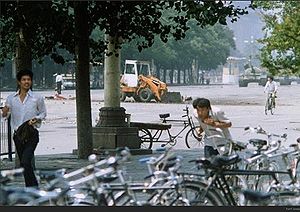
As Times editor Patrick Witty writes, the newly published image encourages a fresh evaluation of the encounter: “Mr. Jones’ angle on the historic encounter is vastly different from four other versions shot that day, taken at eye level moments before the tanks stopped at the feet of the lone protester. Wildly chaotic, a man ducks in the foreground, reacting from gunfire coming from the tanks. Another flashes a near-smile. Another pedals his bike, seemingly passive as the tanks rumble towards confrontation.”
At the above link you can also read Jones’ account from Tiananmen, and why he didn’t seek to have his photo published until 20 years later.
The truth about U.S. bombing in Afghanistan
Filed under: media, politics | Tags: Afghanistan, foreign affairs, intelligence, national security, politics, terrorism, war
Comments (1) When dozens of Afghan civilians were killed during U.S. air strikes early last month, a U.S. military commander attempted to convince the public that the U.S. was not responsible for the deaths. As I wrote here on May 7:
With an investigation of the latest bombing incident underway on Wednesday, the senior U.S. commander in Afghanistan, Gen. David McKiernan, cautioned that the reports of civilian casualties might not withstand scrutiny. “It is certainly a technique of the Taliban and other insurgent groups to claim civilian casualties at every event,” he told reporters. In a follow-up report, McKiernan declined to give any details but said, “We have some other information that leads us to distinctly different conclusions about the cause of the civilian casualties.”
Now, an official U.S. investigation described in media reports today offers a starkly different judgment:
A military investigation has concluded that American personnel made significant errors in carrying out some of the air strikes in western Afghanistan on May 4 that killed dozens of Afghan civilians, according to a senior American military official. The official said the civilian death toll would probably have been reduced if American air crews and forces on the ground had followed strict rules devised to prevent civilian casualties. Had the rules been followed, at least some of the strikes by American warplanes against half a dozen targets over seven hours would have been aborted.
“In several instances where there was a legitimate threat, the choice of how to deal with that threat did not comply with the standing rules of engagement,” said the senior military official, according to the New York Times.
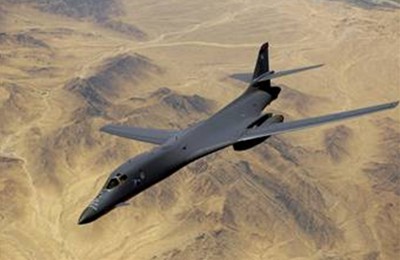
B1 bomber over Afghanistan. (Photo: U.S. Air Force.)
The Times report points out the difficult tactical circumstances of the air strikes on the village of Granai; military investigators also found that the Taliban deliberately used civilians as human shields.
Still, as Noah Shachtman reports today over at Wired, the U.S. military keeps digging in with denials of culpability for the deaths caused by its bombs:
“There is nothing — in the story, or that we’ve seen or heard elsewhere — that says our actions led to additional collateral damage or civilian casualties,” said Lt. Commander Christine Sidenstricker, a spokesperson for U.S. Forces in Afghanistan, according to Shachtman. “And regardless, the fact remains that civilians were killed because the Taliban deliberately caused it to happen. They forced civilians to remain in places they were attacking from.”
As I also noted here recently about plans for further use of U.S. air power in Afghanistan, the Taliban undoubtedly will have more opportunities ahead to “deliberately cause” such civilian deaths.
Digital revolution from Tehran to Tiananmen Square
Filed under: media, politics | Tags: China, foreign affairs, globalization, Iran, media, national security, technology, Twitter
Comments (6) June 2009 could be a big month for democracy on the world stage, with digital technology playing no small part.
With a landmark speech in Cairo on Thursday, Barack Obama will continue his quest to connect with the Muslim world and repair the grave damage done to U.S. standing under George W. Bush. It remains to be seen how much he might also press for government reform by Hosni Mubarak. Egypt is considered a crucial U.S. ally in the Middle East, but more light has been shed on its dark human rights record particularly since 2007, when a video circulated on the Internet showed a man being sodomized with a stick in a Cairo police station.
In Iran later this month, the 10th presidential election could shake things up significantly for a country whose own population is very much displeased with life under Mahmoud Ahmadinejad. The regime has failed to suppress the use of Facebook and Twitter on behalf of the reformist movement.
This week also brings the 20th anniversary of the massacre at Beijing’s Tiananmen Square, where on June 4, 1989, thousands of Chinese pro-democracy protesters were wounded and killed at the hands of the Chinese army. One unknown man, instantly made an indelible historical figure, temporarily halted the killing machine in its tracks.
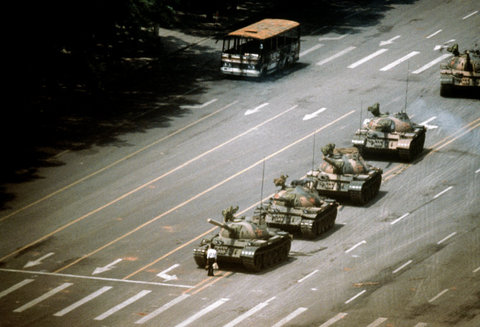
The iconic image of him will again saturate media around the globe in the days to come. (Several versions of it were captured by photojournalists in the vicinity then; the above was taken by Stuart Franklin.) To this day the identity and fate of the so-called Tank Man, who was whisked away by Chinese agents to end the extraordinary standoff, are unknown. (For more, watch this fascinating 2006 documentary, “The Tank Man,” from Frontline.) In the aftermath, the Chinese government maintained that “not one person” was killed in Tiananmen Square, and has depicted the uprising as a “counterrevolutionary rebellion” ever since. As author Yu Hua underscored in an essay this weekend titled “China’s Forgotten Revolution,” today the event is little known to the nation’s youth.
This is the first time I am writing about Tiananmen Square. I am telling my story now because 20 years later — the anniversary is June 4 — two facts have become more apparent. The first is that the Tiananmen pro-democracy protests amounted to a one-time release of the Chinese people’s political passions, later replaced by a zeal for making money. The second is that after the summer of 1989 the incident vanished from the Chinese news media. As a result, few young Chinese know anything about it.
Twenty years later, hopefully the above image and the truth about its bloody context will percolate widely among China’s younger generations. Could the explosive spread of the Internet be the key?
In terms of state media control, China in some ways is a very different place today than even just a few years ago, according to The Washington Note’s Steve Clemons. Following what he describes as a “very candid” diplomatic meeting recently, as well as some guidance from one unnamed Chinese youth, Clemons shared insight about the limitations the Chinese government faces in trying to control an uncontrollable force:
In fact, this young person walking through Internet access issues with me said that Chinese young people can essentially access anything that the government might try and does block. This person who works in international affairs says that the ability of the Chinese government to significantly control access to web-based content is quickly eroding.
And as a result of very interesting and candid discussions with the Vice Minister of the State Council Information Office, Qian Xiaoqian, I believe that many Chinese government officials know that the practice of blocking this site or that is undergoing significant change or reform.
At the end of 2008 China was home to nearly 300 million “netizens,” or regular Internet users, with 162 million blogs and 117 million mobile Internet users, according to Clemons. By the end of this month, Chinese authorities predict another 20 percent jump in those figures.
“Terminals are everywhere,” Clemons says. “The newspapers are actually full of stories about people critiquing government officials, standards, building and infrastructure quality. It’s fascinating — not perfect. I do get the sense that political entrepreneurship is mostly a non-starter here, but even on that front, I have found several key cases where even that form of self-censorship is changing for the better.”
A very relative assessment, of course — seemingly still plenty far from the day when what happened at Tiananmen Square is understood widely across China. But amid the continuing technological revolution, that day could be on the horizon.
UPDATE 6/2/09: From photo sharing on Flickr.com to BBC television, the Chinese government now has a sweeping effort underway to enforce a media blackout of anything revealing the Tiananmen uprising 20 years ago. “The measures came as the authorities tried to close all avenues of dissent ahead of Thursday’s anniversary, placing prominent critics under house arrest and banning newspaper from making any mention of the pro-democracy protests,” reports the Telegraph. “The co-ordinated internet ‘takedown’ occurred at 5pm local time (10am GMT) on Tuesday as a broad range of websites suddenly became unavailable to Chinese internet users.”

But the evolving digital realm apparently is enabling at least some breakthrough: “Twitter users found alternative outlets in rival providers to evade the censors.”
More on the Twitter aspect from the Guardian.
The coming war on Sonia Sotomayor
Filed under: media, politics | Tags: immigration, law, media, politics, Twitter
Comments (2) It’s already underway, of course. The attacks in fact began well before her nomination.
 Barack Obama’s selection of Sotomayor for the Supreme Court weaves another bright strand into an epic of American political transformation — both a groundbreaking and politically shrewd move by the president. But don’t think for a minute that’ll stop opponents from fighting dirty and doing whatever they can to block her path to the nation’s top bench.
Since the announcement of her selection on Tuesday morning, many pundits have parroted the same silly theory: The tattered Republican Party, the reasoning goes, just can’t afford to attack the first Hispanic woman ever nominated to the court — not least because the GOP in recent years has screwed itself royally with the pivotal voting bloc she represents.
“Unless the vetting process missed something big that will turn sentiment against her,” wrote Chicago Tribune blogger Eric Zorn, “Republicans who try to stall or block the first Hispanic nominee to the high court will be stepping into what looks almost like a political trap — a way to further marginalize the GOP and identify it as the party of angry white people.”
Across the cable news networks on Tuesday, this same wishful thinking was flowing from liberal guests holding forth with Keith Olbermann and Larry King. The folly can also be seen in this post from blogger David Kopel at The Volokh Conspiracy, who points out the herd-like denial of lefty bloggers on the subject:
A special poll of bloggers from The National Journal asked “Would it be politically smart for Republicans to try to block the confirmation of Judge Sonia Sotomayor?” Among the Left bloggers, the unanimous answer was “No.” On the Right, 53% said “No” and 47% said “Yes.”
I voted “Yes,” and wrote: “The Democrats who tried to block Roberts and Alito appear to have suffered no adverse consequences. [And, I should have added, neither did the Dems. who filibustered Miguel Estrada, who, like Sotomayor, is a Hispanic with an impressive life story.] Sotomayor is on the wrong side of fairness, empathy, the Constitution and the American people in regards to firearms ownership (Maloney v. Cuomo; United States v. Sanchez-Villar); wealthy people using the government’s eminent domain power to extort money from small business (Didden v. Village of Port Chester); and a racial spoils system for government employees (Ricci v. DeStefano).
Conservatives know full well that the stakes with Sotomayor’s nomination go far beyond the next election cycle or perhaps a couple more years in the political wilderness. While her place on the Supreme Court’s political continuum (presumably somewhere left of center) wouldn’t be clear for some time, if confirmed, the 54-year-old judge is likely to serve for decades.
The battle began even before she was nominated. In a preemptive strike published in the right-wing magazine FrontPage in early May, John Perazzo played to racial fears in an article titled “The Next Token Justice?”
“Sotomayor considers her ethnicity of paramount importance,” he wrote. “She began consciously developing a sense of her ethnic identity as a young woman and has allowed identity politics to act as a lens through which she sees her jurisprudence. During her student years at Princeton University in the 1970s, Sotomayor became actively involved in two campus organizations devoted chiefly to the celebration of an ethnicity distinct from that of the white majority.”
While most Senate Republicans so far seem to be feigning polite caution about the nomination, former GOP presidential candidate Mike Huckabee isn’t holding back:
Sotomayor comes from the far left and will likely leave us with something akin to the “Extreme Court” that could mark a major shift. The notion that appellate court decisions are to be interpreted by the “feelings” of the judge is a direct affront of the basic premise of our judicial system that is supposed to apply the law without personal emotion. If she is confirmed, then we need to take the blindfold off Lady Justice.
Rush Limbaugh wasted no time, of course, calling Sotomayor a “reverse racist” and “hack.” Newt is also in on that act, via Twitter. Others are running with “socialist,” thanks to an obviously sinister Norman Thomas citation Sotomayor used — for a college yearbook photo in 1976.

Without a doubt the attacks, from low-down to laughable, are just beginning.
No honeymoon for gay marriage in California
Filed under: California, culture, politics | Tags: California, law, politics, San Francisco
Comments (1) Everybody knew that Tuesday’s ruling on Proposition 8 from the California Supreme Court could only be another charged moment in a long and continuing battle. Even though the 18,000 marriages that followed a favorable court decision here last May will stand, Tuesday’s decision upholding the ban on gay marriage was a near-term victory for social conservatives.
The court had signaled back in March its reluctance to intervene in the ballot initiative process and overturn the will of the voters. But the lone dissenter in the 6-1 decision Tuesday, Justice Carlos Moreno, wrote eloquently (see pp.151-175) about just how much is at stake:
The rule the majority crafts today not only allows same-sex couples to be stripped of the right to marry that this court recognized in the Marriage Cases, it places at risk the state constitutional rights of all disfavored minorities. It weakens the status of our state Constitution as a bulwark of fundamental rights for minorities protected from the will of the majority.
If California invariably serves as America’s cultural vanguard, what seems odd now is how the state appears to be behind the times. Iowa, of all places, is looking more socially progressive. Moreno cited the recent decision striking down a ban on gay marriage by that state’s high court, whose justices pointed out “the long and painful history of discrimination against gay and lesbian persons” in many parts of the country.
Moreno continued: “I realize, of course, that the right of gays and lesbians to marry in this state has only lately been recognized. But that belated recognition does not make the protection of those rights less important. Rather, that the right has only recently been acknowledged reflects an age-old prejudice … that makes the safeguarding of that right by the judiciary all the more critical.”
Reactions on both sides of the ruling have been heated, to say the least, and San Francisco is abuzz with demonstrations.

“Well, looks like religiously inspired hatred has won the day over the values this formerly great nation was founded on,” said one of nearly 1,800 commenters on SFGate.com Tuesday afternoon.
“Its not about equality folks. It’s about bowing down to the homosexual agenda or being called a bigot,” said another.
And as another made clear, the costly battle is far from over: “As expected from a legal standpoint, but nevertheless disappointing from the larger view of justice for all. Back to the voters and if the trend continues Prop 8 will be repealed by a decent majority in 2010. Onward!”
Dick Cheney and the audacity of hostility
Filed under: media, politics | Tags: CIA, Dick Cheney, foreign affairs, intelligence, national security, politics, terrorism, war
Comments (4) The former vice president’s speech on Thursday at the American Enterprise Institute was little more than an exhaustive rehash of his hard-line views about the so-called war on terror. But it was notable for one thing: The degree to which it was shot through with antagonism.
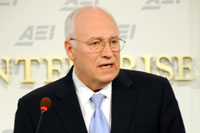 Cheney went beyond his usual monotone delivery. He set himself up as a “freer man” who ostensibly could now speak his mind outside the constraints of politics. The speech he then went on to deliver was fraught with nothing but politics — betraying how much he desires to extend his political influence beyond office and shore up his tortured legacy. The familiar litany of dubious assertions he made about covert Bush administration programs, from spying inside the United States to “enhanced interrogations” of captured terrorists, will be debunked yet again across the media.
But what of his naked disdain for one of the nation’s most respected news gathering institutions? Cheney emphasized that the Bush government’s Terrorist Surveillance Program “prevented attacks and saved lives,” despite that no clear evidence of that has ever emerged. “The program was top secret, and for good reason,” he said, “until the editors of the New York Times got it and put it on the front page.” He noted how, after September 11, 2001, the Times had spent months publishing the pictures and the stories of everyone killed by al-Qaeda in the terrorist attacks. “Now here was that same newspaper publishing secrets in a way that could only help al-Qaeda,” he sneered. “It impressed the Pulitzer committee, but it damn sure didn’t serve the interests of our country, or the safety of our people.”
(This was derision crafted in advance, no less; his prepared remarks, as posted on AEI’s web site, contained the emphatic “damn sure” phrase.)
Political opponents in general were the target of Cheney’s wrath for not seeing all the “exacting efforts to do a hard and necessary job and to do it right” when it came to CIA operatives subjecting captured terrorists to such measures as mock execution by drowning.
“We hear from some quarters nothing but feigned outrage based on a false narrative,” Cheney said. “In my long experience in Washington, few matters have inspired so much contrived indignation and phony moralizing as the interrogation methods applied to a few captured terrorists.”
At several turns Cheney directly attacked President Obama — by most counts unusual behavior from a top member of a preceding administration against a sitting president. Noting that Obama “reserved for himself the authority to order enhanced interrogation after an emergency,” Cheney scorned the president: “When they talk about interrogations, he and his administration speak as if they have resolved some great moral dilemma in how to extract critical information from terrorists. Instead they have put the decision off, while assigning a presumption of moral superiority to any decision they make in the future.”
Another terrorist attack on Americans is not a matter of if but when. It may come at a Bronx synagogue. It may come in Minneapolis.
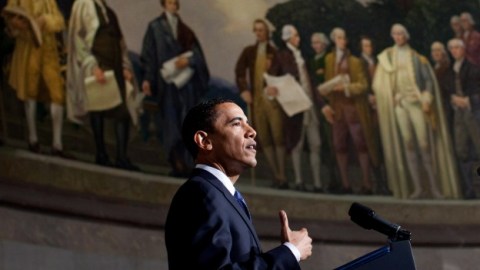 In his own speech on Thursday, Obama acknowledged the danger. “Neither I nor anyone can stand here today and say that there will not be another terrorist attack that takes American lives.” Yet, though his speech at the National Archives in Washington was delivered just prior to the former vice president’s on Thursday, it couldn’t have been a clearer rebuke of the Cheney doctrine:
The American people are not absolutist, and they don’t elect us to impose a rigid ideology on our problems. They know that we need not sacrifice our security for our values, nor sacrifice our values for our security, so long as we approach difficult questions with honesty and care and a dose of common sense. That, after all, is the unique genius of America. That’s the challenge laid down by our Constitution. That has been the source of our strength through the ages. That’s what makes the United States of America different as a nation.
I can stand here today, as President of the United States, and say without exception or equivocation that we do not torture, and that we will vigorously protect our people while forging a strong and durable framework that allows us to fight terrorism while abiding by the rule of law. Make no mistake: If we fail to turn the page on the approach that was taken over the past several years, then I will not be able to say that as President. And if we cannot stand for our core values, then we are not keeping faith with the documents that are enshrined in this hall.
The outcome of last November’s election was in part a popular rejection of the politics of fear. After eight years of Bush-Cheney governance, from the mess at Guantanamo Bay to the mess in Afghanistan, there are no clear or easy solutions. But on a day of charged, dueling speeches, at least there can be no confusion about which of the two voices has the power to act on the nation’s behalf.
Untold damage of Iraq and Afghanistan
Filed under: media, politics | Tags: Afghanistan, foreign affairs, health, media, national security, politics, terrorism, war
Leave a Comment In recent months the war in Iraq had mostly retreated from the national headlines. It took the disturbing news of an American soldier apparently gunning down five of his fellow servicemen in a Baghdad “combat stress clinic” to jump-start any major media coverage. The killings provided the kind of sensational firepower the cable news networks seem to require for any sustained coverage — but the incident also highlighted a grave problem, one that America increasingly will have to confront as two long wars go on.
New York Times columnist Bob Herbert says that he “couldn’t have been less surprised” by the fratricide in Baghdad. “The fact that this occurred at a mental health counseling center in the war zone just served to add an extra layer of poignancy and a chilling ironic element to the fundamental tragedy,” he wrote on Tuesday. “The psychic toll of this foolish and apparently endless war has been profound since day one. And the nation’s willful denial of that toll has been just as profound.”

A Washington Post report on Sunday laid out the bleak metrics for anyone who might care to look:
Since 2001, nearly 1 million soldiers have deployed to Iraq and Afghanistan, and more than 300,000 of them have served multiple combat rotations, most lasting 12 to 15 months. Currently there are 160,000 soldiers in those war zones, and of those, nearly 30,000 are on at least their third or fourth tour, Pentagon data show.
An estimated 20 percent of service members return from the wars psychologically damaged, with depression or symptoms of post-traumatic stress disorder such as nightmares, hyper-vigilance and emotional numbing, according to a Rand Corp. study last year.
That’s tens of thousands of combat veterans with psychological damage.
And there is no end in sight for the predicament — for the near-term at least, the total number of troops in the war zones is going up, with President Obama deploying another 20,000 to Afghanistan.
That escalation sparked debate in a conversation I had with a couple of friends over the weekend regarding Afghanistan and Pakistan. The question we grappled with: Now under Obama’s leadership, what exactly is the U.S. trying to accomplish in the region? None of us could come up with a clear answer.
Steve Coll suggests that Obama’s aid-driven approach is focused on hearts and minds, that it “seeks to alter the daily experiences and thus the political outlooks of Afghan and Pakistani civilians” and thereby drain recruiting pools for the Taliban and Al Qaeda. But as I wrote about here recently, the concurrent heavy use of air power is exacting a counterproductive cost. As Coll also notes: “Four years ago, polls showed that eighty-three per cent of Afghans held a favorable view of the United States; today, only half do, and the trajectory is downward. Persistent civilian casualties caused by air strikes in rural Afghanistan are a major cause of this deterioration.”
That may help explain why a top U.S. military commander would try to mislead the public about U.S. air strikes gone wrong. The foolish thing about that tactic, of course, is that the illusion can’t last for long.
Why Obama is right about the torture photos
Filed under: media, politics | Tags: CIA, FBI, foreign affairs, intelligence, law, national security, politics, terrorism, war
Comments (1) The president’s decision this week not to make public additional graphic photos from U.S. military investigations into torture was the right one. I say that as someone who had a hand in helping make public a large collection of such photos three years ago.
In early 2006, I was part of a team of reporters and editors at Salon that spent many weeks scrutinizing, reporting on and carefully assembling a cache of raw evidence from a classified Army investigation that had been obtained by investigative reporter Mark Benjamin. The culmination of our work was “The Abu Ghraib Files,” a groundbreaking report documenting the notorious Iraq war scandal and its aftermath.
One purpose then of our publishing nearly 300 disturbing images from the Army’s criminal investigation was to help deepen the American public’s understanding of what some members of its military had done. The other essential purpose of our report was to underscore that, two years after the scandal had come to light, nobody above the level of foot soldier in the U.S. military or government had been held accountable — even though it had become clear that the criminal acts sprang from policies crafted and directed at the highest levels of the Bush government.
That failure of accountability remains in place today, to our national discredit. And that should be the primary focus now: The continued pursuit of those responsible for the policies that gave rise to the war crimes.

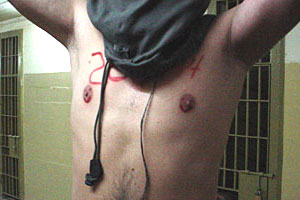

That’s not to say Obama’s choice was an easy one, particularly given his vows of greater transparency, but I think his cost-benefit analysis here is wise. The nature of the crimes has been documented extensively and is known the world over. Publication of the additional images, based on the contours we have of them from news reports, is not likely to add “any additional benefit to our understanding of what was carried out,” as Obama put it on Wednesday. Allowing past if newly revealed images of intimidation and degradation to be splashed across the media in an explosive news cycle, on the other hand, would likely enrage legions worldwide and do fresh damage to America’s reputation.
Beginning to repair the grave damage done to America’s standing in the world under Bush was part of the great promise of Obama’s election. He’s been off to a strong start, with his gestures of respect for the Muslim world and his reaching out to political adversaries from Tehran to Havana. Perhaps it would be worth the risk of undermining that shift if the torture perpetrated by Americans at Abu Ghraib, Guantanamo Bay and elsewhere somehow remained obscure. But that’s not the case.
Obama did miscalculate with part of his rationale, emphasizing that releasing additional photos could endanger U.S. troops. As Pentagon spokesman Geoff Morrell reiterated in the Washington Post, “With 20,000 additional forces coming into Afghanistan, an election in August and the fighting season in full swing right now, the timing is particularly bad.”
The commander in chief wants to show support for the troops, especially at a time of escalation — but it’s a misguided emphasis, because on its face it aligns Obama too closely with tactics used at the outset of the torture scandal by Bush, Cheney and Rumsfeld as they sought to cover it up. (Unsurprisingly, some on the political left have used this point to pounce on Obama.) Moreover, it’s an unconvincing argument — U.S. troops are already in danger on a daily basis in Iraq, Afghansitan and elsewhere.
More important to consider in all this is the president’s courageous decision recently to declassify Justice Department memos and reignite a national debate, false dogma of Dick Cheney and all, about the policy origins of the disaster. The important development of the week, then, was not Obama’s about-face but the congressional testimony of Ali Soufan, a former FBI agent directly involved in the interrogation of crucial terrorist captives early in the war. Soufan, a highly authoritative source on the matter by most counts, barely stopped short of testifying that George W. Bush and his top officials peddled lies apparently fed to them by the CIA about the interrogation of Abu Zubaydah. (Soufan called the former president’s statements “half truths.”)
Allegations that serious, atop further evidence concerning the authors of the brutal interrogation policy — and there are indications that other revealing memos may be forthcoming — seem to suggest real momentum toward greater accountability, possibly at a much higher level than we’ve seen. That of course is the goal here. Are more grim photos necessary to reach it?
I have friends in the human rights community, some of whom I worked with at length to help expose the troubling national security policies of Bush and Cheney. But I have to disagree with them on this one.
“This essentially renders meaningless President Obama’s pledge of transparency and accountability,” said the ACLU’s Amrit Singh this week, regarding the reversal on the photos. The Obama administration, she said, “has essentially become complicit with the torture that was rampant during the Bush years by being complicit in its coverup.”
It’s an advocacy group’s job to keep the heat on, but that’s rhetoric pretty far gone. It has long been clear that the torture debacle must be resolved to higher account. How best to do that remains up for debate. Meantime, what I see is a president working to navigate treacherous political waters, and doing it mostly with skill and conviction, in a prolonged and painful storm not of his making.
UPDATE 5/24/09: Heartening today to see that I’m in good company on the Op-Ed pages of the Sunday Times, where journalist Philip Gourevitch, who has explored the Abu Ghraib nightmare at great length, underscores why releasing additional photographs wouldn’t tell us anything we don’t already know. After all, as he points out, Dick Cheney has been glad to take credit lately for having terrorists under interrogation slammed against walls or waterboarded.
“Photographs can’t show us that the real bad apples were at the top of the civilian chain of command in Washington,” Gourevitch writes, “but that is what we need to know — or, rather, since we’ve known it and gone along with it for a long time, that is what we need to come to terms with now.”
 Mark Follman
You must be logged in to post a comment.