Archive for the ‘media’ Tag
Brevity, brainpower… and Obama’s beer hour
Filed under: culture, media, politics | Tags: CIA, foreign affairs, intelligence, Israel, media, national security, technology, television, terrorism, war
 Leave a comment
 If attention spans these days are indeed being digitally obliterated, you may not get very far past this sentence. But if you’re looking for a few good places where you might actually go a little deeper (besides this blog, of course!), here are a few recommended links — a quick rundown of What Else I’ve Been Reading Lately.
Benedict Carey continues an engrossing series about the human brain, with the latest installment looking into the science of gut feelings. What is it that might give some U.S. soldiers in Iraq or Afghanistan exceptional ability to detect roadside bombs? It could be that cognitive abilities matter most — whether innate or gained potentially through training.
NPR has a look at how Bryant Neal Vinas, a 26-year-old aspiring jihadi from Long Island, made his way pretty darn close to Osama bin Laden. According to terrorism expert Sam Rascoff, “Vinas’ experience tends to undermine the story we’ve been telling about what it takes to get inside the hard-core al-Qaida.”
In “The Kill Company,” Raffi Khatchadourian further investigates the dark side of U.S. military action in Iraq. In the fog of this long war, where is the line between killing and murder on the battlefield?
With a thought-provoking Op-Ed in the Times, Haaretz’s Aluf Benn suggests Barack Obama has blown it by not talking to Israelis, while just about everyone else in the world has been hearing directly from the Diplomat in Chief. “This policy of ignoring Israel carries a price,” Benn says, especially with respect to the incendiary issue of the settlements.
After spending a chunk of time back in June writing about the election upheaval in Iran, it was inspiring to read this high-quality exchange between bloggers Ethan Zuckerman and Robert Mackey about the challenges of covering events in Iran. Would that this kind of open discussion, at the nexus of technology, politics and journalism, be much more commonplace.
 And last but not least… Gates-gate. Since you made it this far, I’ll go a tad deeper here. Obviously, a bunch of media folks have no choice but to waste a bunch of time obsessing about and over-analyzing what brands will be consumed during the imminent beer summit at the White House. (How revealing that the black Harvard professor is going for a Red Stripe! Etc.) It’s not as if there’s an array of daunting issues in the world on which to focus. Nonetheless, CNN’s “Situation Room” today has been featuring a “beer chat” countdown clock onscreen, along with graphic deconstructions of where the gathering will take place in the White House rose garden, and with Wolf Blitzer practically beside himself teasing the event every 60 seconds. (Jon Stewart no doubt is hailing the cable news gods ahead of tonight’s sendup.)
In the end, I think Obama “acted stupidly” himself by getting so directly involved in this whole kerfuffle. He has done wonders to help push America forward on intractable issues of race. (His March 2008 speech in Philadelphia on race was perhaps the high-water mark of his tidal wave of a presidential campaign.) But I agree with Glenn Loury that Obama spent his political capital poorly on this — even if, as Charles M. Blow recounted quite poignantly, America still has a long way to go.
 UPDATE: An important twist in the paramount beer summit story: It turns out that Gates recalculated and went with a Sam Adams instead. We can only ponder the significance… also see Michael Scherer, on how the White House press corps got played on this one.
On unsettling ground in Israel
Filed under: politics | Tags: art, foreign affairs, Israel, media, national security, politics
Leave a comment Even after working for years with several deeply knowledgeable, insightful writers to cover the morass known as the Israeli-Palestinian conflict, perhaps the only thing that’s really clear to me right now is this: It is ever atop the list of the world’s most daunting problems. And while no problem is more fraught with righteousness and political posturing (on all sides), at the heart of it is the long-running battle over facts on the ground. Sometimes that battle is more open, sometimes it is more clandestine — but always the struggle for the land, that seemingly tiny yet politically enormous sliver of it.
Despite my strong desire to see the region for myself, I’ve not yet had a chance to visit. And that’s one reason why Eric Orner’s recent piece, “The Land Grab out My Front Door: A Memoir of Jerusalem in Pictures,” grabbed my attention.

In a subject realm where anger and outrage are the norm, Orner’s work is an understated and intimate account of what’s happening on the ground in Jerusalem’s Abu Tor neighborhood, where Orner has been living.
“Israelis call Abu Tor ‘mixed’, meaning both Arabs & Jews live here,” he writes. “This doesn’t really capture the reality of the place, though. Well-off Jewish American ex-pats live in fancy condos at the top of the hill… while Arab families live further down the street as it makes a twisty descent towards the valley floor…”
He goes on to depict what appear to be dubious actions by Israeli authorities to demolish an Arab community that apparently stands in the way of developing “an archeological theme park” in a coveted part of Old Jerusalem. Such a development, Orner notes, is likely to draw lots more “Euro-Yankee tourist Shequels.” (Not to mention what it would add in terms of Israel-favorable facts on the ground.)

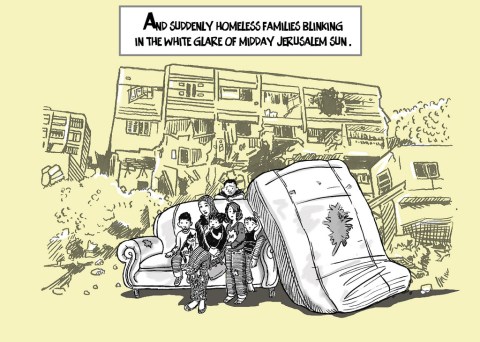
Check out the whole piece (at the above link), both visually engaging and eye-opening.
Meantime, while there seem to be some hopeful signs of progress for Palestinians in the West Bank these days, according to a report from the Times’ Isabel Kershner, few people believe that the right-wing government of Bibi Netanyahu is sincere when it comes to the Israeli prime minister’s recent talk of peace with the Palestinians. Netanyahu has been under pressure from the Obama administration, particularly on the issue of Israeli settlements.
But as Kershner reports, “even senior officials and prominent figures of his conservative Likud Party have been busy explaining, privately and publicly, why they think there is not likely to be a Palestinian state any time soon, in ways that raise even more questions about the current government’s commitment to reaching a final peace accord. And Mr. Netanyahu’s diplomatic turnaround was greeted by a notable silence among the Likud firebrands and hawks, widely interpreted here as a sign that they feel they have nothing to fear.”
According to the Israeli newspaper Haaretz, Netanyahu claimed this week that Jerusalem is an “open city” that permits all its inhabitants, Jewish and Palestinian, to purchase homes in both its eastern and western parts. “An examination by Haaretz, however, presented a rather different situation on the ground,” reports the paper, under the headline “Most Arabs can’t buy most homes in West Jerusalem.”
Haaretz also reports: “Deputy Foreign Minister Danny Ayalon said Tuesday that Israel had an ‘indisputable’ right to build anywhere in Jerusalem, including East Jerusalem, following international calls on Israel to halt construction in the disputed area.”
The political picture apparently has grown tense enough that a senior aide to Chancellor Angela Merkel of Germany — whose country usually displays staunch support for Israel — commented in a German publication that if the settlement building does not stop, Israel is running the risk of “gradually committing suicide as a democratic state.”
Sharp turn on Wall Street
Filed under: culture, media, politics | Tags: economy, globalization, law, media, politics, recession, television, Wall Street
Leave a comment My cover story for the July/August issue of Arrive is now riding the northeastern rails, a look at the nation’s economic crisis and the role of the financial media. CNBC’s Maria Bartiromo, the Wall Street Journal’s David Wessel and others ponder the end of days on Wall Street and what the American economy will look like on the other side of its most vicious hangover in decades.
CNBC has taken some big lumps this year for the behavior of some of its on-air personalities, perhaps deservedly so. But during a lengthy chat for the story earlier this year, after pushing past a bit of canned stuff, I found Bartiromo to be quite knowledgeable, engaging and forthright. And I happen to agree with her take on Jon Stewart’s big beatdown of Jim Cramer and CNBC back in March.
 Will America’s investment banking sector soon be a miniature of its turn-of-millennium self? (And would that be a good thing?) Who are the most deserving villains in the blame game? Read on… Meanwhile, during a quick ATM stop at a Chase bank branch yesterday I witnessed an exchange that seemed in some small way encouraging — perhaps an indication that America has started to move beyond the denial/anger stage, and into the acceptance/change stage.
A bank employee was walking out just as a long-time customer was walking in. The customer asked the bank employee if in the past few weeks it had gotten any easier to get a loan. (The specific type wasn’t clear, though it was obviously either a home mortgage or small business loan.) “No, it hasn’t gotten any easier,” the bank employee said, with a cheery smile. “As you know, they’re asking a lot more questions now.” The customer smiled back, unfazed, and headed into the bank, paperwork in hand.
Moonwalk for Mahmoud Ahmadinejad
Filed under: culture, media, politics | Tags: foreign affairs, globalization, Iran, media, music, national security, politics, technology, television, Twitter
Leave a comment The embattled Iranian regime couldn’t have dreamed up a better reprieve from scrutiny than the worldwide media frenzy over Michael Jackson’s death, only just getting underway.
How much Jackson coverage will be too much? (Whatever that is, we’re likely to find out.) His death is tragic but unsurprising given his condition in recent years. A great sadness for his family, friends and fans — and arguably a great relief, as the world can finally stop fixating on the downtempo horror show of misery and self-mutilation, and instead remember Jackson for the extraordinary music and artistry he gave, particularly in his earlier days.

Indeed, the postmortem coverage will be ceaseless for days to come, while Mahmoud Ahmadinejad’s sham of a reelection and attendant brutality recedes from the headlines. But what continues unfolding in Iran remains worthy of top billing. Prospects for the beginnings of rapprochement with the Obama administration now appear to be on ice. The regime is claiming the election was fraud-free. (The voting populations of various Iranian towns must have swelled overnight.) Clerics close to Ayatollah Khamenei are calling for dissidents to be punished ruthlessly and savagely. Veteran journalists anticipate that the country’s media lockdown will continue for a long time. (NBC News chief foreign correspondent Richard Engel: “We’re openly being called the instigators of a revolt.” More details here on the media crackdown.)
 Decentralized digital communications may become ever more critical to publicizing what’s transpiring inside Iran. As of Friday afternoon Michael Jackson commanded the top three slots for Twitter hashtags (#MJ’s; #RIP Mj; #michaeljackson), but Iran was still trending at fifth and sixth (#Iran; #iranelection). Also of note: The UK blogger whose Iran cyberwar guide mysteriously vanished last week is back online and has a second installment, an interesting rundown for tech and politics junkies alike. Meanwhile, this recently posted mash-up evokes the strange confluence of the historical moment, setting images from the Iranian election upheaval (some of them graphically disturbing) to Jackson’s controversial song “They Don’t Care About Us.”
Black clouds over Tehran
Filed under: culture, media, politics | Tags: foreign affairs, globalization, Iran, law, media, national security, politics, technology, Twitter
Comments (1) There will be blood — much more of it, if need be — was the implicit message from Ayatollah Khamenei at Friday prayers in Tehran. “Struggling on the streets after elections is not acceptable,” the Iranian Supreme Leader said. “If they do not stop these actions, then any consequences will be their responsibility.”
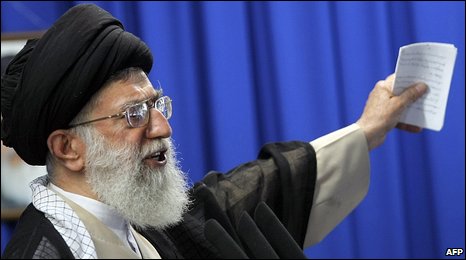
Khamenei emphasized that the Islamic republic would never “commit treason” by manipulating votes, that the country’s legal system does not allow vote-rigging. Mahmoud Ahmadinejad’s large margin of victory — supposedly by 11 million votes — proved that the election could not have been fixed, Khamenei said.
Many Iranians, and people around the world, understand that’s a lie. As Stanford University’s Abbas Milani noted on CNN Thursday night, numerous towns across Iran had reported vote totals for Ahmadinejad amounting to more than 100 percent of their resident populations.
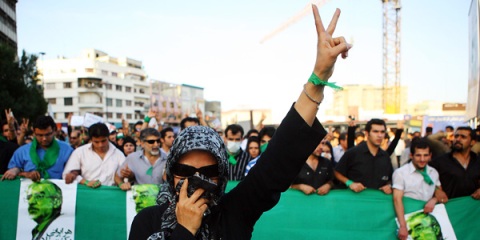
But in Iran the fist, not the facts, likely will prevail.
 Neil MacFarquhar reports on the violence unleashed in Iranian cities at night since last Friday’s election, with the vigilante thugs known as Basijis beating, looting and sometimes gunning down protesters they tracked during the day. Says one Iranian exile who helped found the Revolutionary Guards during the 1979 Islamic revolution: “It is the special brigades of the Revolutionary Guards who right now, especially at night, trap young demonstrators and kill them.”
If mass protests continue, as seems almost certain, more violence will spill into broad daylight, whether or not any foreign media is left inside the country to document it.
UPDATE: The Times’ Lede blog has a source in Tehran describing the use of Twitter — apparently less instrumental in organizing street demonstrations, while “primarily being used to communicate with the outside world.”
Regarding prospects for greater violence and ultimate political outcome, Steve Clemons shares an interesting dispatch from “a well-connected Iranian internationalist” who has been in Tehran during the post-election unrest. The source describes witnessing young Mousavi supporters in the streets at night, fighting back by “hunting” Basijis. He describes them as agile “militia style” groups, including “a surprising number of girls.”
Iran election upheaval continues
Filed under: culture, media, politics | Tags: foreign affairs, globalization, Iran, media, national security, politics, technology, Twitter
Comments (3) Trading in their bright green for black, hundreds of thousands of protesters marched again in Iran on Thursday, urged by presidential challenger Mir Hossein Mousavi to mourn the students killed during demonstrations earlier in the week. Photographer Saeed Kamali Dehghan documented the action for the Guardian in Tehran’s Imam Khomeini square:


 NPR’s Mike Shuster reports that members of the Basij, the feared Iranian paramilitary group, have instigated violence under cover of darkness — apparently to help justify a more forceful crackdown against the opposition movement, which by most accounts largely has remained peaceful. One eyewitness report includes a thug exploding an incendiary grenade under a car.
The extraordinary role of digital media in the upheaval remains a hot topic, now including some obligatory contrarianism from the veteran journo corps. (Any hot story in the media tends to provoke both herd-like hyperventilation and a subsequent above-the-fray backlash.) Slate’s Jack Shafer questions the noise-to-signal ratio of the gangbusters #IranElection Twitter stream and points to a potential dark side: “How long before the secret police start sending out organizational tweets — ‘We’re massing at 7 p.m. at the Hall of the People for a march to the Hall of Justice!’ — and busts everybody who shows up?”
Business Week’s Joel Schectman wonders if the “Twitter revolution” has been overblown: “Iran experts and social networking activists say that while Iranian election protesters have certainly used social media tools, no particular technology has been instrumental to organizers’ ability to get people on the street.”
Sure, it’s a worthwhile reminder not to get too utopian about the empowerment of digital technology, especially as the foreign media gets pushed out of the country — but the bottom line is clear: Media control has long been a powerful, essential weapon of the Iranian regime. Twitter, Facebook and blogs increasingly are powerful forces toward neutralizing that weapon. According to Abbas Milani, director of the Iranian Studies Program at Stanford University, Iran has the highest number of bloggers per capita in the world. No matter the outcome of Iran’s historic turmoil, they will continue to be heard.
Twitter as unstoppable diplomacy in Iran
Filed under: culture, media, politics | Tags: foreign affairs, globalization, Iran, language, media, national security, politics, technology, Twitter
Comments (5) The Guardian reports an estimated half million people protesting in Tehran on Wednesday, the fifth day of unrest. Despite President Obama’s cautious posture thus far, the Iranian regime has now begun to openly blame the United States for interfering in the election and inciting upheaval. As the vulnerabilities of the regime and its Supreme leader, Ayatollah Khamenei, have become more apparent, the tactic undoubtedly is aimed at undercutting an opposition movement in a country where anti-U.S. sentiment still exerts a powerful pull. It seems to have an out-of-touch air of desperation to it — blame the ol’ Great Satan, and maybe the masses will fall back in line with renewed nationalist fervor. The problem is, those masses now see Barack Obama, not George W. Bush, presiding in the White House. (Not to mention the price of tomatoes in Tehran.)
The situation on the ground appears to be growing more ominous. According to a Reuters report from Wednesday, Mohammadreza Habibi, the senior prosecutor in the central province of Isfahan, declared that demonstrators could be executed under Islamic law. “We warn the few elements controlled by foreigners who try to disrupt domestic security by inciting individuals to destroy and to commit arson that the Islamic penal code for such individuals waging war against God is execution,” Habibi reportedly announced.
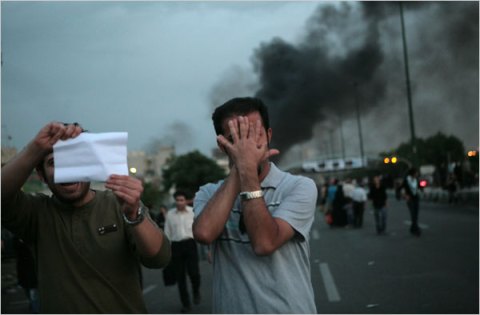
Protesters in Tehran, June 15. (Newsha Tavakolian/Polaris/New York Times)
Other dispatches from Wednesday described the regime further cracking down on digital communications. In one particular way, it’s an area where official U.S. involvement indeed appears to have been instrumental, in terms of the extraordinary role Twitter has played following the election upheaval. With the messaging network set to go offline temporarily earlier this week, the U.S. State Department stepped in. The Times reports:
On Monday afternoon, a 27-year-old State Department official, Jared Cohen, e-mailed the social-networking site Twitter with an unusual request: delay scheduled maintenance of its global network, which would have cut off service while Iranians were using Twitter to swap information and inform the outside world about the mushrooming protests around Tehran. The request, made to a Twitter co-founder, Jack Dorsey, is yet another new-media milestone: the recognition by the United States government that an Internet blogging service that did not exist four years ago has the potential to change history in an ancient Islamic country.
“This was just a call to say: ‘It appears Twitter is playing an important role at a crucial time in Iran. Could you keep it going?’” said P.J. Crowley, the assistant secretary of state for public affairs. Twitter complied with the request, saying in a blog post on Monday that it put off the upgrade until late Tuesday afternoon — 1:30 a.m. Wednesday in Tehran — because its partners recognized “the role Twitter is currently playing as an important communication tool in Iran.”
The global interconnection helping to electrify Iran’s history in the making has been on display in myriad ways over the last few days. This morning I was able to zoom in on one specific example of it: After I’d written here yesterday about a UK blogger’s “#Iranelection cyberwar guide” — which soon vanished from the Web and remains missing as of Wednesday morning Pacific time — I’d also put the link out via my Twitter page. By early this morning at least one person apparently located in Tehran had read and re-tweeted it. (See tweet there with: “http://bit.ly/mfo0i #iranelection”) That quickly led to a burst of referral traffic coming to my site from that person’s Twitter feed. You can imagine the exponential spread to follow. Multiply that by millions of other blog posts and tweets, and you start to see the extraordinarily powerful picture of communication.
As I noted yesterday, there isn’t necessarily any way to verify the particular Twitter user’s location or identity — is it really some young woman, a spark in her eyes, now leaving her dorm room for the massive demonstration in Tir square? — and it’s just one little example of precisely why the Iranian regime will not be able to stem the digital tide.
UPDATE 12:30pmPDT: As K.M. Soehnlein points out, the crackdown on foreign journalists inside Iran raises a disturbing contrast. The Times surveys the latest circumstances, and it’s chilling to read. Most journalists allowed into Iran only get one-week visas, and their numbers are fast dwindling:
“Visa extensions have been denied across the board,” says Times executive editor Bill Keller, who has himself been reporting from Tehran this week. “Some reporters have considered staying on without visas, working under the radar. There are two problems with that. First, this is a fairly efficient police state; the chances of anyone eluding arrest long enough to see how the story plays out are slim. More important, in my mind, is that it puts at risk the decent, hospitable Iranians who would be needed to put us up, translate and help us get the story out.”
Many Western journalists were effectively confined to their offices on Tuesday after the information ministry forbid them to report on protests or conduct interviews outside, according to the Times. Some were told they would be arrested if they were spotted on the streets with a camera.
Jim Sciutto, an ABC News correspondent in Tehran, said the Iranian government had “run out of patience” with the televised images of protests. Until Tuesday, he told the Times by email, “we sensed there was the slightest bit of wiggle room and so we took the risk of filming on our cellphones. But now the message seems to be ‘don’t even think about it.’”
And from Keller’s dispatch above:
For a sense of what may await Iran’s discontented when there is no one around to report on it, consider Monday night in Isfahan, Iran’s third largest city and a five-hour drive from the nearest foreign TV camera. As in Tehran, large parts of the city — the squares and boulevards — were scenes of smoke and flames, tear gas, stones crashing into windows, bloodied heads.
The uprising seemed more organic than organized — groups of a few dozen merging into groups of a few hundred, converging on lines of helmeted riot police officers, chanting “Death to the dictator!”
But in Isfahan the police response seemed far tougher.
At one point, a white S.U.V. with a red ambulance-style light raced up behind a knot of protesters and smashed into them, running one over before racing a few blocks to the protection of the riot police.
It may not be much longer before a lot more blood flows.
Iran’s Twitter revolution goes global
Filed under: culture, media, politics | Tags: foreign affairs, globalization, Iran, language, media, national security, politics, technology, Twitter
Comments (3) It’s been amazing to watch it spread.
“As the embattled government of President Mahmoud Ahmadinejad appears to be trying to limit Internet access and communications in Iran, new kinds of social media are challenging those traditional levers of state media control and allowing Iranians to find novel ways around the restrictions,” reports the New York Times. “Iranians are blogging, posting to Facebook and, most visibly, coordinating their protests on Twitter, the messaging service. Their activity has increased, not decreased, since the presidential election on Friday and ensuing attempts by the government to restrict or censor their online communications.”
The circuitry of the situation in Iran truly has gone global — not only is the world watching, but political and tech junkies everywhere are getting involved in the communications battle. One compelling example: A blogger in Wales, Esko Reinikainen, has posted a #iranelection cyberwar guide for beginners.
“The purpose of this guide is to help you participate constructively in the Iranian election protests through twitter,” Reinikainen says. He offers tips including how to disseminate proxy IP addresses for Iranian bloggers to use, how to help them target repressive Web sites and how to help give them cover: “change your twitter settings so that your location is TEHRAN and your time zone is GMT +3.30. Security forces are hunting for bloggers using location and timezone searches. If we all become ‘Iranians’ it becomes much harder to find them.”
 At the Atlantic, Andrew Sullivan is keeping a running log in bold green lettering of tweets ostensibly flowing from the streets of Tehran and beyond. There isn’t really a way to judge the source or authenticity of the material. (For one thing, there are regular mentions at this point of Iranian security operatives spreading disinformation digitally; meanwhile, if Twitter users worldwide increasingly are posing as Iranians per above, how to identify the real ones?) But assuming a majority of it remains authentic, it’s fascinating reading. A sampling from Tuesday morning:
Tehran hotels under high security to stop Iranians from contacting foreign press
anyone with camera or laptop is attacked in street
i am seeing tweets about a lot of disturbances, arrests, violence in Shahrak Gharb, any reports?
we hear 1dead in shiraz, livefire used in other cities RT
Very scared, I was talkin to myuncle in shiraz and he was so paranoid.
If you hear the forces talking in arabic..BE CAREFUL..these guys are imported in, they are not affraid of suicide bombing and killing
Police the reason of insecurity; Dead students buried by profs
Basij attacking Shiraz and Mashad universities, Shiraz U’s dean resigned
some student killed by the 4a blast in Babol Univ’s dorms; surrounded by Basij forces
Militia still attacking people in sidestreets but main roads are peaceful marchers.
All last night we hear shooting accross Tehran – everyone is full of rumours and stories – many arrests in night
stay safe and I will RT anything you write! The world is watching and history is being made–we bear witness!
UPDATE – 6/16/09, 9:55amPDT: Esko Reinikainen’s blog apparently is now having technical problems — overloaded with traffic, perhaps, or blocked or otherwise shut down. The above link currently leads to an “Account Suspended” page at Justhost.com. Unclear if or when his site will be back up. Reading the comments section on his page earlier this morning, I noted that his “cyberwar guide” had already been linked and copied widely, including translations in Spanish and German. I was working quickly and didn’t think to grab the whole thing, unfortunately. Reinikainen himself had warned of the potential for his site to go down, and encouraged copying it.
UPDATE 2: Wired’s Noah Shachtman digs into the complexities of the battle online, and has more of the copy from Reinikainen’s missing blog post. How all of this ultimately shapes events in Iran remains to be seen, but there can be little doubt about the rising potential of digital communications for political movements, from Tehran to Tiananmen.
Panetta ices Cheney, but CIA skates
Filed under: media, politics | Tags: CIA, Dick Cheney, FBI, foreign affairs, intelligence, law, media, national security, politics, terrorism, war
Leave a comment  A long article about CIA director Leon Panetta in the June 22 issue of the New Yorker has prompted a flurry of media attention for comments Panetta made in reaction to Dick Cheney’s latest fear mongering over terrorism and U.S. national security. “It’s almost as if he’s wishing that this country would be attacked again, in order to make his point,” Panetta said of Cheney, according to the article. “I think that’s dangerous politics.”
Cheney pushed back on his “old friend Leon” on Monday, according to Fox News. John McCain also jumped in, defending Cheney’s motivations and playing up discord among rank-and-file spooks: “By the way, I hear morale is not at an all-time high over at the CIA under Mr. Panetta’s leadership,” McCain said. Joe Biden weighed in on the talk-show circuit.
The back and forth is politics in the wake of dueling speeches from Obama and Cheney, but it’s a sideshow. Perhaps the famously secretive Cheney’s inner thoughts can’t really be known, but his hand in brutal interrogation policy couldn’t be better known. As I wrote about here recently, paramount for Cheney is protecting his political legacy and seeing his national security policies vindicated. (The essence of Panetta’s point.) The real news in the New Yorker article, buried deep into its 7,600 words, is the continuing absence of accountability for those who carried out Cheney’s vision to horrific ends.
No criminal charges have ever been brought against any C.I.A. officer involved in the torture program, despite the fact that at least three prisoners interrogated by agency personnel died as the result of mistreatment. In the first case, an unnamed detainee under C.I.A. supervision in Afghanistan froze to death after having been chained, naked, to a concrete floor overnight. The body was buried in an unmarked grave. In the second case, an Iraqi prisoner named Manadel al-Jamadi died on November 4, 2003, while being interrogated by the C.I.A. at Abu Ghraib prison, outside Baghdad. A forensic examiner found that he had essentially been crucified; he died from asphyxiation after having been hung by his arms, in a hood, and suffering broken ribs. Military pathologists classified the case a homicide. A third prisoner died after an interrogation in which a C.I.A. officer participated, though the officer evidently did not cause the death. (Several other detainees have disappeared and remain unaccounted for, according to Human Rights Watch.)
That’s just the tip of the black iceberg, if you add in the numbers involving U.S. military operations — entwined with CIA operations — under Bush and Cheney. As I reported for Salon back in 2005, by then 108 detainees were known to have died in U.S. military and CIA custody since the start of the so-called war on terror. At least 26 deaths were deemed criminal homicides. Who knows if additional bodies piled up since.
As was also reported long ago, medical doctors and mental health professionals were involved in the torture, too, although the extent of their roles remains buried. Citing recently declassified Justice Department memos, Nathaniel Raymond, who works with the advocacy group Physicians for Human Rights, says that medical personnel working for the CIA were “the designers, the legitimizers and the implementers” of interrogation using torture. “We still don’t know how many detainees were in the black sites, or who they were,” Raymond says in the New Yorker. “We don’t fully know the White House’s role, or the C.I.A.’s role … This is arguably the single greatest medical-ethics scandal in American history. We need answers.”
If the accountability picture remains grim (both in terms of the operators and the policy overlords) there is one positive development detailed in the New Yorker piece: Panetta has ambitious plans for a new kind of legally acceptable interrogation capability. A task force led by Harvard Law professor Philip Heymann has been advising Panetta on a proposal to create an elite U.S. government interrogation team, staffed by some of the best CIA, FBI and military officers in the country, and drawing on the advice of social scientists, linguists and other scholars. According to the New Yorker, Heymann describes it as an effort to create “the best non-coercive interrogation team in the world,” the equivalent of “a NASA-like, man-on-the-moon effort” for human-intelligence gathering.
Without a doubt, America would benefit much from recruiting more Ali Soufans, while throwing its “Big Steves” behind bars.
Dave Eggers, Peter Orner and more
Filed under: California, culture | Tags: art, books, California, comedy, film, media, San Francisco, writing
Leave a comment I’m at work on a couple of freelance projects that will soon take me back to the great northwest. More bits here in a couple of days; in the meantime, I must recommend a visit to The Rumpus, a great online culture mag launched a few months back in San Francisco.

It’s got entertaining and informative and sexy stuff of all sorts. (Disclosure: A few of my posts have also been published there.) Editor Stephen Elliott recently interviewed Dave Eggers, who has a forthcoming nonfiction book, “Zeitoun,” about the aftermath of Hurricane Katrina as seen through the eyes of a Muslim-American family in New Orleans. I was struck by Eggers’ comments about his collaborative (and exhaustive) approach to the project:
With a book like this, I think you get the most accuracy when you involve your subjects as much as possible. I think I sent the manuscript to the Zeitouns for six or seven reads. They caught little inaccuracies each time. They have to live with the book, of course, as much as I do, so I needed their approval. With What Is the What and with this book, I consider the book as much theirs as mine. So they were intimately involved in every step, as were their extended families. We had many months to get everyone’s approval over everything, to make sure it was accurate.
Eggers recommends an edition of the Quran to read, discusses why he’s optimistic about print in the digital age (“Do we all want to look at screens from 8am to 10pm? There’s room in the world for both online and paper”) and describes some intriguing plans for McSweeney’s to put out a newspaper.
 Absolutely also check out Peter Orner’s new column, “The Lonely Voice.” His appreciative ruminations on the art of the short story are as engaging and illuminating as any literary writing you’ll find online. (Or in print, for that matter.) Not to be missed.
Tiananmen Square erased
Filed under: media, politics | Tags: China, foreign affairs, globalization, intelligence, media, national security, original reporting, politics, technology
Comments (1) “Today, reports abound of young Chinese saying they don’t know or don’t care about events in 1989,” Xiao Qiang, founder of China Digital Times, wrote this week. “Yet all one has to do is go online to the vast number of Chinese forums and blogs to know that the spirit of Tiananmen is still alive.” He described China’s nearly 300 million youthful netizens and their unprecedented capability to express a roar of dissent, despite heavy government censorship.
I shared that essential optimism, albeit cautiously, in thinking and writing earlier this week about the potential of digital communication from Tehran to Beijing. After I published that post, a friend who teaches in the Bay Area emailed me with a striking example of how successful the Chinese government has been at burying the bloody history of June 4, 1989:
I taught modern Chinese history last semester. I had 3 students who grew up in mainland China in my class. They had never heard about Tiananmen. One of them is the son of a top official in China who was heavily involved in the economic development of Shanghai, the miracle city we all saw during the Olympics. This kid was brilliant and incredibly well informed about Chinese history already. He has levels of access you and I can only imagine and is being groomed to be an elite in the Chinese power system. He had never heard about Tiananmen. Interesting to think that a generation of leaders is growing up with a false view of their recent history.
While the student’s ignorance isn’t surprising, it is indeed astonishing to think that even the very people who might soon be running China wouldn’t necessarily know about what transpired at Tiananmen. Imagine Barack Obama being elected U.S. senator from Illinois without having a clue that Chicago had been torn by violent protests in the 1960s.
One place for inquiring Chinese youth to start would be the collection of raw U.S. government reports from 1989 found in the declassified history of Tiananmen Square at The National Security Archive.

An overview section titled “The Crackdown” brings into focus the actions of the Chinese People’s Liberation Army and the resulting human toll. (In retrospect the initial estimates of people wounded, killed, arrested and executed were conservative. Emphasis here is mine.)
The Secretary of State’s intelligence summary for the following morning (Document 13) reports that “deaths from the military assault on Tiananmen Square range from 180 to 500; thousands more have been injured.” It also describes how “thousands of civilians stood their ground or swarmed around military vehicles. APCs [Armored Personnel Carriers] were set on fire, and demonstrators besieged troops with rocks, bottles, and Molotov cocktails.” …
One section of the Secretary of State’s Morning Summary for June 5th (Document 17), titled “After the Bloodbath,” focuses on developments in Beijing. It reports that “troops continued to fire indiscriminately at citizens in the area near Tiananmen Square.” It also notes the destruction of a large number of military vehicles, threats to execute students, and the potential for violent resistance by students. …
By June 21, the Morning Summary (Document 29) was reporting that, “More than 1,500 have been arrested … including at least six of the 21 ‘most wanted’ student leaders.”
That same section documents how Chinese soldiers also began to turn on each other.
 PBS/Frontline has a lucid narrative timeline of the political and on-the-ground developments leading up to the explosion of violence, including the moment when the PLA soldiers began “firing on unarmed civilians with AK-47s loaded with battlefield ammunition.”
On the New York Times’ Lens blog, four photojournalists who captured famous images of the Tank Man share engrossing eyewitness accounts.
“The remainder of the day was spent trying to gain access to hospitals to determine how many had died or were wounded,” photographer Stuart Franklin writes. “In the two hospitals I could get access to, I found young Chinese — probably students — being treated on the floor of hospital corridors. It was mysterious that there were no dead. I understood later that the majority of the fatalities were taken to children’s hospitals in the city to avoid media attention. Chinese officials worked very hard to obscure evidence of the massacre.”
And Chinese officials remain hard at work on that goal today, despite the irrepressible promise of digital technology. As Yang Jianli, who participated in the 1989 uprising and was held as a political prisoner in China for several years, wrote this week: “It is estimated that the Communist Party employs over 30,000 ‘cyber cops’ to censor Internet traffic.”
UPDATE: In addition to the four photojournalists’ accounts and well-known images from Tiananmen, The Times’ Lens blog now has up an image never before published, with a dramatically different perspective on the Tank Man. The image was captured by then AP photographer Terril Jones. The Tank Man can be seen at the left, in the distance, with the tanks rumbling towards him, while other protesters flee in the foreground:
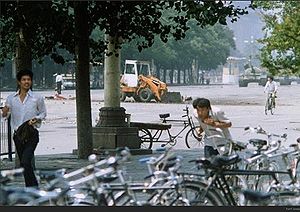
As Times editor Patrick Witty writes, the newly published image encourages a fresh evaluation of the encounter: “Mr. Jones’ angle on the historic encounter is vastly different from four other versions shot that day, taken at eye level moments before the tanks stopped at the feet of the lone protester. Wildly chaotic, a man ducks in the foreground, reacting from gunfire coming from the tanks. Another flashes a near-smile. Another pedals his bike, seemingly passive as the tanks rumble towards confrontation.”
At the above link you can also read Jones’ account from Tiananmen, and why he didn’t seek to have his photo published until 20 years later.
Digital revolution from Tehran to Tiananmen Square
Filed under: media, politics | Tags: China, foreign affairs, globalization, Iran, media, national security, technology, Twitter
Comments (6) June 2009 could be a big month for democracy on the world stage, with digital technology playing no small part.
With a landmark speech in Cairo on Thursday, Barack Obama will continue his quest to connect with the Muslim world and repair the grave damage done to U.S. standing under George W. Bush. It remains to be seen how much he might also press for government reform by Hosni Mubarak. Egypt is considered a crucial U.S. ally in the Middle East, but more light has been shed on its dark human rights record particularly since 2007, when a video circulated on the Internet showed a man being sodomized with a stick in a Cairo police station.
In Iran later this month, the 10th presidential election could shake things up significantly for a country whose own population is very much displeased with life under Mahmoud Ahmadinejad. The regime has failed to suppress the use of Facebook and Twitter on behalf of the reformist movement.
This week also brings the 20th anniversary of the massacre at Beijing’s Tiananmen Square, where on June 4, 1989, thousands of Chinese pro-democracy protesters were wounded and killed at the hands of the Chinese army. One unknown man, instantly made an indelible historical figure, temporarily halted the killing machine in its tracks.
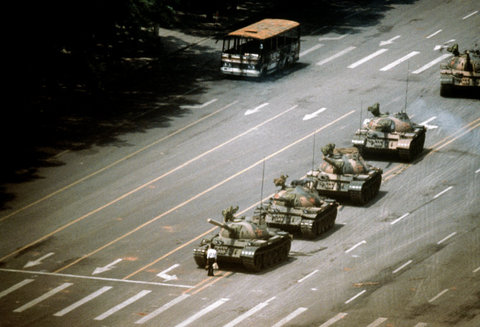
The iconic image of him will again saturate media around the globe in the days to come. (Several versions of it were captured by photojournalists in the vicinity then; the above was taken by Stuart Franklin.) To this day the identity and fate of the so-called Tank Man, who was whisked away by Chinese agents to end the extraordinary standoff, are unknown. (For more, watch this fascinating 2006 documentary, “The Tank Man,” from Frontline.) In the aftermath, the Chinese government maintained that “not one person” was killed in Tiananmen Square, and has depicted the uprising as a “counterrevolutionary rebellion” ever since. As author Yu Hua underscored in an essay this weekend titled “China’s Forgotten Revolution,” today the event is little known to the nation’s youth.
This is the first time I am writing about Tiananmen Square. I am telling my story now because 20 years later — the anniversary is June 4 — two facts have become more apparent. The first is that the Tiananmen pro-democracy protests amounted to a one-time release of the Chinese people’s political passions, later replaced by a zeal for making money. The second is that after the summer of 1989 the incident vanished from the Chinese news media. As a result, few young Chinese know anything about it.
Twenty years later, hopefully the above image and the truth about its bloody context will percolate widely among China’s younger generations. Could the explosive spread of the Internet be the key?
In terms of state media control, China in some ways is a very different place today than even just a few years ago, according to The Washington Note’s Steve Clemons. Following what he describes as a “very candid” diplomatic meeting recently, as well as some guidance from one unnamed Chinese youth, Clemons shared insight about the limitations the Chinese government faces in trying to control an uncontrollable force:
In fact, this young person walking through Internet access issues with me said that Chinese young people can essentially access anything that the government might try and does block. This person who works in international affairs says that the ability of the Chinese government to significantly control access to web-based content is quickly eroding.
And as a result of very interesting and candid discussions with the Vice Minister of the State Council Information Office, Qian Xiaoqian, I believe that many Chinese government officials know that the practice of blocking this site or that is undergoing significant change or reform.
At the end of 2008 China was home to nearly 300 million “netizens,” or regular Internet users, with 162 million blogs and 117 million mobile Internet users, according to Clemons. By the end of this month, Chinese authorities predict another 20 percent jump in those figures.
“Terminals are everywhere,” Clemons says. “The newspapers are actually full of stories about people critiquing government officials, standards, building and infrastructure quality. It’s fascinating — not perfect. I do get the sense that political entrepreneurship is mostly a non-starter here, but even on that front, I have found several key cases where even that form of self-censorship is changing for the better.”
A very relative assessment, of course — seemingly still plenty far from the day when what happened at Tiananmen Square is understood widely across China. But amid the continuing technological revolution, that day could be on the horizon.
UPDATE 6/2/09: From photo sharing on Flickr.com to BBC television, the Chinese government now has a sweeping effort underway to enforce a media blackout of anything revealing the Tiananmen uprising 20 years ago. “The measures came as the authorities tried to close all avenues of dissent ahead of Thursday’s anniversary, placing prominent critics under house arrest and banning newspaper from making any mention of the pro-democracy protests,” reports the Telegraph. “The co-ordinated internet ‘takedown’ occurred at 5pm local time (10am GMT) on Tuesday as a broad range of websites suddenly became unavailable to Chinese internet users.”

But the evolving digital realm apparently is enabling at least some breakthrough: “Twitter users found alternative outlets in rival providers to evade the censors.”
More on the Twitter aspect from the Guardian.
 Mark Follman
You must be logged in to post a comment.