Archive for the ‘technology’ Tag
The revolution will be further digitized
Filed under: culture, media | Tags: economy, future-of-journalism, media, technology
 Comments (1)
 A large newspaper in a major American city has just gone all-digital. Depending on how you choose to look at it, the occasion is either tragic or revolutionary.
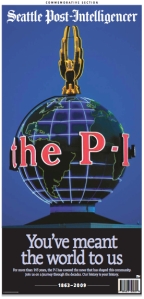 The 146-year-old Seattle Post-Intelligencer printed its last edition on Tuesday, becoming an Internet-only news source. In a report on its own Web site, the “paper” described the contours of the new, much smaller operation now in place. The P-I, as it’s called, is a “community platform” that will feature “breaking news, columns from prominent Seattle residents, community databases, photo galleries, 150 citizen bloggers and links to other journalistic outlets.” The New York Times notes that The P-I “will resemble a local Huffington Post more than a traditional newspaper,” with a news staff of about 20 people rather than the 165 it had, and with an emphasis more on commentary, advice and links to other sites than on original reporting.
The P-I venture may well fail — but in an essential way, that’s a good thing. Why that’s the case is explained in an indispensable essay posted by media-technology thinker Clay Shirky a few days ago. Glancing as far back as the 16th-century advent of the printing press, Shirky’s piece is an illuminating synthesis of the industry’s past and present — and, from where I’m sitting, brims with aphoristic insights pointing to a bright future for digital journalism. Original reporting in that realm — still much underdeveloped and ripe for innovation, in my view — will play a vital role in the further transformation.
Shirky writes: “People committed to saving newspapers [keep] demanding to know ‘If the old model is broken, what will work in its place?’ To which the answer is: Nothing. Nothing will work. There is no general model for newspapers to replace the one the internet just broke.”
To the old journalism guard, that’s a heartbreaking epilogue. Which of course misses the point. (Revolutions create a curious inversion of perception, Shirky notes.) “With the old economics destroyed, organizational forms perfected for industrial production have to be replaced with structures optimized for digital data,” he continues. “It makes increasingly less sense even to talk about a publishing industry, because the core problem publishing solves — the incredible difficulty, complexity, and expense of making something available to the public — has stopped being a problem.”
Revolution is a dramatic word, but it’s exactly what we’re witnessing, if in slow motion. It began a little more than a decade ago and perhaps will require another decade before reaching a level of maturity and stability with new form. Shirky describes the familiar process: “The old stuff gets broken faster than the new stuff is put in its place. The importance of any given experiment isn’t apparent at the moment it appears; big changes stall, small changes spread. Even the revolutionaries can’t predict what will happen.”
(On recognizing “the importance of any given experiment,” see Shirky’s great distillation of the rise of Craigslist. Experiments are only revealed in retrospect to be turning points, he observes. And regarding “big changes stall” — the fashionable HuffPo model, anyone? With all due respect and admiration for its achievements during an epic election year, who really believes HuffPo’s almost-zero-reporting approach is the future of journalism?)
On with the greater experimentation and innovation, then. Many new attempts like The P-I probably will fail, and, in effect, we need them too. “There is one possible answer,” Shirky says, “to the question ‘If the old model is broken, what will work in its place?’ The answer is: Nothing will work, but everything might.”
This just in: No newspaper at all
Filed under: California, media | Tags: California, economy, future-of-journalism, media, recession, San Francisco, technology
Leave a comment More American newspapers appear to be accelerating toward demise. For anyone who’s been paying attention to the industry, it’s been clear at least since last fall that 2009 would be a year of considerable destruction. Take the spreading flame of digital technology, pour on a vicious economic downturn and quickly you have a raging forest fire. In the New York Times today Richard Pérez-Peña reports on which U.S. cities soon might not have a major daily print paper at all. Perhaps it’ll be Seattle or Denver. Or maybe San Francisco. Just a short while ago the prospect would’ve been inconceivable.
I like the forest fire metaphor here because it suggests an essential part of the picture that in many quarters still isn’t getting its proper due: The fertile rebirth that follows the destruction. I’ve been surprised to see a degree of pessimism even from some who’ve already been toiling on the frontier:
 “It would be a terrible thing for any city for the dominant paper to go under, because that’s who does the bulk of the serious reporting,” says Joel Kramer, the editor and CEO of Minneapolis-based MinnPost.com, in the Times today. (Kramer was formerly editor and publisher of The Star Tribune.) “Places like us would spring up, but they wouldn’t be nearly as big. We can tweak the papers and compete with them, but we can’t replace them.”
Really? There’s a tendency to equate the withering of the old medium (newsprint) with the demise of what it has delivered (news reporting). But increasingly it’s going to be delivered digitally. If the old media companies don’t do it, others will, because the demand (and therefore market) for it is undeniable. Sooner than we probably realize, we’re all going to be walking around carrying some kind of digital newspaper in our hands. Organizations will arise and mobilize to provide the reporting in it. And people will pay for it. (Businesses are also likely to advertise around it.)
Indeed, formidable challenges remain to working out viable business models. But the field is increasingly wide open and waiting to be seeded. (New tracts soon available!—see above.) You can look at the crisis as a tragedy, or you can look at it as an opportunity.
As Pérez-Peña notes, the Washington Post had a newsroom of more than 900 people six years ago, with fewer than 700 now. The LA Times newsroom is half the size it was in the 1990s, with a staff of about 600 today.
Call me crazy, but that’s still an awful lot of resources with which to gather and produce stories. Without the major printing and distribution costs of their antique brethren, digital ventures still will probably need to be considerably smaller and more nimble to succeed. (In the near-term economy, at least.) Even if some early experiments haven’t been so impressive, my sense is that those who survive and thrive will do so especially via robust local and regional reporting, fast dwindling in many places now. (Apparently the LA Times has some other strategy in mind.)
Self-described “newsosaur” Alan Mutter offers some intriguing advice for those who reportedly may launch the first digital-only newspaper in a major U.S. city, from the ashes of the Seattle Post-Intelligencer. “Be different” and “cop an attitude,” he suggests. “Think of the site as more of a blog than a newspaper.”
Hmm, it seems there’s no shortage of that to go around… but I like his closing thoughts: “The work you do will play a major role in helping to define the future – and the future economics – of local news coverage. Take risks, try everything and have fun. Whatever you do, don’t look back.”
The future of Internet news, circa 1981
Filed under: California, media | Tags: California, future-of-journalism, media, technology, television
Comments (2) This ancient clip from a local San Francisco broadcast has been floating around for a while, but it keeps popping up in discussions about the fate of the newspaper industry, so I couldn’t resist. It’s pretty priceless viewing if you haven’t seen it.
And not just because it’s hilariously antique — it’s also a prelude to a cautionary tale. Believe it or not, the San Francisco Examiner was once working on the cutting edge of the Internet. The Examiner’s David Cole certainly intended no irony when interviewed then about their “electronic newspaper” experiment: “We’re trying to figure out what it’s going to mean to us as editors and reporters and what it means to the home user. And we’re not in it to make money. We’re probably not going to lose a lot, but we aren’t going to make much, either.”
Online media pioneer Scott Rosenberg (at the Examiner himself back in the 1980s and a mentor of mine at Salon in the early 2000s) wrote insightfully about this clip a few weeks back, and how far the newspaper industry hasn’t come:
The spirit of experimentation that the Examiner set out with in 1981 dried up, replaced by an industry-wide allergy to fundamental change. “Let’s use the new technology,” editors and executives would say, “but let’s not let the technology change our profession or our industry.” They largely succeeded in resisting change. Now it’s catching up with them.
That’s probably putting it lightly, considering the current state of the San Francisco Chronicle (a participant in the 1981 “experiment”), the Seattle Post-Intelligencer, the Rocky Mountain News and so many others.
Today, a heartfelt eulogy from Nancy Mitchell, a former reporter for the freshly defunct Rocky, carries its own layer of irony. Mitchell’s sentiments are genuine and noble, and certainly appreciated by this fellow newspaper fan and ardent believer in the value of quality reporting.
But Mitchell falls yet into the trap described above — denial of inexorable industry transformation, and a failure of imagination. She blames faceless management types at the Rocky for attempting foolish or half-baked ways to recast the paper in a time of dramatic change. (No doubt they did.) She quietly denigrates experimentation with digital tools like blogs, Flickr and Twitter, as if nobody interested in serious journalism should have to deal with “the anxiety attached to learning the gimmicks.” She seeks shelter in a credo once posted in her managing editor’s office: “Three simple rules, not produced by a focus group: Get the news. Tell the truth. Don’t be dull. I’d like to believe we did all three.”
What Mitchell doesn’t seem to realize is that all three — and more — increasingly can and will be done digitally. The audience will be there to engage with it. Business models will arise to support it. Technology will keep transforming it. It seems obvious to say it’s the way the world is fast going, whether with reporting, commentary or many other information-based creations. Just note where her piece was published, of course, and how you’re encountering it right now.
Not even sexy ladies will save them
Filed under: culture, media | Tags: future-of-journalism, media, technology
Leave a comment 
It’s no secret that the print magazine business, like the newspaper business, is in deep trouble, due primarily to a nosediving ad industry. The New York Times laid out the grim picture a few weeks ago. From Forbes to Time to the New Yorker, few have been immune. Playboy announced Wednesday that it lost $158 million in 2008 and may put itself up for sale. It expects a 27 percent decline in ad revenue in its publishing division in the first quarter of 2009.
It’s not just a matter of the plunge in ad sales, of course, it’s the fact that consumers are ever-more plugged in online, where the expectation remains that most content should be available for free. Last month Playboy stated it would cut costs by closing its New York offices and combining its print and online editorial operations. (Sources tell me that Hugh Hefner’s storied publication might face a particularly competitive environment in the online space, where reportedly there is upwards of 260 new alluring ventures launched each day.)
The print media industry has been under pressure for years per the rise of the Internet, but the economic crisis is causing it to implode. Dare I say there could be a silver lining in these circumstances. Because advertising is so depressed at a time when technology is rapidly changing media consumption, it could force more rapid innovation toward viable production and delivery of digital content.
Plenty of people are talking about what they think isn’t likely to work. (Howard Kurtz takes a turn running the list today.) But Slate’s Jack Shafer, arguing that not all information wants to be free, points to an interesting prospect — moving beyond the Web browser as we know it. Whether an autonomous online application such as Apple’s mega-successful iTunes, or Amazon’s Kindle book reader, or the New York Times’ experimental news reader, I agree with Shafer that it’s still early in a major transition period. Quality information eventually wants to be paid for — and produced with the right combination of creativity, authenticity and authority, in the digital future (when “Web browsing” may easily look antiquated) it may not have to ride on a bunch of SUV ads.
 Mark Follman
You must be logged in to post a comment.