Archive for the ‘media’ Tag
The coming war on Sonia Sotomayor
Filed under: media, politics | Tags: immigration, law, media, politics, Twitter
 Comments (2)
 It’s already underway, of course. The attacks in fact began well before her nomination.
 Barack Obama’s selection of Sotomayor for the Supreme Court weaves another bright strand into an epic of American political transformation — both a groundbreaking and politically shrewd move by the president. But don’t think for a minute that’ll stop opponents from fighting dirty and doing whatever they can to block her path to the nation’s top bench.
Since the announcement of her selection on Tuesday morning, many pundits have parroted the same silly theory: The tattered Republican Party, the reasoning goes, just can’t afford to attack the first Hispanic woman ever nominated to the court — not least because the GOP in recent years has screwed itself royally with the pivotal voting bloc she represents.
“Unless the vetting process missed something big that will turn sentiment against her,” wrote Chicago Tribune blogger Eric Zorn, “Republicans who try to stall or block the first Hispanic nominee to the high court will be stepping into what looks almost like a political trap — a way to further marginalize the GOP and identify it as the party of angry white people.”
Across the cable news networks on Tuesday, this same wishful thinking was flowing from liberal guests holding forth with Keith Olbermann and Larry King. The folly can also be seen in this post from blogger David Kopel at The Volokh Conspiracy, who points out the herd-like denial of lefty bloggers on the subject:
A special poll of bloggers from The National Journal asked “Would it be politically smart for Republicans to try to block the confirmation of Judge Sonia Sotomayor?” Among the Left bloggers, the unanimous answer was “No.” On the Right, 53% said “No” and 47% said “Yes.”
I voted “Yes,” and wrote: “The Democrats who tried to block Roberts and Alito appear to have suffered no adverse consequences. [And, I should have added, neither did the Dems. who filibustered Miguel Estrada, who, like Sotomayor, is a Hispanic with an impressive life story.] Sotomayor is on the wrong side of fairness, empathy, the Constitution and the American people in regards to firearms ownership (Maloney v. Cuomo; United States v. Sanchez-Villar); wealthy people using the government’s eminent domain power to extort money from small business (Didden v. Village of Port Chester); and a racial spoils system for government employees (Ricci v. DeStefano).
Conservatives know full well that the stakes with Sotomayor’s nomination go far beyond the next election cycle or perhaps a couple more years in the political wilderness. While her place on the Supreme Court’s political continuum (presumably somewhere left of center) wouldn’t be clear for some time, if confirmed, the 54-year-old judge is likely to serve for decades.
The battle began even before she was nominated. In a preemptive strike published in the right-wing magazine FrontPage in early May, John Perazzo played to racial fears in an article titled “The Next Token Justice?”
“Sotomayor considers her ethnicity of paramount importance,” he wrote. “She began consciously developing a sense of her ethnic identity as a young woman and has allowed identity politics to act as a lens through which she sees her jurisprudence. During her student years at Princeton University in the 1970s, Sotomayor became actively involved in two campus organizations devoted chiefly to the celebration of an ethnicity distinct from that of the white majority.”
While most Senate Republicans so far seem to be feigning polite caution about the nomination, former GOP presidential candidate Mike Huckabee isn’t holding back:
Sotomayor comes from the far left and will likely leave us with something akin to the “Extreme Court” that could mark a major shift. The notion that appellate court decisions are to be interpreted by the “feelings” of the judge is a direct affront of the basic premise of our judicial system that is supposed to apply the law without personal emotion. If she is confirmed, then we need to take the blindfold off Lady Justice.
Rush Limbaugh wasted no time, of course, calling Sotomayor a “reverse racist” and “hack.” Newt is also in on that act, via Twitter. Others are running with “socialist,” thanks to an obviously sinister Norman Thomas citation Sotomayor used — for a college yearbook photo in 1976.

Without a doubt the attacks, from low-down to laughable, are just beginning.
Untold damage of Iraq and Afghanistan
Filed under: media, politics | Tags: Afghanistan, foreign affairs, health, media, national security, politics, terrorism, war
Leave a comment In recent months the war in Iraq had mostly retreated from the national headlines. It took the disturbing news of an American soldier apparently gunning down five of his fellow servicemen in a Baghdad “combat stress clinic” to jump-start any major media coverage. The killings provided the kind of sensational firepower the cable news networks seem to require for any sustained coverage — but the incident also highlighted a grave problem, one that America increasingly will have to confront as two long wars go on.
New York Times columnist Bob Herbert says that he “couldn’t have been less surprised” by the fratricide in Baghdad. “The fact that this occurred at a mental health counseling center in the war zone just served to add an extra layer of poignancy and a chilling ironic element to the fundamental tragedy,” he wrote on Tuesday. “The psychic toll of this foolish and apparently endless war has been profound since day one. And the nation’s willful denial of that toll has been just as profound.”

A Washington Post report on Sunday laid out the bleak metrics for anyone who might care to look:
Since 2001, nearly 1 million soldiers have deployed to Iraq and Afghanistan, and more than 300,000 of them have served multiple combat rotations, most lasting 12 to 15 months. Currently there are 160,000 soldiers in those war zones, and of those, nearly 30,000 are on at least their third or fourth tour, Pentagon data show.
An estimated 20 percent of service members return from the wars psychologically damaged, with depression or symptoms of post-traumatic stress disorder such as nightmares, hyper-vigilance and emotional numbing, according to a Rand Corp. study last year.
That’s tens of thousands of combat veterans with psychological damage.
And there is no end in sight for the predicament — for the near-term at least, the total number of troops in the war zones is going up, with President Obama deploying another 20,000 to Afghanistan.
That escalation sparked debate in a conversation I had with a couple of friends over the weekend regarding Afghanistan and Pakistan. The question we grappled with: Now under Obama’s leadership, what exactly is the U.S. trying to accomplish in the region? None of us could come up with a clear answer.
Steve Coll suggests that Obama’s aid-driven approach is focused on hearts and minds, that it “seeks to alter the daily experiences and thus the political outlooks of Afghan and Pakistani civilians” and thereby drain recruiting pools for the Taliban and Al Qaeda. But as I wrote about here recently, the concurrent heavy use of air power is exacting a counterproductive cost. As Coll also notes: “Four years ago, polls showed that eighty-three per cent of Afghans held a favorable view of the United States; today, only half do, and the trajectory is downward. Persistent civilian casualties caused by air strikes in rural Afghanistan are a major cause of this deterioration.”
That may help explain why a top U.S. military commander would try to mislead the public about U.S. air strikes gone wrong. The foolish thing about that tactic, of course, is that the illusion can’t last for long.
Daphne Merkin’s literary depression
Filed under: culture, media | Tags: art, books, health, language, media, writing
Comments (2) There is a peculiar quality to “A Journey Through Darkness,” Daphne Merkin’s memoir of chronic depression published this week in the Times Magazine. Her intimate account of lifelong struggle with the disease, centered on her latest stint in a Manhattan psychiatric facility in 2008, evokes the perspective of a highly intelligent, sensitive, deeply troubled soul. Even if the trappings are familiar from numerous other written explorations of the subject, her story seems to shed light on the dark terrain of mental illness by way of an intense personal account.
But an intriguing question sits at the margins: Who, exactly, is telling this story?

Merkin is a skilled writer with a clear command of technique. Memory has been and always will be a writer’s imperfect tool. But something about her in-depth reflection feels a little too… artful. It begins and ends with the bright imagery of ocean beaches, neatly bookending the tale of her latest debilitating episode. There is elevated language and metaphor all over the place. “Soggy as my brain is from being wrenched off a slew of antidepressants and anti-anxiety medications in the last 10 days, I reach for a Coleridgian suspension of disbelief, ignoring the roar of traffic and summoning up the sound of breaking waves,” she writes of an attempt at mental escape from the hospital grounds.
And: “Depression — the thick black paste of it, the muck of bleakness — was nothing new to me.”
And: “When I was awake (the few hours that I was), I felt a kind of lethal fatigue, as if I were swimming through tar.”
And: “I felt as if I were being wished bon voyage over and over again, perennially about to leave on a trip that never happened.”
And: “In truth there was more uncharted time than not, especially for the depressives — great swaths of white space that wrapped themselves around the day, creating an undertow of lassitude.”
As with that last flourish, there are other assertions of truth telling. Which is not to say her story is untruthful.
Merkin has in the past written publicly about her experience with depression, and to her credit here she points at a vexing problem of distinction — it’s almost as if she’s questioning her own reliability as narrator:
Whatever fantasies I once harbored about the haven-like possibilities of a psychiatric facility or the promise of a definitive, once-and-for-all cure were shattered by my last stay 15 years earlier. I had written about the experience, musing on the gap between the alternately idealized and diabolical image of mental hospitals versus the more banal bureaucratic reality. I discussed the continued stigma attached to going public with the experience of depression, but all this had been expressed by the writer in me rather than the patient, and it seemed to me that part of the appeal of the article was the impression it gave that my hospital days were behind me. It would be a betrayal of my literary persona, if nothing else, to go back into a psychiatric unit.
Certainly a writer aims to convey an experience as vividly as possible. Merkin’s work gives the sense she is deeply invested in sorting out her experience, both for herself and for her audience. (Having that audience, as she seems to know, could be a particularly complicating factor.) Yet as carefully constructed as it is, something about her story feels distinctly blurred.
Maybe it’s of a piece with a vexing question about the treatment of mental illness, one I’ve often puzzled over when concerned for people I know who are afflicted: Where, exactly, is the line between the physical and the psychological?
In that respect Merkin’s deliberate prose does little to help us out of the dark.
Sick with swine flu racism
Filed under: culture, media, politics | Tags: economy, foreign affairs, globalization, health, immigration, media, Mexico, national security, politics, terrorism
Comments (4) The threat of a deadly swine flu pandemic appears to be fading, despite an outbreak of hype that one former CNN reporter says stemmed from the media’s “economic vested interest in promoting the fear.”
But fear may well be lingering — fueled by animosity toward Mexicans — thanks to a rash of comments from some of America’s nastiest right-wing broadcast personalities.
Ignoring news reports that some swine flu victims inside the U.S. likely contracted the virus during recent trips to Mexico, Fox News regular Michelle Malkin asserted: “I’ve blogged for years about the spread of contagious diseases from around the world into the U.S. as a result of uncontrolled immigration.”
“No contact anywhere with an illegal alien!” radio host Michael Savage warned listeners about the contagion threat. “And that starts in the restaurants,” he said, where you “don’t know if they wipe their behinds with their hands.”
As Media Matters for America reported, radio host Neil Boortz stoked fears of a “bioterrorist” plot, asking, “What better way to sneak a virus into this country than to give it to Mexicans?”
Savage also ran with that idea: “There is certainly the possibility that our dear friends in the Middle East cooked this up in a laboratory somewhere in a cave and brought it to Mexico knowing that our incompetent government would not protect us from this epidemic because of our open-border policies.” He suggested terrorists may realize that Mexicans “are the perfect mules for bringing this virus into America.”
 Rush Limbaugh ranted about an Obama administration conspiracy to use both the swine flu scare and the renewed debate over torture “to cover up the mess that is the United States of America right now.” (One wonders if he’s including Dick Cheney’s prominent role in the latter.)
While such ugliness from this bunch is predictable, it’s worth remembering that these folks have sizeable to large audiences. Moreover, the rank xenophobia underscores an uneasy truth: America has yet to contend in a serious way with its enormous immigration problem.
Obama continues promising to do so, as when he campaigned for president. The task, like many others since last fall, has been swallowed up in the nation’s economic maelstrom — but it’s inextricable. (So is overhauling health care in Obama’s view.) As Colin Powell emphasized when I interviewed him back in 2007 — not long after immigration had commanded headlines in a national election cycle — dealing with the issue is at once a moral and economic imperative. In an hour-long conversation covering much political ground, Powell’s comments on the matter stood out. We should do everything we can, he said, to admit people legally, dry up the flow of illegals and defend our borders. “But let’s recognize that these folks, whether legal or illegal, are making an enormous contribution to America’s well-being. They do the jobs that others don’t want to do.”
He continued: “It’s outrageous for us to take advantage of this population of 12 million people, to use them to cut our grass and build our houses and repair our streets, but keep them illegal and subject to deportation. That’s not equitable — that’s not America. We have to find a dignified way to work through with this population.”
With the swine flu scare, the unpleasant opportunism of the far right reflects how incredibly far we still have to go.
This is your senator on Twitter
Filed under: culture, media, politics | Tags: language, media, poetry, politics, technology, Twitter
Comments (1) In a column last weekend Matt Bai argued that Capitol Hill’s growing infatuation with the micro-blogging service is the last thing D.C. needs. His analysis in terms of the political culture is persuasive. But poke around on a few politicians’ Twitter pages and there’s a simple reason the trend deserves to be voted down posthaste: Washington’s minute-by-minute musings are, for the most part, epically dull.


A universe more than 140 characters has been typed about the greater Twitter phenomenon. At this late date the triviality of bazillions of “tweets” is no secret. But additionally there’s even something micro-insulting about the daily minutiae dispatched by elected officials. It purports to be about transparency, or even intimacy, but essentially it’s a ceaseless stream of micro-campaigning. Even if it’s utterly uninteresting:
Sen. Chris Dodd:
Holding an Executive Session in the Banking Committee to vote on a few HUD, Treasury, and Export-Import Bank nominations.
7:17 AM Apr 28th from txt
Sen. Chuck Grassley:
4hr healthcare mtg turned into 6 hr mtg. Took up all day. Watch my cable show tonight on mediacom. 630pm CST. U can ask questions.
3:50 PM Apr 29th from txt
Rep. Steve Israel:
Heading to DC. This week’s legislative schedule: hate crimes bill and credit card consumer protections.
12:17 PM Apr 27th from twitterrific
Rep. Darrell Issa:
On the way home to San Diego sunshine (fingers crossed…but we need the rain!)
about 3 hours ago from TweetDeck
As a member of the opposition party, at least Issa is willing to add a tad of zing:
Had fun watching the staff photoshop. Let’s just say Obama could’ve saved us a cool million using that instead of buzzing manhattan in AF1!
2:42 PM Apr 28th from TweetDeck
There is indeed a certain awkwardness to some of it given the pretense of informal and personal. See John McCain, in an oddly self-aggrandizing moment:
Sec. Napolitano confirmed Swine Flu has spread to 4 new states including AZ. I call on the Admin to do more to prevent further outbreaks!
08:42 AM Apr 29
Of course, staffers are probably behind much of the messaging. Though apparently not in Claire McCaskill’s case:
I have strict policy. I write every tweet and tumblr blog. These are my thoughts and my words. Really. For good or for bad……
5:06 AM Apr 28th from web
For good or for bad, or, as Bai noted, for her fast food faves:
I get old style crunchy taco, and a chicken burrito supreme & Diet Coke at Taco Bell. Miss those tostados.
2:06 PM Mar 12th from web
 It seems Twitter functions much more effectively as a portal into the world of celebrity entertainment. There must be a good reason that CNN is locked in a popularity showdown with Ashton Kutcher. Or that Snoop Dogg has 195,862 followers:
been 4 dayz since been of here. Happy 420 ma twizzles may all your smokn dreams come true!! yeezzzziiirr!!
1:25 PM Apr 20th from web
Fa shizzle.
At times Twitter has proven strikingly useful as a tool for disseminating information; its profile shot up per a role in covering major news events such as when terrorists struck in Mumbai and when a jetliner ditched into the Hudson River. As an additional tool for journalists — or for anyone seeking to report or share information quickly — its potential is undeniable.
If you’re at a loss, though, to find much that’s culturally meaningful about the Tweet-geist at this point — I confess that I am, still preferring my short-form poetry on the page or in person — New York Magazine appears eager to help with its freshly posted Twitter Approval Matrix. Apparently not many pols have made the cut. Meanwhile, you’d think that someone commanding as much attention as Sarah Palin — who just jumped into the Twitter fray this week — might give the lot a boost. As of this post, her first six tweets aren’t even interestingly banal enough to quote.
You can find your favorite lawmaker’s latest by way of Tweet Congress.
Don’t all click at once.
A fevered case of swine flu hype
Filed under: California, culture, media | Tags: California, foreign affairs, globalization, health, media, Mexico, television, Wall Street
Leave a comment Will the outbreak of the H1N1 virus get historically serious? According to global health experts, the answer is that nobody really knows. Pandemics tend to hit in waves, and the biggest danger could come this winter.
 For now the news media is maintaining its fever pitch as long as possible, of course, hungry to feast at the ratings trough. As one analyst told Howard Kurtz yesterday, “Cable news has 24 hours to fill, and there isn’t 24 hours of exciting news going on. If you scare people, they’ll tune in more.” Still, when flipping past CNBC on Monday afternoon I was a bit shocked to encounter the blaring graphic “Pandemic Pandemonium” accompanying a discussion about reaction on Wall Street. (In fact, the market barely budged early this week.)
Naturally, some news consumers are caught up in the hallucinatory chatter. From an inquiry to Bay Area physician and blogger Doc Gurley — posted, I kid you not, under the headline Swine Flu Sex? — on SFGate today:
Dear Doc,
My husband and I are trying to get pregnant. We’ve just recently “put the pedal to the floor” and are undergoing fertility treatment. Now I’m concerned that I may be putting myself and an unborn fetus at extra risk for the Swine Flu that is wending its way down the pipeline. Included in this concern is the fact that I’ve heard that anti-virus medications can adversely affect a developing fetus, which means it would be a lose/lose case scenario if I had the opportunity to prevent an imminent case in the future. Should we shelve this project for a few months or what?
Gurley replies that pregnant women do have “very mildly” suppressed immune systems. However, she continues, “The fact is, given the way the world (and media coverage) works, there will, undoubtedly, never be a time when the world looks rosy, all-welcoming, and risk-free. Yesterday’s potential nuclear annihilation is today’s swine flu. It’s a wonder, in fact, that any baby ever sticks its head out.”
If they only knew about the likes of AC360 or Countdown with Keith Olbermann.
Mexico, meanwhile, now suffers from a confluence of maladies. As GlobalPost’s Ioan Grillo reports from Tijuana: “Amid a U.S. recession, a fever pitch fear of the Mexican drug war and now an epidemic of swine flu sweeping across Mexico, Humberto Beltran says business at his border city store has nosedived 85 percent this April compared to the same time last year.”
From North America to the Far East, another pressing question has arisen amid the swine flu scare: Is it still OK to love bacon?
UPDATE: As of Wednesday afternoon the World Health Organization has raised its alert level, determining that a “pandemic is imminent.” So too is plenty more cable news yammer.
Google, Kindle and The Library of Babel
Filed under: California, culture, media | Tags: books, California, future-of-journalism, language, law, media, poetry, San Francisco, technology, writing
Comments (1) Technological innovation seems almost strangely commonplace these days, from say, contact lenses that could layer data directly onto your view of the world to robots fighting far-flung wars to computer systems perhaps smart enough to compete on “Jeopardy!” All astonishing developments in their own right, and yet the most profound change of our times may yet be purely informative in nature: The digitization of all that we read.
At the University of San Francisco on Sunday I participated in a symposium on “Life after the MFA” for students graduating the writing program. Unsurprisingly, the technological upending of books, magazines and newspapers was a particular focus. Fellow panelist Patrick Dunagan, a poet who works as a specialist at the USF library, spoke with some alarm about the rate at which books and print periodicals there are going the way of the dodo. The idea is that many are being replaced digitally. I expressed a bit of surprise to him about this afterward, whereby he asked me when I last conducted any research in a library. Point taken. If only Borges were still hanging around and could rejoin the discussion.

One theme I hoped to suggest in my part of the talk was that print vs. digital isn’t a zero-sum equation. We can still love books and newspapers while getting charged about the possibilities of digital publishing. In many ways the latter remains a Wild West — and without a doubt has blown holes in some old ways of doing business. But in my view the rising digital infosphere is far more expansive and generative than it is destructive.
In a recent essay published in the Wall Street Journal, author Steven Johnson explores both the thrill and potential chill of electronic books, a fast-growing realm thanks to Amazon’s innovative e-book reader, the Kindle, and Google’s Book Search service, home to approximately 10 million scanned titles and counting. One exciting aspect Johnson flags with regard to ideas and research:
Before too long, you’ll be able to create a kind of shadow version of your entire library, including every book you’ve ever read — as a child, as a teenager, as a college student, as an adult. Every word in that library will be searchable. It is hard to overstate the impact that this kind of shift will have on scholarship. Entirely new forms of discovery will be possible. Imagine a software tool that scans through the bibliographies of the 20 books you’ve read on a specific topic, and comes up with the most-cited work in those bibliographies that you haven’t encountered yet.
But there will be pitfalls, too, especially with respect to evolving market forces. The all-powerful search engine that is Google, and the ways in which it guides users to digital content of all sorts, could impact how books actually get written:
Writers and publishers will begin to think about how individual pages or chapters might rank in Google’s results, crafting sections explicitly in the hopes that they will draw in that steady stream of search visitors.
Individual paragraphs will be accompanied by descriptive tags to orient potential searchers; chapter titles will be tested to determine how well they rank. Just as Web sites try to adjust their content to move as high as possible on the Google search results, so will authors and publishers try to adjust their books to move up the list.
What will this mean for the books themselves? Perhaps nothing more than a few strategically placed words or paragraphs. Perhaps entire books written with search engines in mind. We’ll have to see.
A strength of Johnson’s essay is that he doesn’t pass judgment on these possibilities; he concentrates on laying out in lucid terms what he sees coming. (Another recent piece of his, on how the web’s information ecosystem changes how we get our news, is also well worth reading.)
The latter segment above, under the subhead “Writing for Google,” got me thinking about a worn adage heard in MFA programs everywhere: “Write what you know.” If that advice translates fundamentally to writing from a place of experience and passion, it could take on fresh meaning in the digital future — when the suggestion to “Write what you can search engine optimize” may well become a growing temptation.
UPDATE: Some wonder if Google already has too much sway with its Book Search service, including the U.S. Department of Justice.
A blogger breaks news on waterboarding
Filed under: media, politics | Tags: CIA, FBI, future-of-journalism, intelligence, media, national security, NYT, politics, technology, terrorism, war
Comments (2) Pondering the rise of new media and the decline of the traditional newsroom, skeptics still tend to cling to either-or thinking: You’ve either got shrill partisan hacks or experienced professional reporters, and never the twain shall meet. The failure of imagination involved is pretty obvious. Digital media has unlocked great potential for nontraditional approaches to the gathering and analysis of information — a vast middle ground of additional possibilities.
Let’s say the government releases a bunch of documents related to a controversial, secretive activity. Now anybody with a computer, an Internet connection and a little motivation can dig in. (Of course, this has already been going on for quite a while.)
 Today brings a fresh example of how reporting by bloggers can contribute to, or even lead, a major news cycle. In a front-page story today, the New York Times announces that the CIA used waterboarding, a torture technique provoking fear of death by drowning, hundreds of times on two Al Qaeda suspects — far more than was previously known. It’s newsworthy information on several levels, including for how it punches holes in past testimonials from U.S. officials about covert interrogations conducted by the Bush government.
This was not a scoop from the nation’s largest newsroom. The information underpinning the Times report came via blogger Marcy Wheeler, who discovered over the weekend that Khalid Sheikh Mohammed was waterboarded 183 times in one month when she examined the fine print in a newly declassified Bush administration memo from 2005. Wheeler also used the memo to look at a telling clash between the FBI and CIA over the interrogation program and to examine the key question of whether waterboarding actually is effective, as has been claimed by Dick Cheney et al.
The Times report underscores that this story remains far from over (also see Mark Danner for an in-depth political discussion of the unresolved torture issue) — and the public has an enterprising blogger to thank for pushing it ahead.
America loves doga! (Or, a brief meditation on the dubious trend story)
It’s a kind of yoga. You do it with your dog. No, seriously. Together with your pooch you stretch, you meditate, you pose. The New York Times reported on this recently. Maybe you’d already heard about it, but probably not. (More on that in a minute.) For an hour or so on the evening of April 8 the story was featured, replete with large photo, atop the leading news site. It was number one on the Times’ list of most e-mailed stories for a couple days thereafter. Apparently doga is a rising trend in America, worthy of much attention.
Or is it? Indeed, there’s a bit of a journalism issue here, but first things first: Sure, the pictures of the dogs were pretty cute and/or pretty funny, and who doesn’t love cute-funny dogs, and who wouldn’t click gleefully on a slide show with additional pictures of cute-funny dogs, thereby contributing to what certainly must’ve been a big spike in page views for nytimes.com.
There’s probably not much reason to add that partner yoga with your dog may sound like one of the more inane things you’ve ever heard of, because others are likely to say that (yogis among them), as well as to suggest that the dogs involved may well be feeling less than enlightened by the activity, and anyway, the photos (by Michael Nagle) from the Times’ slide show really do speak for themselves:



There is good reason to add, however, that claims about doga’s growing popularity across the land seem howlingly suspect. Behold the all too common trend story that offers no real evidence of a trend.
After a brief opening anecdote about a few people in Chicago, New York and Seattle variously contorting with their Jack Russell terriers and Shih Tzus, the Times report says this of doga (emphasis mine):
Ludicrous? Possibly. Grist for anyone who thinks that dog-owners have taken yoga too far? Perhaps. But nationwide, classes of doga — yoga with dogs, as it is called — are increasing in number and popularity. Since Ms. Caliendo, a certified yoga instructor in Chicago, began to teach doga less than one year ago, her classes have doubled in size.
That’s it, folks. The rest of the article contains no further quantitative information about the purported legions of spiritually enlightened pet owners caught up in the craze.
Perhaps the Times reporter spotted some sort of trend in other stories about the alleged trend: The Associated Press covered it back in 2007, and ABC News published a story on April 1 (whose date apparently was a coincidence, although you could be forgiven for thinking the story was fake.) ABC included San Francisco and Jacksonville, Fla., on the list of locales and described a few doga accessories being sold. But no hard numbers there, either. Instead, the story leaned on “pet trend expert” Maggie Gallant to claim that doga “has the potential to be a very widespread trend.” As Gallant panted, “There are 75 million homes in America that have dogs and about 13 million people practicing yoga.”
Kudos to Chicago Tribune columnist Mary Schmich for sniffing out the truth. With a little follow-up reporting, she discovered that the Chicago locale cited in the Times article — the one where classes “have doubled in size” — now offers one doga class a week, with three to 12 students in each.
Aside from whatever benefits may lie in store for dog owners who team up with their beloved furry ones for stretching and meditation, it seems that America’s big embrace of doga turns out to be, well, a particular kind of scoop indeed.
On Mark Bowden’s NYT takedown
Filed under: culture, media | Tags: books, economy, future-of-journalism, Iran, media, NYT, recession, writing
Comments (4) The so-called crisis in the news industry sure has generated some sensational stories of late. “American journalism is in a period of terror,” announces Mark Bowden in a tome of an article appearing in the May issue of Vanity Fair. Mostly a deft hatchet job on Arthur Sulzberger Jr., the publisher of the New York Times, Bowden’s piece sent the media cognoscenti into a tizzy, although nobody seems to have noticed its one truly illuminating segment.
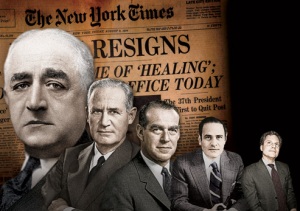
Photo illustration from Vanity Fair.
Even the mighty Times is facing financial peril these days, and Bowden’s premise is that the newspaper scion “has steered his inheritance into a ditch.” He abuses tools of the trade to help suggest his case. As one unnamed “industry analyst” tells us, “Arthur has made some bad decisions, but so has everyone else in the business. Nobody has figured out what to do.” Earth shattering. Perhaps Bowden should pick up a copy of the Times and read Clark Hoyt on the suitable use of anonymous sources. For a substantive take on contemporary debacles across the business, check out this recent piece by Daniel Gross.
In fact, I’m a big fan of Bowden’s. Right now I happen to be reading his 2006 book “Guests of the Ayatollah,” a riveting account of the Iran hostage crisis. Particularly in the realm of national security, few reporters are as exhaustive, persuasive — and downright exciting to read — as him.
On the media, not so much. There he has tended toward the self-involved, maybe a particular pitfall for great reporters covering their own vocation. (See the opening line of the Sulzberger article, which zooms in directly on… Bowden himself, as he receives a phone call from Sulzberger: “I was in a taxi on a wet winter day in Manhattan three years ago…” Especially telling, I think, given that in another recent piece orbiting the news business, a profile of David Simon, Bowden also wrote himself prominently into the narrative.) The Vanity Fair article is exquisitely timed with the accelerating upheaval in the newspaper industry, and reads mostly like, well, a salacious, insider-y Vanity Fair article.
And yet, buried deep in the 11,500 words is one of the best analogies I’ve encountered anywhere conveying the potential for digital journalism:
When the motion-picture camera was invented, many early filmmakers simply recorded stage plays, as if the camera’s value was just to preserve the theatrical performance and enlarge its audience. To be sure, this alone was a significant change. But the true pioneers realized that the camera was more revolutionary than that. It freed them from the confines of a theater. Audiences could be transported anywhere. To tell stories with pictures, and then with sound, directors developed a whole new language, using lighting and camera angles, close-ups and panoramas, to heighten drama and suspense. They could make an audience laugh by speeding up the action, or make it cry or quake by slowing it down. In short, the motion-picture camera was an entirely new tool for storytelling.
Bowden uses the comparison in the service of whacking Sulzberger — but it also points directly to a broader stagnation in media companies’ use of the digital platform. There is experimentation going on, but often without much imagination: Digital video clips are all the rage? OK, we’ll put reporters on camera describing the stories they’ve just published! Online communities and reader interactivity are the latest buzz? OK, we’ll feature the shouting matches in our comments threads as actual news!
The rising multimedia and publishing capabilities of the digital realm are charged with promise, and demand deeper thinking about their optimal use. With any given subject, which digital tools are most effective for gathering information and telling the story? How can the information-rich ecosystem of the Web enhance the knowledge gained? What new ways are there to produce reliable, authoritative and compelling content, taking maximum advantage of a decentralized and participatory technology like no other we’ve ever known?
Soon enough we may all be getting our news on a kind of flexible digital paper. The possibilities for what it could contain are big, and they’re just beginning.
UPDATE: Mark Bowden responds.
Guardian’s Twitter move, GM’s bailout madness
Filed under: culture, media | Tags: California, comedy, media, recession, technology
Comments (3) It’s adding up to a strange day in the news, my friends, but then again these are no ordinary times.
The venerable 188-year-old Guardian, apparently seeing the ugly writing on the wall for the media business, has taken perhaps the boldest step yet to embrace digital technology. Will such an all-in bet on rapid-fire reporting pay off?
 Meanwhile, in the heart of Silicon Valley, a hotshot entrepreneur has moved to capitalize on social networking technology in a different cutting-edge way. If the producers of “The Bachelor” take notice, look out for a full convergence of reality TV and the Internets even sooner than already anticipated.
And in what can only really be considered a desperate move, General Motors apparently is grasping for a solution to its epic troubles by way of two well-known, if irritating, car experts.
More odd stuff going on across the pond.
Seeing Obama’s burden, the drug war and more
Filed under: culture, politics | Tags: art, economy, foreign affairs, media, politics, technology
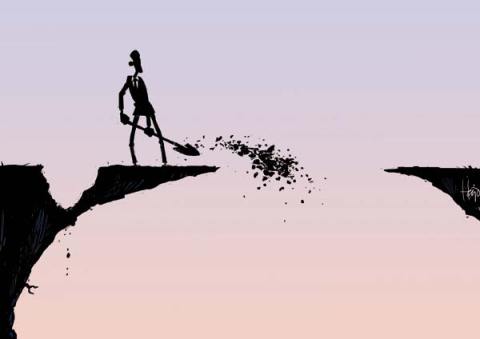
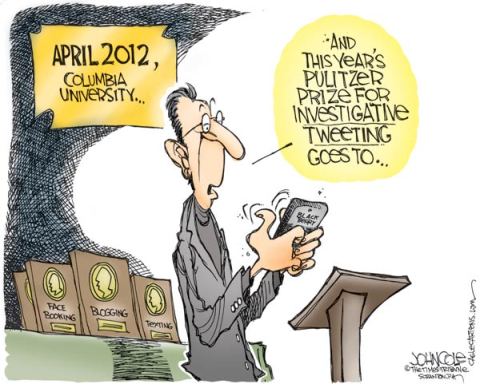
Leave a comment Even in the loquacious realm known as the blogosphere, it is possible at times to lack words. Or to feel that there are simply too many of them. Either way, Daryl Cagle’s Political Cartoonists Index offers a pleasing alternative. Here are three recent entries that caught my eye.
Hajo (Amsterdam), on President Obama’s economic travails:
John Cole (Scranton, PA), peering into journalism’s truncated future:
Pat Bagley (Salt Lake City), a potent take on the Mexican-American drug war:

 Mark Follman
You must be logged in to post a comment.